
You typed a sentence, paused, and stared at the word. Inquire? Enquire? Your spell checker stayed quiet, which somehow made it worse. The confusion around inquire vs enquire is one of those small writing snags that costs more time than it should, especially in emails where you want to sound polished.
Good news: neither spelling is wrong. They just belong to different sides of the Atlantic, and one of them carries a slightly different job description. Here is the clean version.
Quick Answer: Inquire vs Enquire
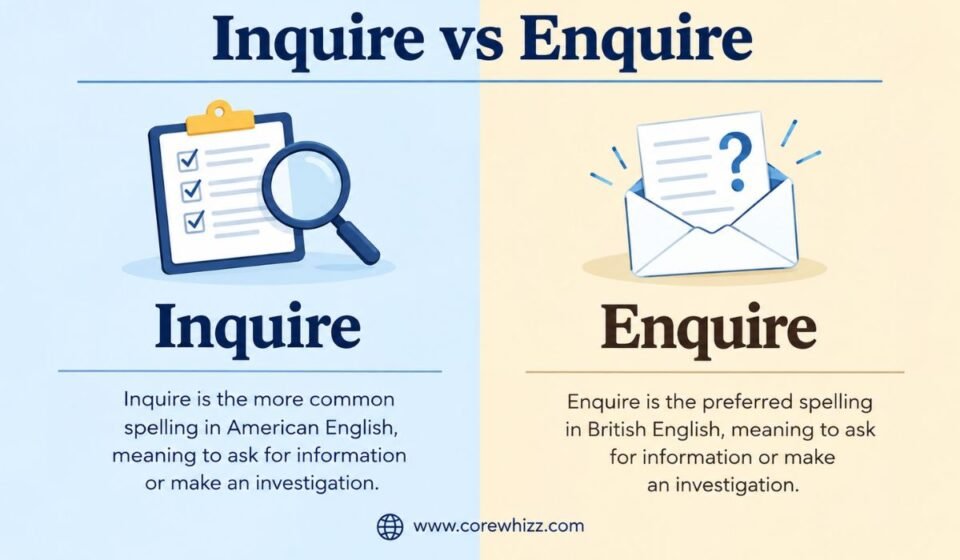
Inquire and enquire mean the same thing: to ask or seek information. The difference is regional. American English uses “inquire” for everything. British English traditionally uses “enquire” for casual asking and “inquire” for formal or official investigations. If you write for a US audience, use inquire every time and stop thinking about it.
Inquire vs Enquire at a Glance
| Feature | Inquire | Enquire |
| Meaning | To ask or investigate | To ask or investigate |
| Preferred in | American English | British English |
| Typical use | All contexts (US); formal investigations (UK) | General, everyday asking (UK) |
| Noun form | Inquiry | Enquiry |
| US usage frequency | Very common | Rare, often flagged as a typo |
| Safe for global business writing | Yes | Only for UK audiences |
What Inquire Means
Inquire means to ask a question or to carry out a formal investigation. It works for both the small stuff and the serious stuff.
You can inquire about a job opening. A committee can inquire into a company’s finances. Same verb, very different stakes.
In the United States, this word does all the heavy lifting. Dictionaries such as Merriam Webster list inquire as the main entry and treat enquire as a variant spelling.
What Enquire Means
Enquire means exactly the same thing as inquire, but it is the British preferred spelling for ordinary questions. A shopper in London might enquire about store hours. A neighbor might enquire after your health.
There is no hidden shade of meaning here. Nobody is being more polite or more casual by choosing enquire. It is simply the spelling that grew comfortable in Britain.
Americans who see enquire usually assume someone misspelled the word, which is the real risk of using it in US content.
More Confusing Words Made Simple: People Do vs People Does
Where These Two Spellings Came From
Both words trace back to the Latin verb “inquirere,” meaning to seek into or search for. That root broke into two paths on its way into English.
The Latin form gave us inquire, with its tidy “in” prefix intact. The Old French form enquerre gave us enquire, carrying the softer “en” sound that French handed to English on a regular basis.
For centuries, writers used both spellings with no system at all. Shakespeare era English was gloriously inconsistent about this sort of thing.
The neat British split between the two only settled in during the 1800s, when style guides started assigning each spelling a lane. American lexicographers, led by Noah Webster’s preference for Latin based spellings, went the other way and standardized on inquire.
How American English Handles Inquire
American English collapsed the two words into one: inquire. There is no formal versus casual distinction to memorize, no context test to run. A journalist inquires about a source. A customer inquires about a refund. A federal panel inquires into misconduct. All inquire.
Major US style guides back this up. AP style and Chicago style both use inquire and inquiry, and American publications follow suit almost without exception. If your reader is in the US, using enquire will not confuse them, but it will look like a slip.
How British English Splits the Two
British English keeps a soft distinction: enquire for asking, inquire for investigating. Think of it as the difference between curiosity and an official inquest.
Someone enquires about train times. A government body inquires into a scandal. The BBC and The Guardian generally follow this pattern, and so do most UK style guides.
The word “soft” matters, though. Plenty of British writers ignore the rule entirely, and both spellings appear in UK newspapers on the same day. Even the Oxford English Dictionary describes the split as a useful convention rather than an ironclad law. Canada and Australia sit in the middle. Canadian writing leans American with inquire, while Australian writing leans British with enquire.
Inquiry vs Enquiry: The Noun Forms
The nouns follow the same rule as the verbs: Americans write “inquiry,” while the British choose between “enquiry” and “inquiry” based on formality.
This is where the split shows up most visibly. A British shop window might read “Enquiries Within,” while a British newspaper reports on a “public inquiry” into a train crash.
In American writing, inquiry covers both. A sales inquiry, a police inquiry, a congressional inquiry. One spelling, no decisions to make. One pronunciation note that trips people up: in the US, inquiry is usually stressed on the first syllable (IN quir ee). In the UK, the second syllable often takes the stress (in QUIRE ee). Neither is wrong.
Which Spelling Belongs in Business Writing
For business writing aimed at a global or American audience, use “inquire” and “inquiry” without exception. It is the safer, more widely recognized choice.
Contact forms, sales pages, and customer service templates in the US almost always say “Send an inquiry” or “Inquire now.” Matching that expectation keeps your writing invisible in the good way.
If your audience is specifically British, enquire for general questions reads as natural and local. Switching to inquire there will not cause problems, but enquiry may feel warmer to a UK reader. The one rule that matters more than either choice: pick one spelling and stay consistent across your entire document or website. Mixing them in the same piece is what actually looks careless.
Real Sentences That Show the Difference
Seeing the words in place makes the pattern click faster than any rule.
American English (use inquire throughout):
- She called the office to inquire about the vacancy.
- Please direct all inquiries to our support team.
- The board opened an inquiry into the missing funds.
British English (split usage):
- He popped in to enquire about the opening hours.
- I sent an enquiry through the website.
- Parliament launched an inquiry into the data breach.
Notice how the British examples reserve inquire for the serious institutional matter. That is the whole distinction in practice.
Common Mistakes to Avoid
The biggest mistake is not picking the wrong spelling, it is switching between them inside one piece of writing.
Here are the errors that show up most often:
- Mixing spellings on a website. A homepage that says “Enquire Now” next to a contact page reading “Inquiry Form” looks unedited.
- Using enquire in US content. American readers and editors will read it as a typo, even though it is a legitimate spelling.
- Assuming a meaning difference in US English. There is none. Inquire covers casual questions and formal investigations alike.
- Getting the noun wrong. If you commit to enquire, the matching noun is enquiry, not inquiry.
- Trusting spell check to decide. Most spell checkers accept both spellings, so they will not flag an inconsistency.
An easy memory trick: E for England, I for the USA. It is not a perfect rule, since the British use inquire too, but it points you in the right direction every time.
More Confusing Words Made Simple: Nighttime or Night Time?
Frequently Asked Questions
Is enquire a real word or a misspelling?
Enquire is a real, correct word. It is the standard British spelling for asking a general question.
Can I use inquire and enquire interchangeably?
Yes, in meaning. But regional expectations differ, so stick to one spelling throughout your writing.
Which spelling is correct in American English?
Inquire is correct in American English. It covers both casual questions and formal investigations without exception.
What is the difference between inquiry and enquiry?
Inquiry is the American spelling and the British formal term. Enquiry is the British spelling for everyday questions.
Should my website say “Inquire Now” or “Enquire Now”?
Use “Inquire Now” for American or global audiences. Choose “Enquire Now” only for a specifically British market.
Final Takeaway
The inquire vs enquire question sounds like a grammar trap, but it is really just a map. Americans write inquire and inquiry for every situation. British writers often save inquire for official investigations and use enquire for ordinary questions.
Pick the spelling that matches your reader, then use it everywhere in that piece. Consistency is the only part of this your audience will actually notice.
Here we have more helpful guides on Grammar: