
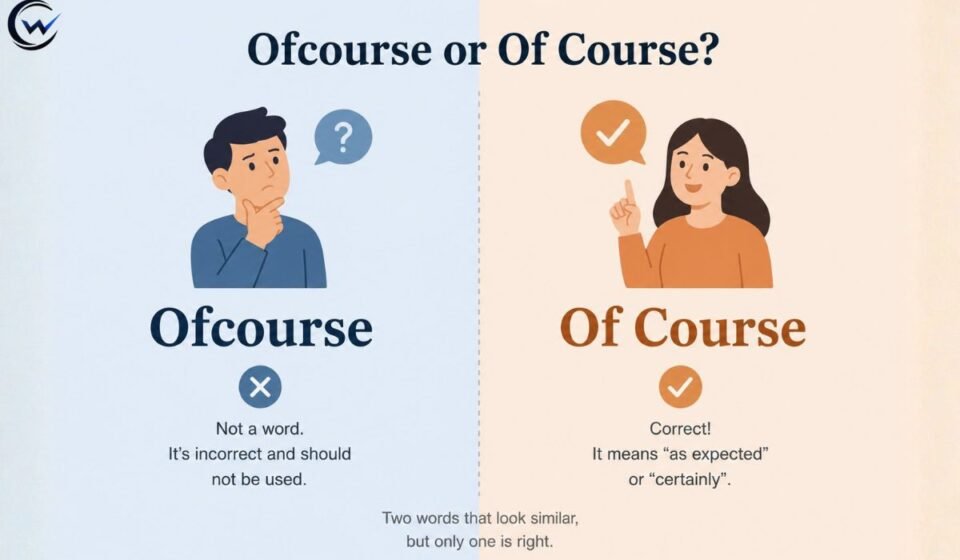

Have you ever paused while typing Ofcourse or Of Course and wondered which one is correct? You’re not alone. It’s one of the most common English spelling mistakes because people often hear the phrase much more often than they see it written.
The good news is that the rule is simple. Once you understand it, you’ll never second guess yourself again. This guide explains the correct spelling, why it matters, and how to use it confidently in everyday writing.
Quick Answer
"Of course" is the correct spelling. "Ofcourse" is incorrect and is not recognized as a standard English word.Use of course as two separate words whenever you want to express agreement, certainty, permission, or something that is obvious.
- Correct: Of course I can help you.
- Incorrect: Ofcourse I can help you.
If you want accurate English writing, always choose of course.
| Feature | Of Course | Ofcourse |
| Correct spelling | ✅ Yes | ❌ No |
| Standard English | ✅ Yes | ❌ No |
| Found in dictionaries | ✅ Yes | ❌ No |
| Appropriate in formal writing | ✅ Yes | ❌ No |
| Appropriate in casual writing | ✅ Yes | ❌ No |
Why “Of Course” Is the Correct Spelling
English contains many expressions made up of two separate words. Of course is one of them.
The word of is a preposition. The word course is a noun. Together, they form a fixed expression that means something is expected, obvious, or agreed upon.
Because these are two separate words with different grammatical roles, they should never be combined into ofcourse.
Think of it the same way you would write:
- of time
- of interest
- of value
You would not join those words together, and the same rule applies to of course.
What Does “Of Course” Mean?
The phrase of course has several meanings depending on the situation. In every case, the spelling stays the same.
To Show Agreement
People often use of course when answering a question positively.
Examples:
- Of course I’ll come to your birthday party.
- Of course you can borrow my notebook.
- Of course we remembered your name.
To Say Something Is Obvious
Sometimes the phrase shows that something is expected or already known.
Examples:
- Of course water freezes in cold temperatures.
- Of course she recognized her childhood friend.
- Of course the store was busy during the holiday season.
To Give Permission
It can also sound warm and polite when giving someone permission.
Examples:
- Of course you may sit here.
- Of course you can ask another question.
- Of course you are welcome to join us.
Why Do People Write “Ofcourse”?
The mistake usually happens because English is spoken much faster than it is written. When native speakers say of course, the two words often sound connected. Someone learning English may hear a single sound and assume it is one word. There are a few common reasons for this confusion.
Fast Speech
In conversation, of course is often pronounced quickly, making the space between the words difficult to notice.
Typing Too Quickly
Many people accidentally remove the space while texting or writing online.
Similar English Words
English has many compound words such as:
- everywhere
- somebody
- nobody
- notebook
Since these are written as one word, some writers assume ofcourse follows the same pattern. It does not.
More Confusing Words Made Simple: Vender or Vendor
Is “Ofcourse” Ever Correct?
No. There are no standard situations where ofcourse is considered correct English.
Major dictionaries, grammar references, and professional style guides all recognize only of course. If you write ofcourse in an email, essay, business document, or school assignment, it will usually be marked as a spelling mistake. The same rule applies whether you are writing:
- Academic papers
- Business emails
- Social media posts
- Blog articles
- Text messages
Always write of course as two separate words.
Easy Ways to Remember the Difference
A simple memory trick can help you avoid this mistake forever.
Ask yourself this question:
- Can I separate the words naturally when I read the sentence?
If the answer is yes, then they should stay separate.
For example:
- ✔ Of course we finished the project on time.
You can clearly hear both words.
Another easy trick is to remember that of almost always stands as its own word in English. It rarely joins directly with another word to create a new spelling. Once you notice this pattern, choosing of course becomes automatic.
Common Examples in Everyday English
Here are some natural examples you might hear every day.
- Of course I remember your birthday.
- Of course you can bring a friend.
- Of course that answer is correct.
- Of course we should double check the details.
- Of course they enjoyed the movie.
- Are you coming tomorrow?
Of course I am. - Can I call you later?
Of course.
Notice that every example uses of course as two separate words. That rule never changes.
Is Of Course Formal or Informal?
One reason of course is so common is that it works in almost every type of writing and conversation. You can use it in formal documents, workplace emails, classroom discussions, and everyday chats.
That said, the tone depends on how you use it.
Formal examples
- Of course, the final decision will depend on the committee’s approval.
- Of course, additional research may be necessary.
- Of course, we appreciate your feedback.
Informal examples
- Of course I’ll be there!
- Of course that’s funny.
- Of course you can borrow it.
Be careful with your tone. Sometimes of course can sound impatient if it suggests the answer should have been obvious.
For example:
- ❌ “Of course you should know that.”
A friendlier version would be:
- ✔ “Yes, that’s right.”
- ✔ “Absolutely.”
Choosing the right tone makes your writing sound more natural.
Similar Expressions You Can Use Instead
Repeating of course too often can make your writing feel repetitive. These alternatives work well in different situations.
| Expression | Best Used For |
| Certainly | Formal writing |
| Absolutely | Strong agreement |
| Definitely | Casual conversation |
| Sure | Friendly replies |
| Naturally | Something expected |
| Yes | Simple confirmation |
| Without a doubt | Strong certainty |
Example:
Instead of:
- Of course I’ll help.
You could also write:
- Certainly, I’ll help.
- Absolutely, I’ll help.
- Definitely, I’ll help.
Choose the expression that matches the tone you want.
Common Mistakes to Avoid
People usually make the same few mistakes when writing of course.
Writing it as one word
- ❌ Ofcourse I agree.
- ✔ Of course I agree.
Forgetting the space while typing
Fast typing often turns of course into ofcourse. Always check before you publish or send your writing.
Using it too often
Starting every answer with of course can make your writing sound repetitive.
Instead of this:
- Of course I agree.
- Of course that’s correct.
- Of course we can go.
Try this:
- Absolutely.
- Certainly.
- Yes.
- Definitely.
A little variety keeps your writing engaging.
Tips for Using Of Course Naturally
If you want your English to sound smooth and natural, keep these simple tips in mind.
- Always write of course as two separate words.
- Use it to express agreement, certainty, or permission.
- Avoid overusing it in the same paragraph.
- Match the tone to the situation.
- Proofread your work before sending it.
These habits will help you avoid one of the most common spelling mistakes in English.
Frequently Asked Questions
Is ofcourse a real word?
No. Ofcourse is not a standard English word. Dictionaries and grammar guides recognize only of course as the correct spelling.
Why do people write ofcourse instead of of course?
Most people write ofcourse because the phrase is often spoken quickly. When heard in conversation, it can sound like a single word even though it should always be written as two words.
Can I use of course in formal writing?
Yes. Of course is appropriate in both formal and informal writing. Just make sure it fits the tone of your sentence.
Is of course grammatically correct?
Yes. Of course is grammatically correct and has been a standard English expression for many years. It is commonly used to express agreement, certainty, permission, or something that is obvious.
How can I remember the correct spelling?
A simple trick is to remember that of is almost always written as a separate word in English. If you are using the expression of course, keep a space between the two words every time.
Final Verdict
If you are deciding between ofcourse or of course, the answer is simple.
- Of course is the only correct spelling in standard English.
- Ofcourse is a spelling mistake and should not be used in emails, essays, business writing, social media posts, or everyday communication.
Whenever you want to show agreement, certainty, permission, or something obvious, write of course as two separate words.
Remember this simple rule:
If you see “ofcourse” written as one word, it should almost always be changed to “of course.”