

You typed a word, stared at it for two seconds, and thought “wait, does that look right?” Then the second guessing kicked in. Is it writing or writting? One extra letter can make you second guess an entire sentence, and that tiny doubt slows down emails, essays, and captions every single day. Here’s the fix, in plain English.
Quick Answer: Writing or Writting?
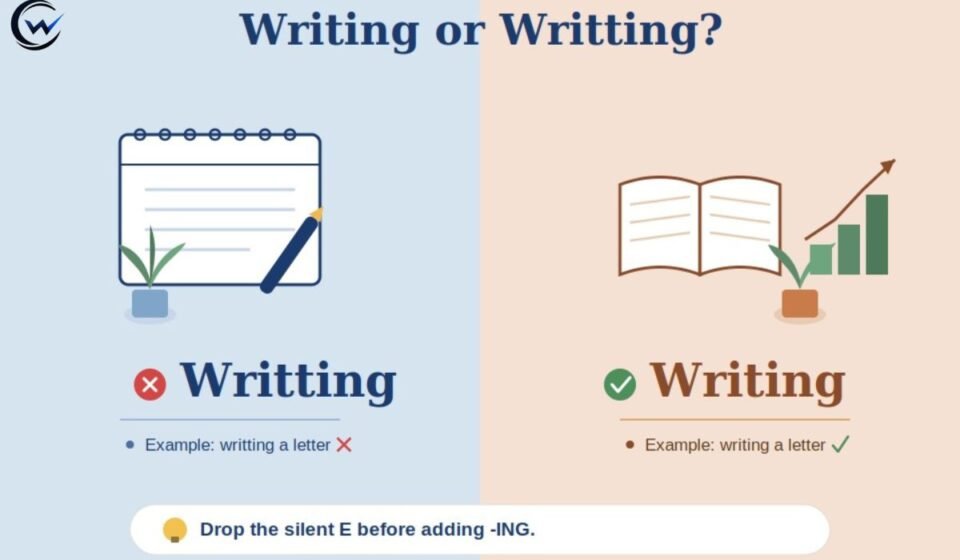
Writing is the correct spelling. Writting is not a word in English, no matter how it looks or sounds.
The confusion happens because of a spelling rule most people never learned properly, not because “writting” has any real usage. Once you see the rule, you won’t second guess it again.
Writing vs Writting at a Glance
| Term | Correct? | Why |
| Writing | Yes | Follows the “drop the silent e” rule when adding -ing |
| Writting | No | Adds an extra “t” that doesn’t belong |
| Write | Yes | Base verb form |
| Writter | No | Should be “writer,” one t |
Why “Writting” Feels Right (But Isn’t)
Your brain hears the short “i” sound in writing and assumes the consonant needs doubling, like sitting or hitting. That instinct makes sense on the surface.
But write doesn’t follow that pattern. It already has a silent e at the end, and English handles silent e words differently when you add -ing.
The Actual Spelling Rule Behind “Writing”
Here’s the rule in one sentence: when a verb ends in a silent e, you drop the e before adding -ing.
Write becomes writing. Not writeing. Not writting.
Compare it to similar words:
- Bake → Baking
- Drive → Driving
- Hope → Hoping
- Write → Writing
Notice the pattern? None of these double a letter. They all just lose the silent e and add -ing.
More Confusing Words Made Simple: Ofcourse or Of Course
Why This Differs From Words Like “Sitting”
This is where most people trip up. Words like sit, hit, and run double their final consonant before -ing because they end in a single vowel plus a single consonant, with no silent e involved.
- Sit has three letters and no silent e, so it becomes sitting.
- Write has a silent e at the end, so it becomes writing.
Two different rules, two different word families. Once you separate them mentally, the confusion mostly disappears.
A Simple Way to Remember It
Picture the silent e getting kicked out the door the moment -ing walks in. Write loses its e, and writing takes its place. If you can picture that swap, you’ll spell it right every time, even under pressure.
Where the Word “Writting” Comes From
Writting isn’t an old English spelling or a regional variant. It’s simply a common misspelling, usually caused by:
- Mixing up the doubling rule from words like sitting or running
- Typing too fast and adding an extra letter
- Learning English as a second language, where silent letters feel unpredictable
None of that makes it correct. Dictionaries don’t list writting as an alternate spelling, archaic form, or informal usage. It’s just an error.
Real Examples of Correct Usage
Seeing the word in context makes the correct spelling stick faster than any rule alone.
- Correct: She spent the afternoon writing her college essay.
- Correct: Creative writing helped him process a hard year.
- Correct: The teacher graded twenty writing samples before lunch.
- Incorrect: He is writting a letter to his manager.
- Incorrect: Her writting style feels rushed and messy.
Read those incorrect examples again. They look off once you know the rule, right?
Other Words That Follow the Same Pattern
Once you understand write to writing, a whole group of words suddenly makes more sense.
- Drive → Driving (not driveing or drivving)
- Choose → Choosing (not chooseing or choossing)
- Smile → Smiling (not smileing or smilling)
- Ride → Riding (not rideing or ridding)
Ridding, by the way, is a real word too, but it means removing something, not riding a bike. English loves a good trap like that.
Common Mistakes People Make With “Writing”
Beyond the double-t error, a few related mistakes show up constantly in essays, resumes, and social posts.
- Writer vs Writter. Only one t. The person who writes is a writer, never a writter.
- Writing vs Writeing. Some people overcorrect and forget to drop the e entirely. Still wrong.
- Handwriting as two words. It’s one word, no space, no hyphen.
Small errors like these are exactly what spellcheck tools flag first, and exactly what a careful reader notices before anything else.
Why Getting This Right Actually Matters
A single misspelled word in a cover letter or client email can shift how competent you seem, even if the rest of the message is sharp. Hiring managers, professors, and readers notice spelling errors faster than almost anything else on a page.
Getting writing right isn’t about being a grammar perfectionist. It’s about sounding as capable as you actually are.
Quick Self-Check Before You Hit Publish
Next time you’re unsure, run through this in your head:
- Does the base word end in a silent e? (Write does.)
- Drop the e.
- Add -ing.
- Read it out loud once before sending.
That four-second check catches almost every version of this mistake.
More Confusing Words Made Simple: Vender or Vendor
FAQs
Is writting ever correct in British or Australian English?
No. British, Australian, Canadian, and American English all spell it writing. There’s no regional variant that uses double t.
Why do I keep misspelling writing as writting?
It usually happens because your brain applies the doubling rule from short vowel words like sitting, even though write ends in a silent e and follows a different pattern entirely.
Is writter or writer correct for someone who writes?
Writer is correct, spelled with one t. Writter is a common misspelling of the same word and carries no separate meaning.
Does spellcheck always catch writting as an error?
Most modern spellcheckers catch it instantly since writting isn’t a recognized word, but always glance at flagged words yourself since autocorrect sometimes guesses wrong replacements.
What’s an easy trick to remember the spelling of writing?
Remember that write drops its silent e before -ing joins in, the same pattern used in drive to driving and hope to hoping.
The Bottom Line
Writing is correct. Writting isn’t a word, a variant, or an accepted alternative anywhere in English. The mix up comes from applying the wrong spelling rule, not from any real ambiguity in the language.
Once you connect write to its silent e and remember that -ing simply replaces it, this mistake stops happening for good.