
You’re writing a permission slip, a wedding invite, or a school form, and you freeze. Is it “parent’s signature” or “parents’ signature”? One tiny apostrophe and suddenly you’re not sure if you sound educated or careless.
Getting parent’s or parents’ wrong is an easy mistake, but it’s also an easy one to fix once the rule clicks.
Quick Answer: Parent’s or Parents’
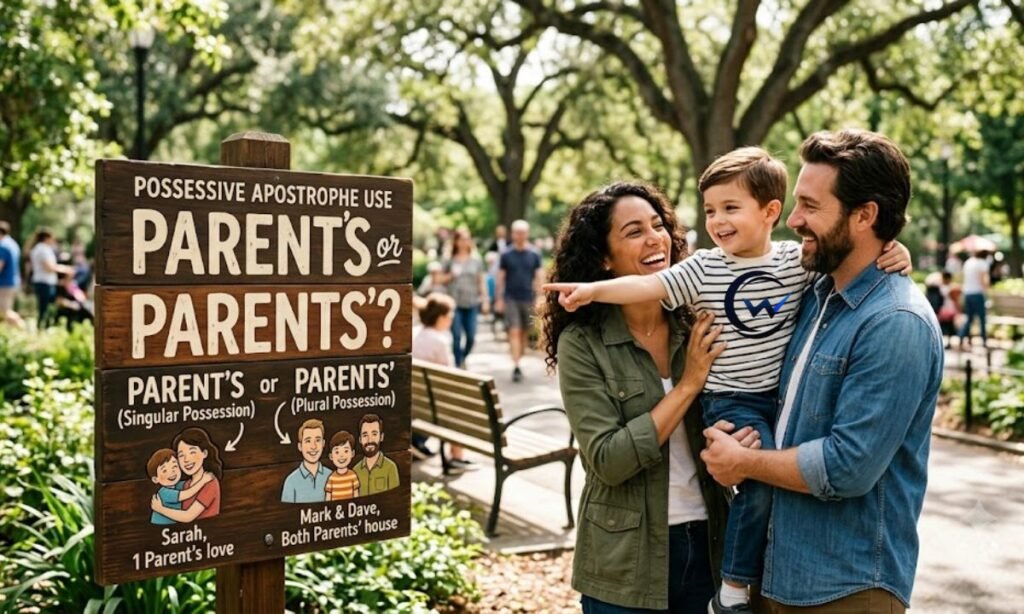
Use parent’s when you’re talking about something belonging to one parent. Use parents’ when it belongs to two or more parents.
- “My parent’s car” means one parent owns the car.
- “My parents’ car” means both parents own it together.
That’s the whole rule. Everything else below just gives you the reps to make it automatic.
Why This Apostrophe Trips Up So Many Writers
English possessives are supposed to be simple: add an apostrophe and an s. But plural nouns that already end in s throw people off, and “parent” becomes “parents” the second you’re talking about more than one.
Your brain sees the extra s and isn’t sure where the apostrophe goes. That confusion is completely normal. It’s one of the most searched grammar questions for a reason.
The Core Rule in Plain English
Apostrophes for possession follow one logic: show what belongs to whom, and show how many owners there are.
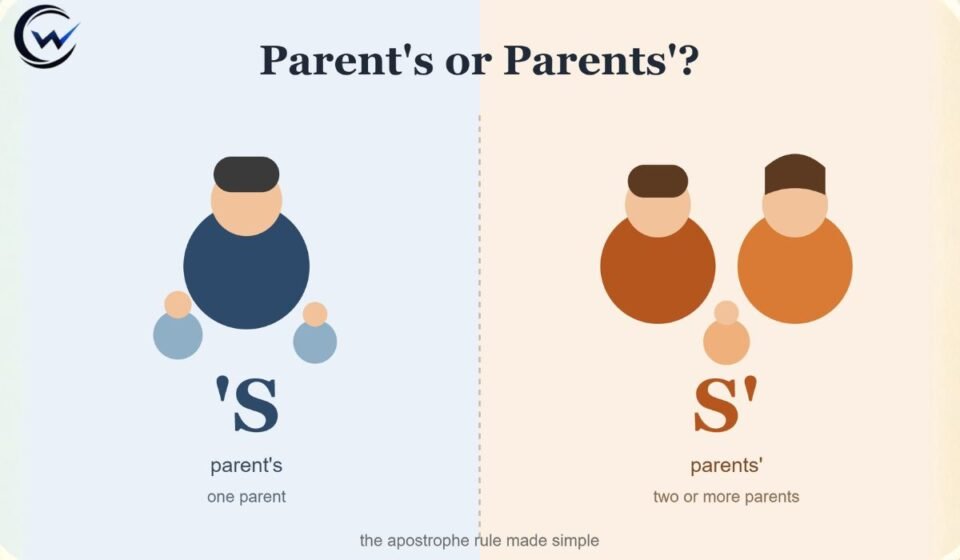
- Singular possessive (one parent): add ‘s Example: parent’s
- Plural possessive (two or more parents): add an apostrophe after the s Example: parents’
No new letters, no new sounds. Just where the apostrophe lands.
Parent’s: When You Mean One Parent
“Parent’s” refers to something that belongs to a single parent. Maybe it’s a mom, a dad, or a guardian, but the ownership is singular.
Examples:
- “The child brought her parent’s ID to the appointment.”
- “His parent’s job requires a lot of travel.”
- “That’s my parent’s handwriting on the envelope.”
In every case, one specific parent owns or is connected to the thing being described.
Parents’: When You Mean Two or More Parents
“Parents'” shows possession by multiple parents. This is the version you’ll use most often for families with two parents, or when talking about parents as a group.
Examples:
- “The parents’ meeting starts at 6 PM.”
- “Both kids inherited their parents’ sense of humor.”
- “The school sent a note to all parents’ email addresses.”
Notice the apostrophe sits after the s because “parents” is already plural before you add possession.
More Confusing Words Made Simple: Vender or Vendor: Which Spelling Is Correct?
Quick Comparison Table
| Phrase | Meaning | Example |
| Parent’s | Belongs to one parent | “My parent’s advice helped me a lot.” |
| Parents’ | Belongs to two or more parents | “My parents’ advice helped me a lot.” |
| Parents | Plural, no possession | “Both parents attended the concert.” |
Keep this table nearby the next time you’re second-guessing yourself.
Where the Apostrophe Rule Comes From
English possessives trace back to Old English, where nouns changed form to show ownership using a genitive case ending, often “-es.” Over centuries, that ending shrank down to the apostrophe and s we use today.
The rule for plurals ending in s came later as a practical shortcut. Writers needed a way to show plural possession without adding an awkward extra syllable, so the apostrophe simply moved to the end of the word. That’s why “parents'” doesn’t need an extra s tacked on.
How to Test Yourself in Five Seconds
Here’s a trick that works every time. Rewrite the sentence using “of” instead of the possessive.
- “The parent’s car” becomes “the car of the parent.” One parent, singular.
- “The parents’ car” becomes “the car of the parents.” More than one parent, plural.
If the “of” version sounds off, you’ve probably picked the wrong form. This trick works for almost any possessive noun, not just parent.
Single-Parent Households and Wording Choices
If you’re writing for a single-parent family specifically, “parent’s” is usually correct since you’re referring to one person. But context matters more than the word itself here.
A form addressed to “parent(s)” without an apostrophe sidesteps the issue entirely, which is why you’ll see that format on official school and medical paperwork. It’s not lazy grammar. It’s intentional, since the writer doesn’t know how many parents are involved.
Common Mistakes People Make With This Word
Mistake 1: Dropping the apostrophe entirely. “Parents signature required” should be “parent’s” or “parents'” depending on context, never bare “parents” when showing ownership.
Mistake 2: Adding an extra s to the plural possessive. “Parents’s” is not a word. Once you’re plural and possessive, the apostrophe alone does the job.
Mistake 3: Confusing plural and possessive. “Parents are coming” needs no apostrophe at all. That’s just a plural noun, not possession. The apostrophe only shows up when something belongs to the parents.
Mistake 4: Autocorrect switching your intended meaning. Phones and word processors sometimes “fix” one version into the other. Always double check after autocorrect touches a possessive.
Real-World Examples You’ll Actually Use
On school forms: “Parent’s signature” if the form expects one parent, “parents’ signatures” if both need to sign.
In legal documents: “The parents’ consent was required before the procedure” when both guardians are involved.
In casual writing: “I still use my parent’s old recipe for banana bread” when only one parent taught you that recipe.
In emails to schools: “Please update all parents’ contact information” when addressing the whole group of families.
A Simple Memory Trick
Picture one parent standing alone. The apostrophe sits right before the s, close to that single person: parent’s.
Now picture two parents standing side by side. The s already covers both of them, so the apostrophe just closes out the word after: parents’. If you can picture the people, you can place the apostrophe.
Frequently Asked Questions
Is it “parent’s night” or “parents’ night” at school?
It depends on who’s attending. If the event is for all parents in general, use “parents’ night.” If a specific single parent is being referenced, use “parent’s night,” though this is rarer in school contexts.
What’s the difference between “parents” and “parents'”?
“Parents” is simply the plural of parent, showing more than one person, with no ownership implied. “Parents'” adds possession, showing that something belongs to those parents.
Is “parents” ever correct without an apostrophe on a form?
Yes. Many official forms use “parent(s)” or plain “parents” when no possession is being shown, such as “parents must attend.” The apostrophe only appears when something belongs to them.
How do I know if I need ‘s or just s’?
Ask how many parents you mean. One parent takes ‘s. Two or more parents take s’. If you’re unsure of the number, “parent(s)” avoids the issue.
Can “parent’s” ever refer to more than one parent?
No. “Parent’s” always means singular possession, one parent only. For two or more parents, you need “parents'” instead.
Bottom Line
One parent, one apostrophe before the s: parent’s. Two or more parents, apostrophe after the s: parents’.
Run the quick “of” test whenever you’re stuck, and you’ll get it right every time without having to memorize a single grammar term.