
“People do” or “people does”? You’ve probably typed both in the same sentence and deleted one, unsure which one actually sounds right versus which one is actually correct. Those aren’t always the same thing in English.
This mix-up shows up everywhere, in emails, essays, even in speech from people who otherwise write well. And when it slips through, it reads as careless rather than a genuine one-off typo.
Here’s the short version: there’s a rule, it’s not complicated, and there’s also a weird little exception almost nobody explains properly. Let’s get into it.
Quick Answer: Is It “People Do” or “People Does”?
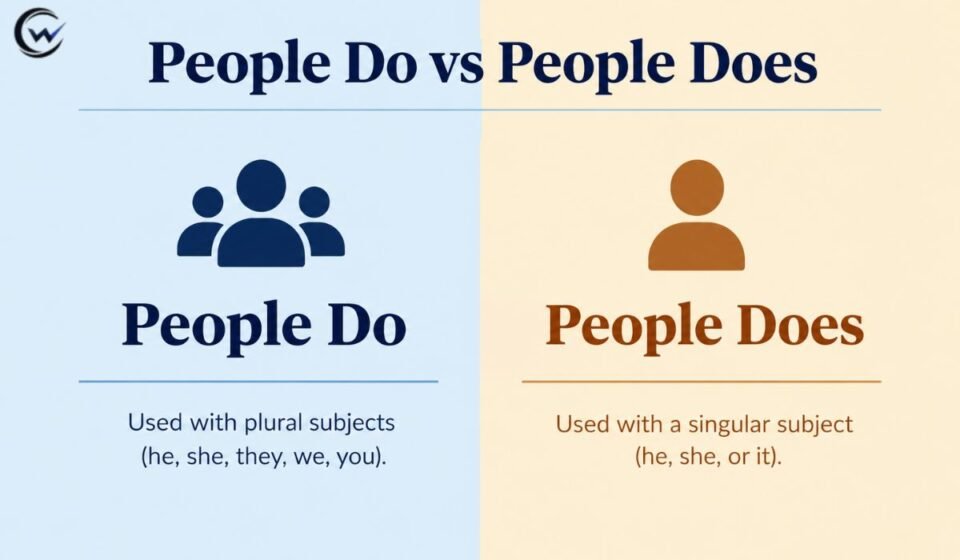
“People do” is correct. People is a plural noun. Plural subjects take “do.” Full stop. “Does” only belongs with singular subjects like he, she, it, or one specific person.
People do what they believe is right, not people does.
Easiest trick: swap “people” for “they.” If “they do” sounds fine, so does “people do.”
Is “People” Singular or Plural?
Almost always plural. It’s the standard plural of “person” and it refers to more than one individual by default.
| Word | Number | Example |
| Person | Singular | A person does her best work under pressure. |
| People | Plural | People do their best work under pressure. |
One thing worth flagging early, because most articles on this topic conveniently skip it: “people” can also mean a nation or ethnic group treated as one unit (the Kurdish people, the Japanese people). In that specific sense it can act like a singular noun, and it even gets its own plural, “peoples.” More on that further down, it’s actually the interesting part.
Do vs Does: The Core Grammar Rule
Both “do” and “does” are present-tense forms of the same verb. What decides which one you use is the subject, nothing else.
| Subject | Verb | Example |
| I | do | I do my own research. |
| You | do | You do great work. |
| He / She / It | does | She does the dishes every night. |
| We | do | We do this every week. |
| They | do | They do not agree. |
| People | do | People do surprising things under stress. |
So: “do” goes with I, you, we, they, and any plural noun. “Does” goes with he, she, it, and singular nouns. People acts exactly like “they,” so it’s “do,” every time, no exceptions in normal usage.
Do People or Does People? The Question Form
Statements are one thing, but questions trip people up more, mostly because “does” just sounds more natural to the ear in question form when you’re not thinking about the subject.
Do people really believe that? Yes, “do” leads. Does people really believe that? No, that’s wrong, even though it might momentarily sound okay out loud.
For comparison, a singular subject flips it:
- Does she really believe that? Do they really believe that?
- Since people behaves like “they,” the question always opens with “Do.”
More Confusing Words Made Simple: Input vs Imput
People Don’t or People Doesn’t?
Same rule, negative form this time, and honestly this one trips up writers more than speakers. People don’t always agree on the details. Correct. People doesn’t always agree on the details. Wrong, even though autocorrect sometimes lets it slide.
“Doesn’t” is short for “does not” and only pairs with singular subjects, he doesn’t, she doesn’t, it doesn’t. People is plural, so it’s “don’t,” the contraction of “do not.”
Subject-Verb Agreement Rule With People
Agreement just means the verb matches the subject’s number. Plural subject, plural verb, across every verb, not just do/does.
- People are helpful.
- People have different opinions.
- People do many interesting things.
Not: people is helpful, people has different opinions, people does many interesting things.
Same trick works here too: they are, they have, they do. If it fits with “they,” it fits with “people.”
Collective Nouns: When Group Words Take a Different Verb
Honestly, this is probably where the “people does” confusion actually comes from in the first place, not from people misunderstanding “people” itself, but from other group nouns behaving inconsistently.
| Collective noun | Typical US usage | Example |
| Team | Singular | The team is confident. |
| Staff | Singular or plural | The staff is trained. / The staff are arriving. |
| Family | Singular | The family owns a small farm. |
| Police | Plural, always | The police are investigating. |
| People | Plural, default | People do many things. |
American English usually treats team, staff, and family as singular units. British English tends to go plural for the same words, “the team are confident” sounds completely normal in the UK. Police and people don’t really follow that dialect split though, both stay plural almost everywhere.
Examples of “People Do” in Real Sentences
Context sticks better than rules alone, so here’s the phrase doing actual work in real sentences.
People do things differently depending on their upbringing. People do their best when there’s a clear goal in front of them. People do make mistakes while they’re still learning.
People do change their minds as they get older, more than they’d probably admit. People do not always agree, and honestly, that’s fine. People do appreciate small gestures more than you’d think.
Common Mistakes When Using “People”
Most errors here come from one root cause: treating “people” as a single unit instead of a group of individuals.
| Incorrect | Correct |
| People is happy. | People are happy. |
| People does understand the problem. | People do understand the problem. |
| People has different ideas. | People have different ideas. |
| People was late. | People were late. |
Spot the pattern once and it applies to every verb form you’ll ever pair with “people,” not just do and does.
When Can “People Does” Actually Be Correct?
Almost never in day-to-day writing. But there’s a real exception, and it’s the part most grammar sites either skip entirely or wave off with a vague “special context” comment.
When “a people” refers to a specific nation, tribe, or ethnic group as a single historical or political entity, it can technically act as a singular collective noun. The Cherokee people has a documented history stretching back centuries. This people has survived centuries of upheaval.
This is formal usage. You’ll see it in historical writing, anthropology, political commentary, not in everyday conversation. In that same narrow sense, “people” even has its own plural: “peoples,” for multiple distinct nations or ethnic groups. The peoples of Southeast Asia speak dozens of different languages, for instance. Outside that specific formal context though, if you’re just talking about a general group of individuals, “people does” is wrong. No exceptions there.
People Do vs Everyone Does: Why They’re Different
“People” and “everyone” both point at groups, but they don’t share a verb rule, and that catches a lot of writers off guard.
People do what they believe is right. Plural, many individuals together. Everyone does what they believe is right. Singular, each person counted one at a time.
“Everyone,” like “everybody,” “someone,” “anybody,” stays grammatically singular even though it’s technically talking about a group. “People” is grammatically plural. Same general idea, opposite verb choice.
More Confusing Words Made Simple: Long Term or Long-Term
FAQs
Is it correct to say “people does”?
No. People is plural, so it pairs with “do.” Save “does” for singular subjects, he, she, it, or one named person.
Do people or does people, which is correct in a question?
“Do people” is correct. People acts like “they,” so questions with it always start with “Do.”
Is it “people don’t” or “people doesn’t”?
“People don’t.” “Doesn’t” only goes with singular subjects, and people is plural.
Is “people” always a plural noun?
Basically always. The rare exception is when it means a specific nation or ethnic group as one unit, which can take a singular verb in formal writing.
What is the plural of “people”?
In everyday use, “people” is already plural. In its narrower “nation” sense though, its plural is “peoples,” used when you’re talking about several distinct groups.
Conclusion
“People do” is the answer you’ll need almost every time you write or speak, whether it’s a statement, a question, or a negative. People is plural, plural takes “do,” and that one fact covers all three forms at once.
The one real exception, “a people has,” only kicks in when “people” means a nation or ethnic group treated as a single unit, and even then it’s mostly reserved for formal or historical writing.
Quickest gut check going forward: swap in “they.” If “they do” works, “people do” works too.