

Trash vs Garbage may seem like a tiny language battle, but these two words can make everyday conversations surprisingly confusing. If you’ve ever wondered whether to call that overflowing bin “trash” or “garbage,” you’re not alone.
Both words refer to unwanted things we throw away, but their usage can vary by context and region. Let’s break down the difference between trash and garbage so you can use each word naturally and confidently.
Quick Answer: Trash vs Garbage in One Sentence
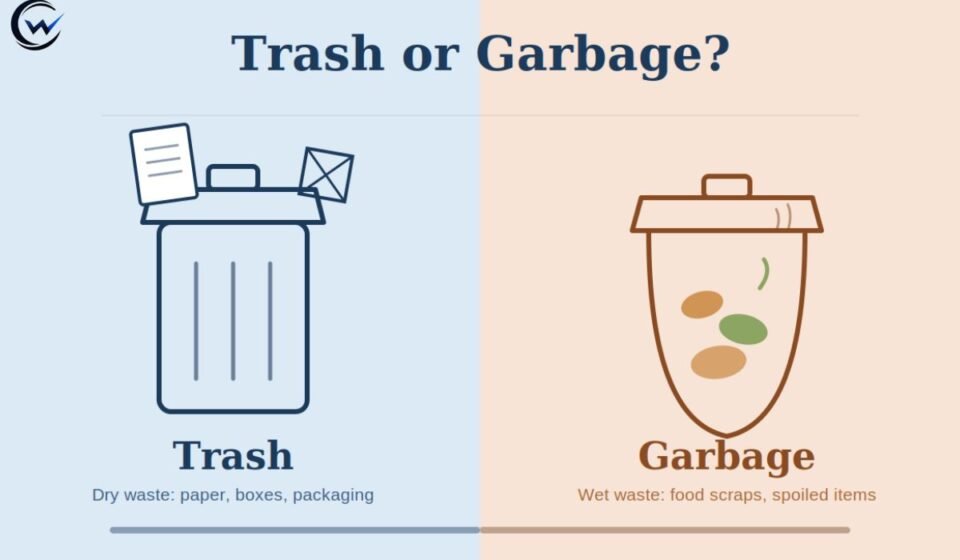
Trash refers to dry waste like paper, cardboard, and packaging, while garbage refers to wet or food based waste that rots and smells.In everyday American speech, people use both words loosely to mean “stuff you throw away,” but if you want to be technically accurate, trash is dry and garbage is wet.
Quick Comparison Table
| Feature | Trash | Garbage |
| Type of waste | Dry (paper, boxes, plastic) | Wet (food scraps, spoiled items) |
| Smell | Usually low odor | Often smells due to decay |
| Common US usage | General waste term | Kitchen or food waste |
| British English equivalent | Rubbish | Rubbish |
| Typical container | Trash can, trash bag | Garbage can, garbage disposal |
| Formality | Casual, widely used | Slightly more specific |
What Does “Trash” Actually Mean?
Trash technically means dry, discarded material. Think crumpled paper, empty cereal boxes, junk mail, or a broken umbrella.
It’s the stuff that doesn’t rot or attract pests right away. That’s why you’ll hear “trash” used for recycling adjacent waste, like office paper or packaging.
In casual American conversation, though, trash has become the default umbrella word. People say “take out the trash” even when the bag has last night’s leftovers in it.
What Does “Garbage” Actually Mean?
Garbage originally referred to food waste specifically. Think vegetable peels, meat scraps, or anything organic that decomposes and starts to stink.
This is why your sink has a “garbage disposal” and not a “trash disposal.” That appliance is built to grind up food, not junk mail.
City sanitation departments sometimes still separate garbage (wet, organic) from trash (dry, general) for collection purposes, especially in older municipal codes.
More Confusing Words Made Simple: Long Term or Long-Term
Where the Words Came From
Both words have surprisingly different roots. “Garbage” traces back to Anglo-Norman French, originally referring to the entrails or waste parts of an animal used for food.
“Trash,” on the other hand, comes from Old Norse, roughly meaning fallen leaves, twigs, or broken material. Neither word started out meaning “everything you throw away.”
Over centuries, both terms broadened. Garbage picked up general waste meaning by the 1800s, and trash followed a similar path in American usage.
American English vs British English
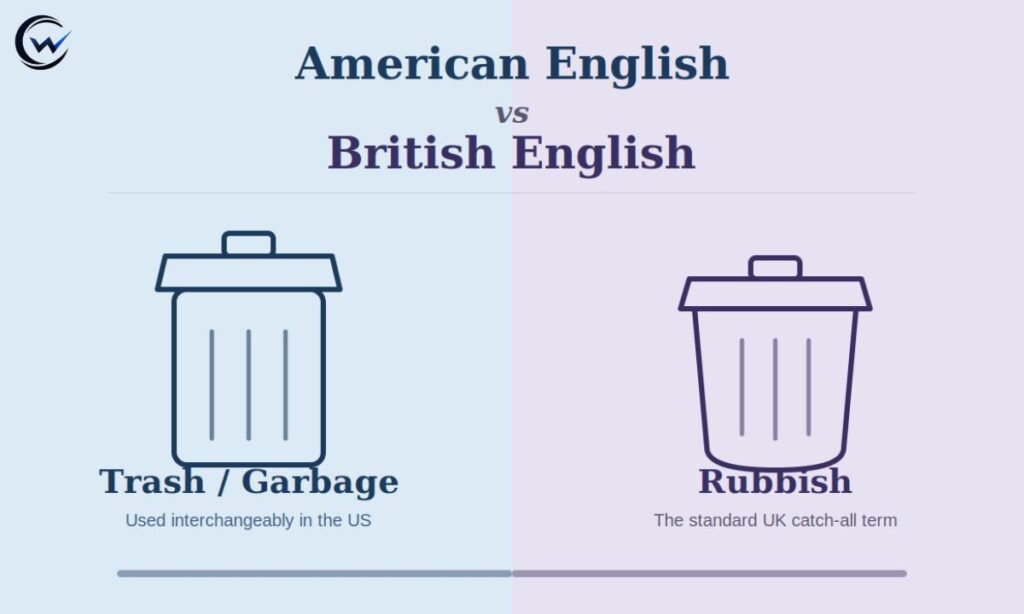
Here’s where things get genuinely useful. In American English, trash and garbage are both common, and most people use them interchangeably without thinking twice.
In British English, neither word dominates. The British default is rubbish, a term that covers pretty much everything Americans split between trash and garbage.
So if you’re writing for a UK audience, “rubbish bin” will land better than either American term. Brits will understand trash and garbage, but rubbish sounds native.
Trash vs Garbage vs Rubbish vs Litter
These four words often get lumped together, but they’re not perfect synonyms. Litter specifically means waste dropped in public spaces, like a candy wrapper on a sidewalk.
Rubbish is the catch all British term. Trash and garbage, as covered above, technically split along the dry versus wet line in American usage, even though most speakers ignore that distinction daily.
Knowing this difference matters most when you’re writing for clarity, not casual conversation. A sanitation article should be precise. A text to your roommate doesn’t need to be.
When to Use “Trash” in a Sentence
Use trash when talking about general household waste, especially dry items. It also works as a verb, meaning to discard or ruin something.
Examples:
- “Can you take the trash out before the truck comes?”
- “He trashed his old textbooks after finals.”
- “That review completely trashed the restaurant.”
Trash also shows up in phrases like “trash talk” and “one man’s trash is another man’s treasure,” both firmly part of everyday American idiom.
When to Use “Garbage” in a Sentence
Garbage leans slightly more toward food waste or a general dismissive tone about quality. It’s also common in compound nouns tied to specific systems.
Examples:
- “Scrape your plate into the garbage before loading the dishwasher.”
- “The garbage truck comes every Tuesday morning.”
- “That movie was garbage.”
Notice how “garbage truck” and “garbage disposal” are fixed terms. You wouldn’t naturally say “trash disposal” even though the meaning would still make sense.
Common Mistakes People Make
Most people don’t actually make a “mistake” using these words since American English tolerates the overlap. But a few slip ups are worth knowing.
- Mistake 1: Assuming British readers will understand “garbage can” the way Americans do. It reads as oddly formal or outright American to a UK audience.
- Mistake 2: Using “garbage” for dry paper waste in technical or municipal writing where the two terms are officially separated by local ordinance.
- Mistake 3: Forgetting that “trash” as a verb means something different from garbage. You can trash a car (ruin it), but you can’t “garbage” a car.
More Confusing Words Made Simple: Parent’s or Parents’
Real-Life Examples You’ll Actually Use
Picture cleaning your kitchen. Food scraps go in the garbage can under the sink. The empty cardboard box from your delivery goes in the trash bin by the door.
At the office, you toss shredded documents in the trash bin, not a garbage bin, because there’s nothing wet or rotting involved.
On a road trip, you might ask your friend to grab the trash from the car floor, meaning wrappers and cups, not literal spoiled food.
Frequently Asked Questions
Is there a real difference between trash and garbage?
Technically yes. Trash means dry waste like paper and packaging, while garbage means wet or food based waste. Most Americans use both words interchangeably in daily speech without any real confusion.
Do British people say trash or garbage?
Neither is common in British English. The standard term is rubbish, which covers all types of household waste. Trash and garbage are understood but sound distinctly American to UK ears.
Why is it called a garbage disposal and not a trash disposal?
Garbage historically referred to food scraps and organic waste, which is exactly what a disposal unit grinds up. The name stuck because it matched the appliance’s original, specific purpose.
Can trash and garbage be used interchangeably?
In casual American English, yes, almost always. The dry versus wet distinction mostly matters in formal, legal, or municipal contexts where waste categories are officially defined and separated.
What do Canadians and Australians call it?
Canadians typically use both trash and garbage similarly to Americans. Australians lean toward rubbish, closer to British usage, though garbage still appears in some regional contexts.
Final Thoughts
n everyday American English, trash and garbage often mean the same thing: unwanted things that are thrown away. The main difference comes from regional or contextual usage, not a completely different meaning.
- Trash: A general word for unwanted items or waste.
- Garbage: Often used for household waste, especially food and other discarded materials.
Both words are correct, so choose the one that sounds natural in your context.