

Picture this. It’s a cold morning, you’re sipping tea near the window, and suddenly you feel a thin stream of cold air brush past your arm. At the same time, your cat jumps up and stretches out on the flat wooden shelf right below the glass. Two different window parts are doing two very different jobs in that one moment, and most people call both of them by the wrong name.
“Window seal” and “window sill” get mixed up all the time. They sound almost the same when you say them fast, they sit close together, and honestly, nobody teaches this in school. You just pick up the words from conversation and hope you’re using them right.
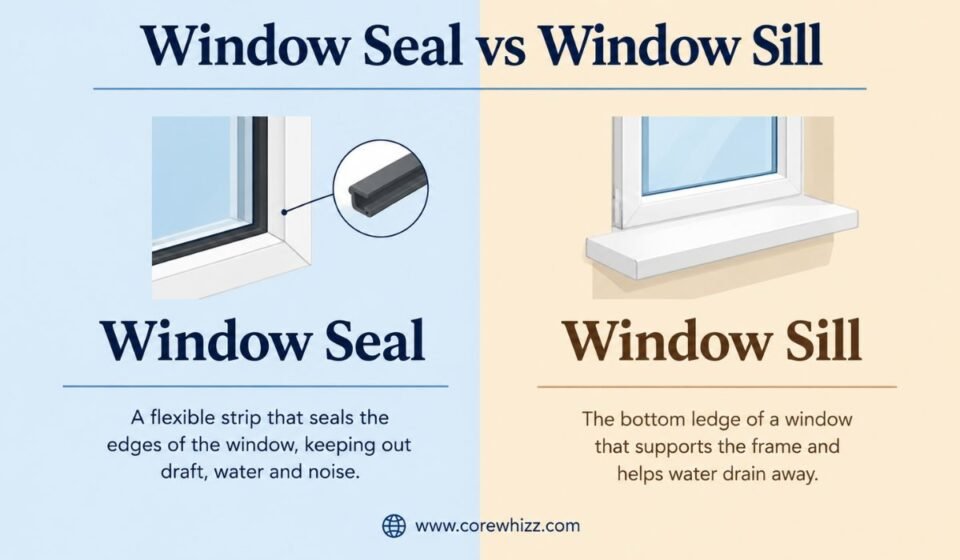
Here’s the short version so you can stop guessing. A window seal is the material that blocks air, water, and dust from sneaking through the gaps around your window. A window sill is the flat ledge at the bottom of the window frame, the one that holds your coffee mug and sends rainwater away from the wall. One protects. One supports. That’s it. That’s the whole difference in a nutshell, and by the end of this guide, you’ll never mix them up again.
We’ll walk through the meaning of each term, show you the correct spelling (yes, there’s a small twist here), explain what happens when either one fails, and even give you real repair costs so you’re not caught off guard by a contractor’s quote. Let’s get into it.
Quick Answer: Window Seal vs Window Sill
A window seal is a strip of rubber, silicone, or sealant that closes the tiny gaps around your window glass and frame. Its whole purpose is to keep drafts, moisture, and dust out of your home.
A window sill is the flat, horizontal surface at the bottom of a window. It supports the frame from below and lets rainwater drain away instead of pooling against your wall.
An easy way to remember it: the seal works like a gatekeeper, and the sill works like a shelf. If a window feels drafty, the seal is usually to blame. If the paint below your window is peeling or the wood looks soft, that’s a sill problem.
| Feature | Window Seal | Window Sill |
| What it is | A sealing material (rubber, silicone, foam) | A flat ledge or shelf |
| Main job | Blocks air, moisture, and drafts | Supports the frame, drains water |
| Location | Around the glass or frame edges | Bottom of the window opening |
| Visible? | Usually hidden from view | Always visible, inside and out |
| Made from | Rubber, silicone, foam gaskets | Wood, stone, vinyl, PVC |
| Common problem | Cracking, fogging, drafts | Rot, cracking, water stains |
What Is a Window Seal?
Think of a window seal as the quiet worker nobody notices until it stops working. It’s the thin material wrapped around the edge of the glass or the frame, and its one job in life is to keep the outside world outside. Rain, cold wind, dust, and even bugs are all constantly trying to find a way in through tiny gaps you can’t see with the naked eye. The seal shuts those gaps down. Most modern windows use rubber or silicone for this, since both materials flex a little with temperature changes without cracking right away.
Double-pane windows take this a step further. Between the two panes of glass, there’s a thin layer of gas, usually argon, and the seal is what keeps that gas trapped in place. This gas layer acts almost like a blanket, keeping heat inside during winter and outside during summer.
Here’s the catch. Seals don’t last forever. Sun exposure, age, and constant expansion and contraction slowly wear them down. Once a seal fails, you’ll usually notice fog trapped between the glass panes (a dead giveaway), a steady draft near the frame even with the window shut, or a heating bill that keeps climbing for no obvious reason.
Real example: “Ever since the window seal cracked, our bedroom feels ten degrees colder at night.”
What Is a Window Sill?
Now flip to the bottom of the window. That flat surface you rest your elbow on, or where your plant sits soaking up sunlight? That’s the sill.
Outside, the sill isn’t perfectly flat. It’s built with a slight downward slope so rainwater naturally rolls away from your wall instead of sitting there and soaking in. This tiny design detail saves homeowners a fortune in water damage over the years. Inside, the sill is flat and simply acts like a mini shelf, a spot for books, candles, a coffee mug, or, let’s be honest, a cat that owns the house now.
Sills come in a handful of common materials. Wood gives that classic, cozy look but needs regular painting and sealing to survive weather exposure. Stone and vinyl are lower maintenance and handle moisture much better over time, which is why a lot of newer homes use them, especially on exterior sills.
Real example: “She lined up three small succulents along the window sill, right in the morning sun.”
More Confusing Words Made Simple: Nighttime or Night Time
Windowsill or Window Sill: Which Spelling Is Correct?
Here’s a question that trips up even confident English speakers. Do you write it as one word, “windowsill,” or two words, “window sill”?
Good news: both spellings are technically correct, and native speakers use them interchangeably. That said, “windowsill” (one word) is the form you’ll see in most modern dictionaries, including Merriam-Webster, and it’s the safer pick for formal or American English writing. “Window sill” (two words) still shows up often, especially in British English and casual writing, and no one will think you made a mistake by using it.
There’s no equivalent debate for “window seal.” That one always stays as two separate words, because “seal” describes a function or a material rather than a fixed, merged compound noun the way “windowsill” has slowly become over decades of use.
Quick rule to remember: writing for a US audience or following AP style? Go with “windowsill,” one word. Writing casually or for a UK audience? “Window sill” works just fine.
Why Do People Mix Up Window Seal and Window Sill?
Honestly, it’s not surprising that people confuse these two. A few small reasons stack up to create one big mix-up.
First, the words sound nearly identical in fast, everyday speech. “Seal” and “sill” are separated by a single vowel sound, and that difference practically disappears once you’re talking at a normal conversational pace.
Second, both parts live in the exact same tiny stretch of the window and both are somehow connected to weather protection. That overlap tricks the brain into assuming they must be the same thing, even though their actual jobs couldn’t be more different.
Third, and this is the big one, most people never think about window parts until something goes wrong. Nobody sits around studying window anatomy for fun. So when a problem shows up, whichever word feels more familiar gets used, right or wrong.
Once the difference clicks (seal blocks weather, sill supports and drains), the confusion tends to disappear for good.
When to Use “Window Seal”
Reach for “window seal” any time you’re talking about drafts, insulation, energy loss, or foggy glass.
Correct usage:
- “The window seal is broken, and I can feel cold air coming through.”
- “We had a technician come out to replace the failed window seal.”
- “Moisture got trapped between the panes because the seal cracked last summer.”
Incorrect usage:
- “I set my coffee cup down on the window seal.” (Should be sill.)
- “The dog loves napping on the window seal.” (Should be sill.)
If your sentence is about temperature, air movement, or moisture getting inside, “seal” is your word every time.
When to Use “Window Sill”
Reach for “window sill” any time you’re describing a physical ledge, a spot to place objects, or water drainage at the base of a window.
Correct usage:
- “He spent the whole weekend repainting the old wooden window sill.”
- “Heavy rain damaged the exterior window sill last spring.”
- “The plant has been sitting on that window sill for years.”
Incorrect usage:
- “The window sill is what stops the cold air from getting in.” (Should be seal.)
- “The window sill traps the gas between the glass panes.” (Should be seal.)
If your sentence is about a surface, a ledge, or physical support, “sill” is the right choice.
Related Window Parts You Should Know
Once “seal” and “sill” feel clear, it helps to know a few neighboring terms too, since these show up constantly in repair quotes and home improvement guides.
| Term | What It Means |
| Sash | The moving part of the window that actually holds the glass |
| Weatherstripping | A separate strip added around a window to block drafts, similar to a seal but often installed afterward |
| Apron | The trim piece just below the interior sill |
| Weep hole | A small drainage hole at the bottom of a window frame |
| Drip cap | A piece above the window that redirects rain away from the frame |
Knowing this small vocabulary set makes you sound a lot more confident the next time you’re on the phone with a contractor or reading through a repair estimate.
More Confusing Words Made Simple: Of or Off
Signs Your Window Seal Is Damaged
A failing window seal rarely breaks without warning. It usually gives you a few clues first, if you know what to look for.
The clearest sign is fog or condensation trapped between the glass panes of a double-pane window. If you see cloudy moisture that won’t wipe away because it’s sealed inside the glass itself, that seal has already failed.
A steady draft near the frame, even with the window closed and locked, is another common red flag. So is an energy bill that keeps climbing month after month with no real change in your habits, since a broken seal forces your heating and cooling system to work overtime.
In some older homes, a failing seal also lets in more outside noise than usual, since a solid seal blocks sound almost as well as it blocks air.
How to Fix a Damaged Window Seal (Steps and Average Cost)
Here’s some reassuring news. A broken window seal doesn’t automatically mean you need a whole new window.
Step 1: Confirm the problem. Check for fog trapped between glass panes, or run your hand slowly around the frame edges to feel for drafts.
Step 2: Decide between repair and full replacement. A simple weatherstripping-style seal is usually an easy DIY fix. But a failed seal inside a double-pane glass unit almost always needs a professional, since the whole glass unit typically has to be reset or replaced.
Step 3: Get a real quote before committing. In the US, a full double-pane glass unit replacement usually runs between $150 and $400 per window, depending on the size and glass type. A basic weatherstripping fix, on the other hand, can cost as little as $20 to $50 in materials if you’re comfortable doing it yourself.
Step 4: Time it smart. Booking the repair before winter or summer hits saves money in the long run, since a failing seal quietly drains extra cash through your energy bill every single day it’s left broken.
Step 5: Check your warranty first. Plenty of window manufacturers cover seal failure for 10 to 20 years after installation, so it’s worth a quick call before you pay out of pocket.
Common Problems With Window Sills
Sills take a real beating from the weather, especially outdoor sills made from wood. Rot tops the list of common problems, and it usually starts small. Water sits on the sill a little too long, doesn’t dry properly, and slowly soaks into the material. Cracks tend to follow close behind, caused by temperature swings, age, or simply a missing coat of protective paint or sealant.
Peeling paint and mold are also frequent visitors on older sills, particularly in humid climates. Once water sneaks under a paint layer, it can quietly damage the wood underneath for months before anyone notices, and by then, repairs cost a lot more than a simple touch-up would have. A quick yearly habit of cleaning and resealing your sill goes a long way toward avoiding a full, expensive replacement down the road.
Window Seal vs Window Sill vs Window Frame
There’s actually a third term that often joins this confusion party: the window frame. Think of the frame as the big outer box, the entire structure that holds your window securely inside the wall. Nothing else works without it.
The seal lives inside that frame, quietly closing the small gaps around the glass. The sill sits at the very bottom of that same frame, acting like both a ledge and a built-in drainage path for rain.
So to put it simply: the frame is the whole house of the window, the seal is the weatherproofing tucked inside it, and the sill is the floor sitting at the base.
Window Sill vs Window Ledge: Are They the Same?
For the most part, yes. “Window sill” and “window ledge” describe the exact same flat surface at the bottom of a window.
“Window sill” is the more technical term, and it’s the one you’ll see in construction documents, repair invoices, and most American English writing. “Window ledge” tends to be more casual and conversational, and it pops up more often in British English or everyday speech.
You won’t confuse anyone by using either word, but if you’re writing something formal, filing a repair request, or talking to a contractor, “window sill” is the safer, more professional choice.
More Confusing Words Made Simple: Targetted or Targeted
FAQs
Is it window seal or window sill?
Both terms are correct, but they mean different things. A seal blocks air and moisture from entering, while a sill supports the frame and drains water away.
Is windowsill one word or two words?
Both spellings work. “Windowsill” as one word is more common in modern dictionaries and formal American English writing today.
How much does it cost to fix a window seal?
A basic DIY weatherstripping fix can cost $20 to $50. A full double-pane seal replacement usually runs $150 to $400 per window.
Can a damaged window sill cause water leaks?
Yes. Cracks or rot in a sill can let water travel behind it and reach the wall, leading to bigger structural damage over time.
Are window sill and window ledge the same thing?
Yes, both refer to the same flat surface at the bottom of a window. “Sill” is simply the more technical, widely used term.
Does a broken window seal always mean a new window?
No. Many seal failures can be repaired with weatherstripping or a glass unit reset, without replacing the entire window frame.
Conclusion
A window seal and a window sill sit inches apart, sound almost identical, and both quietly fight the weather in their own way. But now you know they’re not the same thing at all, and honestly, you probably won’t ever mix them up again.
Keep this short version in your back pocket: the seal keeps air and water out, and the sill holds things up while sending water away. Next time you’re chatting with a contractor, writing a home repair request, or just settling a friendly argument at home, you’ll have the right words ready and the confidence to use them correctly.