
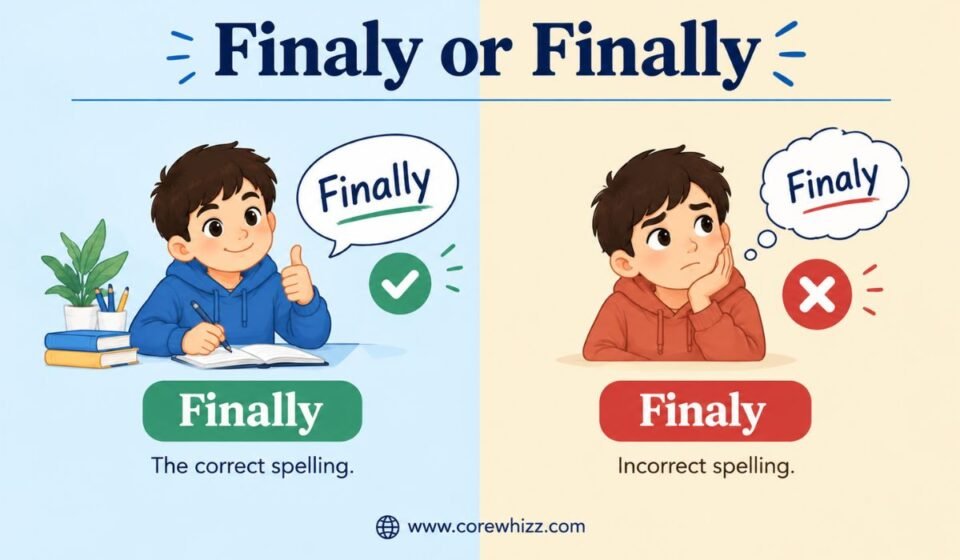

“Finally” and “finaly” look almost identical, and they sound nearly the same when spoken. That’s exactly why the wrong version slips through so easily, especially when you’re typing fast or trusting your ear over the actual spelling rule.
The confusion comes down to one thing: the double L from “final” carries over when you add “ly.” Miss that, and you get “finaly.”
Getting it right matters more than it seems. This guide breaks down the meaning, the reason behind the spelling, and simple examples so you never second guess it again.
Quick Answer – Finaly or Finally
❌ Finaly: Not a real word in English.
✅ Finally: Always spelled with two Ls.
Example:
- We finally booked the tickets. ✅
- We finaly booked the tickets. ❌
Simple rule to lock it in: Final + ly = Finally. If you can spell “final,” you already know how to spell “finally.”
Finaly vs Finally at a Glance
Here’s the short version, laid out so you never have to guess again.
| Spelling | Correct? | Notes |
| Finally | Yes | Standard spelling, always two Ls |
| Finaly | No | Common typo, not a recognized word |
| Finnally | No | Extra N, incorrect |
| Finalley | No | Incorrect, extra letters |
What Does “Finally” Actually Mean?
“Finally” is an adverb, and it does two main jobs. First, it signals that something happened after a long wait. Your package finally arrived. Your neighbor finally mowed that lawn.
Second, it introduces the last point in a list or sequence. “First, preheat the oven. Finally, add the frosting.” Same word, two useful roles.
Where Does “Finally” Come From?
The word traces back to the Latin word finis, meaning “end.” That root gave English the word “final,” and adding the “-ly” suffix turned it into an adverb describing how or when something ends.
So the double L isn’t random. It comes directly from “final” plus “ly,” and that’s the whole secret to spelling it right.
More Confusing Words Made Simple: Naive or Nieve
Why Do People Write “Finaly” Instead?
Honestly, it’s just how English pronunciation works against us sometimes. When you say “finally” out loud, the second L tends to blend into the syllable before it, so your ear doesn’t always catch two distinct L sounds.
Add in autocorrect fatigue and fast typing, and “finaly” sneaks through more often than it should. You’re not alone if you’ve done this. Most people have.
How to Use “Finally” in a Sentence
Once you’ve got the spelling locked in, using it correctly is simple. Here are a few everyday examples:
- After a wait: “The rain finally stopped after three days.”
- As the last item: “Add salt, pepper, and finally, a squeeze of lime.”
- Expressing relief: “I finally finished the report.”
- Summing up a decision: “We finally agreed on a restaurant.”
Notice how the word fits naturally near the beginning, middle, or end of these sentences. That flexibility is part of why it shows up so often in casual writing and speech.
Finally at the Start, Middle, and End of a Sentence
Placement changes the rhythm a little, but not the meaning much. At the start of a sentence, “finally” often introduces a conclusion: “Finally, we reached the summit.”
In the middle, it usually modifies the verb directly: “She finally admitted the truth.” At the end, it can add emphasis, almost like a sigh of relief: “We got the results back, finally.”
All three are grammatically correct. Pick whichever flows best in your sentence.
Common Mistakes to Avoid
Beyond the classic “finaly” typo, a few other slip ups show up regularly.
People sometimes double up unnecessarily, writing “finnally” or tacking on an extra E, like “finalley.” Neither exists in standard dictionaries.
Another mistake is overusing “finally” in writing meant to sound formal or academic. It works great in conversational tone, but in a research paper, something like “ultimately” or “in conclusion” (used sparingly) might fit better.
Finally vs Similar Words: Eventually, At Last, Lastly
These words often get used interchangeably, but they carry slightly different flavors.
- “Eventually” suggests something happened after a stretch of time, without necessarily implying frustration. “Eventually, the storm passed.”
- “At last” leans more dramatic, often used for something long anticipated. “At last, the results came in.”
- “Lastly” is more structural, used specifically to introduce a final point in a list, similar to how “finally” can function.
- “Finally” sits comfortably between all three, which is part of why it’s so widely used.
A Quick Trick to Never Misspell It Again
Here’s a simple mental shortcut. Think of the word “final,” which almost everyone spells correctly without a second thought. Now just add “ly” to the end.
Final + ly = Finally. Two words combined, two Ls preserved. If you can spell “final,” you can spell “finally.” No memorization required.
Does Autocorrect Always Catch This Mistake?
Not always, and that’s the tricky part. Some keyboards and writing apps flag “finaly” instantly, but others let it slide, especially in fast typing on mobile devices where autocorrect sometimes assumes you meant a different word entirely.
Relying only on autocorrect is risky. A quick manual check, especially in professional emails or documents, saves you from an embarrassing typo landing in front of the wrong reader.
Why This Spelling Mistake Is So Common
Part of the reason “finaly” persists is muscle memory. If you’ve typed it wrong once and it wasn’t corrected, your fingers may keep repeating the pattern without your brain flagging it.
It’s also a word we use constantly in casual speech and text messages, where quick typing takes priority over accuracy. The fix is simple awareness, and now that you’ve read this, you’ve got it.
More Confusing Words Made Simple: Inquire vs Enquire
Frequently Ask Questions
Is “finaly” ever an acceptable spelling?
No. “Finaly” is not recognized as a correct spelling in any major English dictionary. The standard and only correct spelling is “finally,” with two Ls throughout.
Why does “finally” have two Ls instead of one?
Because it’s built from “final” plus the suffix “ly.” The base word “final” already ends in one L, and adding “ly” naturally creates a double L in the final spelling.
Can “finally” be used to start a sentence?
Yes, absolutely. Starting a sentence with “finally” is common and grammatically correct, especially when introducing a conclusion or the last item in a sequence of points.
Is “finally” formal or informal?
“Finally” works well in both formal and informal writing. It’s slightly more common in casual and conversational tone, but it appears in professional writing too, particularly when listing steps or summarizing outcomes.
What’s the easiest way to remember the correct spelling?
Think of “final” first, since almost everyone spells that correctly. Add “ly” to the end, and you’ll land on “finally” every time without needing to memorize anything extra.
Final Thoughts
❌ Finaly → wrong, skip it.
✅ Finally → correct, two Ls, every time.
That’s really the whole lesson. Anchor it to “final,” add “ly,” and this typo stops happening on its own. Next time your fingers try to shortcut it to one L, you’ll catch it before it goes anywhere.