

Have you ever stopped while writing eventhough or even though and wondered which one is correct? This is an easy mistake to make because the phrase sounds like a single word when spoken naturally. Many people write it the way they hear it, especially in quick messages or casual writing. But a small spelling difference can change whether your sentence looks correct.
In this guide, we’ll break down the difference with simple examples, so you’ll never second guess this phrase again.
Quick Answer: Eventhough or Even Though
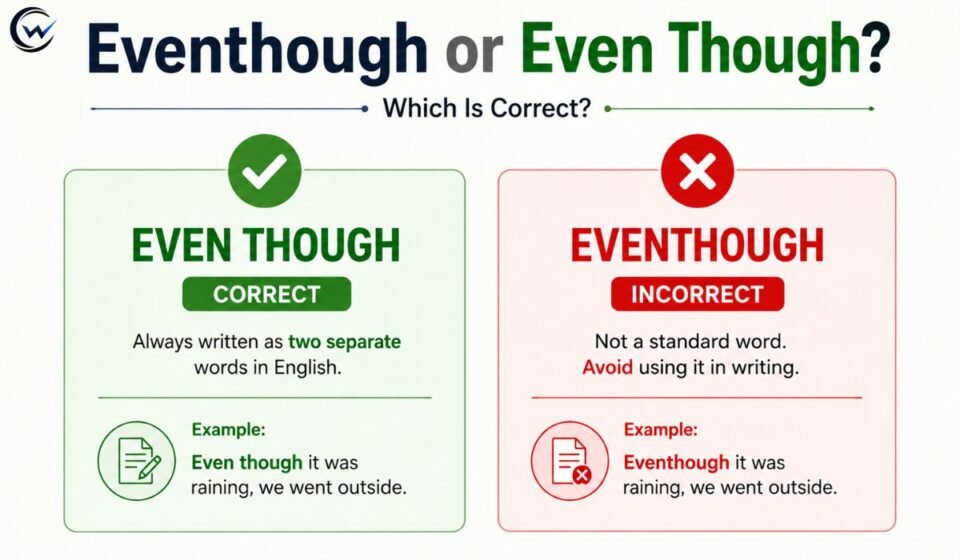
Even though is the correct spelling. It is always written as two separate words when used as a conjunction.Eventhough is not standard English and should be avoided in formal and everyday writing.- Correct: Even though it was raining, we went outside.
- Incorrect: Eventhough it was raining, we went outside.
The easiest way to remember it is simple: even though = two words.
What Does “Even Though” Mean?
Even though is a subordinating conjunction that introduces a contrast or unexpected condition. It connects two ideas that seem surprising when placed together.
For example:
Even though I was tired, I finished my homework.
The sentence tells us that being tired could have stopped the speaker. However, the speaker finished the homework anyway. You can usually replace even though with phrases such as although or despite the fact that, depending on the sentence.
Even Though vs. Eventhough
The difference is mainly spelling, but it matters in writing.
| Form | Correct? | Meaning | Example |
| even though | Yes | Despite the fact that | Even though she was busy, she called. |
| eventhough | No | Not standard English | Eventhough she was busy, she called. |
There is no separate meaning for eventhough. It is simply a common misspelling of even though. This mistake happens because many English expressions combine into one sound during normal speech. When people hear the phrase often enough, writing it as one word can feel natural.
Why Is “Even Though” Two Words?
The phrase contains two separate words with different grammatical roles.
- Even adds emphasis to the contrast.
- Though introduces the contrasting clause.
Together, they create the meaning of “despite the fact that.”
For example:
Even though he practiced every day, he felt nervous.
The first part presents a condition that might normally produce confidence. The second part shows an unexpected result. English contains many phrases that sound connected when spoken. That does not mean they should be written as one word.
More Confusing Words Made Simple: Filed vs Filled
When Should You Use “Even Though”?
Use even though when one fact contrasts with another.
The structure is often:
Even though + condition, result
For example:
Even though the store was closing, we stayed for another minute.
You can also put the phrase after the main clause:
We stayed for another minute even though the store was closing.
Both versions are grammatically correct. The choice usually depends on what you want to emphasize.
Examples of Even Though in Everyday Writing
Here are some natural examples you might actually use:
Even though I woke up early, I was still late.
She went jogging even though it was cold outside.
Even though the movie was long, I enjoyed it.
He ordered dessert even though he was already full.
We kept walking even though the road was difficult.
Even though she studied hard, the test was challenging.
Notice the same pattern in each example. One situation creates an expectation, while the other produces an unexpected result. That contrast is what makes even though useful.
Even Though at the Beginning of a Sentence
Starting a sentence with even though is completely normal.
For example:
Even though I had little time, I helped my friend.
When the dependent clause comes first, a comma normally separates it from the main clause.
The sentence can also be reversed:
I helped my friend even though I had little time.
In this version, a comma usually isn’t needed.
This small punctuation difference is worth remembering when you’re writing longer sentences.
Even Though in Formal Writing
Even though works well in formal writing, academic writing, emails, essays, and everyday communication.
For example:
Even though the results were limited, the study provided useful information.
You don’t need to replace it with a complicated expression just to sound formal. The phrase is already standard and grammatically correct. In many cases, simple wording actually makes your point clearer.
Even Though vs. Although
Even though and although are closely related.
Both can introduce a contrast:
Even though it was expensive, I bought it.
Although it was expensive, I bought it.
The main difference is emphasis.
- Even though often sounds slightly stronger or more emphatic.
- Although can sound a little more neutral or formal.
You can usually use either one without changing the basic meaning.
Even Though vs. Despite
Even though and despite express contrast, but they follow different grammatical patterns.
Use even though before a clause containing a subject and verb:
Even though she was tired, she kept working.
Use despite before a noun, pronoun, or gerund:
Despite being tired, she kept working.
You wouldn’t normally write:
Despite she was tired, she kept working.
That structure is incorrect. This distinction can help you choose the right expression quickly.
Common Mistakes With “Even Though”
The biggest mistake is combining the two words.
❌ Eventhough
Eventhough I was tired, I went to work.
✅ Even though
Even though I was tired, I went to work.
Another common mistake involves confusing even though with even if. These phrases aren’t interchangeable in every situation. Even though usually discusses something that is true or known:
- Even though it was raining, we went hiking.
- Even if describes a possibility or hypothetical situation:
- Even if it rains, we will go hiking.
That difference can completely change the meaning.
How to Remember the Correct Spelling
Try this simple memory trick:
Even though = even + though.
Keep the two words separate. You can also remember that though is already a complete English word. There’s no standard English word spelled eventhough.
If you’re writing quickly, pause whenever the phrase comes to mind. Type even though, not eventhough. A quick mental check can prevent the mistake before you submit an email, essay, or post.
Is “Eventhough” Ever Correct?
No. Eventhough is not considered a standard English spelling. You may see it online, in social media posts, comments, or informal messages. Its appearance doesn’t make it grammatically accepted.
If you’re writing something that needs correct English, use even though. That applies to school assignments, professional emails, articles, resumes, and other polished writing.
More Confusing Words Made Simple: Shiny or Shiney
Frequently Asked Questions
Is “eventhough” one word?
No. Eventhough is a misspelling. The correct form is even though, written as two words.
Which is correct, even though or eventhough?
Even though is correct. Eventhough is not standard English.
Can I use even though at the beginning of a sentence?
Yes. For example: Even though I was tired, I finished the project.
Is even though the same as although?
They have very similar meanings. Both introduce contrast, but even though can provide slightly stronger emphasis.
What is the difference between even though and even if?
Even though normally introduces a known or actual condition. Even if introduces a possible or hypothetical condition.
Final Verdict: Even Though Is Correct
If you’re choosing between eventhough or even though, the answer is straightforward. Use even though every time. It is written as two words and introduces a contrasting idea or condition.
Eventhough is simply a common spelling mistake.
So, when you’re writing that next sentence, keep the phrase split:
Even though it was late, I kept reading.
That’s the correct form.