

You’re typing a sentence, maybe describing a new pair of shoes or a freshly washed car, and you stop halfway through the word. Is it Shiny or Shiney? Both look plausible on the page, and that little hesitation is more common than you’d think.
This guide settles the Shiny or Shiney spelling question for good. Along the way, it explains why the wrong spelling feels so convincing, how the correct word is actually spelled, and how to use it confidently without a second thought.
Quick Answer – Shiny or Shiney
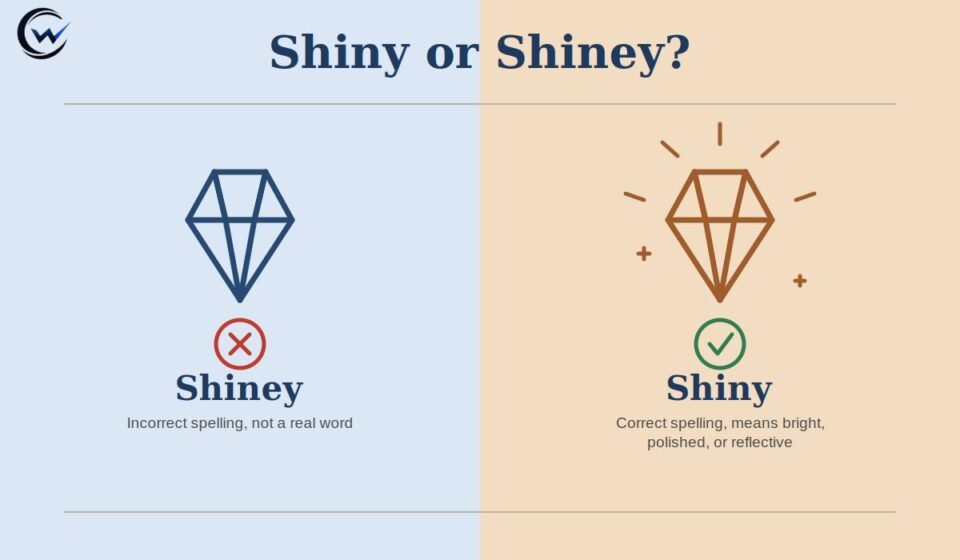
“Shiny” is correct. “Shiney” is a misspelling. That’s the short version, but it’s worth understanding why, because the reasoning is what will actually stop you from typing it wrong again.
| Word | Status | Where You’ll See It |
| shiny | Correct, standard spelling | Dictionaries, professional writing, published content |
| shiney | Incorrect, common misspelling | Casual social posts, typos, some brand names |
There’s one small exception. “Shiney” does exist as a surname, and occasionally as a stylized brand name someone picked on purpose. Outside of those specific cases, “shiny” is the only version that belongs in your writing.
What “Shiny” Means and Where It Comes From
“Shiny” is an adjective describing something bright, polished, or reflective, the kind of surface that catches light and bounces it back. A waxed car, a new coin, a freshly cleaned window, all of these are shiny.
The word traces back to the verb “shine,” which English has used for centuries to describe light being given off or reflected. Add the suffix “-y” to turn that verb into a descriptive adjective, and you get “shiny,” following the exact same pattern as “sun” becoming “sunny” or “wind” becoming “windy.” Once you see that pattern, the spelling starts to make more sense than it might have a minute ago.
Why “Shiney” Feels So Believable
Here’s the part most articles skip: the reason this mistake happens isn’t carelessness, it’s a collision with a rule that actually exists elsewhere in English.
You’ve probably learned that adding a suffix sometimes means keeping the silent “e,” like “hope” becoming “hopeful” or “like” becoming “likeable.” Your brain applies that same logic to “shine,” and “shiney” comes out looking right. The problem is that “shine” belongs to a different group of words, ones where the silent “e” gets dropped, not kept, before certain suffixes.
Add to that the fact that autocorrect doesn’t always flag “shiney” as wrong, and that you’ve probably scrolled past it in captions or comments more than once, and the misspelling starts to feel normal even though it never was.
The Spelling Rule That Settles It
This comes down to one consistent rule: when a word ends in a silent “e,” that “e” usually gets dropped before adding a suffix that starts with a vowel, like “-y,” “-ing,” or “-er.”
- shine + y → shiny (not shiney)
- write + ing → writing (not writeing)
- bake + er → baker (not bakeer)
- hope + ing → hoping (not hopeing)
Notice that “shiny” isn’t some exception you have to memorize on its own. It’s following a rule that shows up constantly in English, which is exactly why learning the rule once saves you from guessing every time.
That same rule carries into related forms of the word. Comparative and superlative versions follow the standard “y to i” adjustment seen in words like “happy”:
- shiny → shinier → shiniest
- happy → happier → happiest
And the noun form, describing the quality itself, is shininess, not “shineyness” or any variation that reinserts the extra “e.”
Seeing the Word in Real Sentences
Rules are easier to trust once you see them working in context. Here’s how “shiny” shows up naturally across different kinds of writing.
In everyday conversation:
- “The car dealership polished every vehicle until it looked shiny under the showroom lights.”
- “She wore a shiny pair of heels to the office party.”
In descriptive or comparative writing:
- “New pennies are shiny, but they dull over time.”
- “This is the shiniest car on the lot.”
In business and marketing copy:
- “Our website redesign gives the homepage a cleaner, shinier look.”
- “This stainless steel finish stays shiny with minimal cleaning.”
Now compare those against the misspelled versions:
- “She wore a shiney pair of heels to the office party.” (should be shiny)
- “The floor looked so shiney after we mopped it.” (should be shiny)
Read out loud, both versions sound identical. That’s exactly why this error slips past so many writers, even careful ones. The mistake lives in spelling, not pronunciation, which means proofreading by ear won’t catch it. You have to know the rule.
More Confusing Words Made Simple: Treck or Trek
Common Mistakes Beyond the Basic Spelling
The core mix-up isn’t the only place this trips people up. It carries into related word forms too.
- Incorrect: This is the shineyest car on the lot.
- Correct: This is the shiniest car on the lot.
- Incorrect: I love how shineiness makes packaging look premium.
- Correct: I love how shininess makes packaging look premium.
- Incorrect: The floor looked so shiney after we mopped it.
- Correct: The floor looked so shiny after we mopped it.
None of these mistakes suggest a lack of understanding, they just show the “e” creeping back in wherever the writer’s instinct says it belongs. Now that you know the rule, you can catch it before it happens.
An Easy Way to Lock In the Correct Spelling
Picture the verb “shine” losing its silent “e” the moment “-y” gets added, the same way “write” loses its “e” to become “writing.” If “writeing” looks obviously wrong to you, “shiney” should start looking the same way.
Another quick trick: say “shine,” then just add “y” without touching anything else. shin-e, drop the e, add y, shiny. One motion, no extra letters.
Where This Matters Most: Professional and Business Writing
Casual typos are usually forgiven, but “shiney” in professional content reads differently. It can come across as careless, especially in industries where describing finish and appearance is part of the sales pitch, think jewelry, automotive, beauty, and home goods.
A few real-world examples of where the correct spelling carries weight:
- Product descriptions: “This stainless steel finish stays shiny with minimal cleaning.”
- Retail and e-commerce copy: “Our shiny gift wrap options are perfect for the holidays.”
- Customer service emails: “Thanks for your feedback. We’re glad the shiny new packaging caught your eye.”
- Website copy: “Browse our shiniest jewelry collection for the season.”
In each case, the word is doing real work, describing exactly what makes a product appealing. Getting the spelling wrong doesn’t change the meaning much, but it does chip away at how polished the writing looks, which matters more in customer-facing content than almost anywhere else.
Common Phrases Built Around “Shiny”
A few expressions use “shiny” so often that they’re worth knowing on their own.
- “Shiny object syndrome” describes getting distracted by whatever’s new or exciting instead of staying focused on a plan. It shows up constantly in marketing and business conversations.
- “Shiny new toy” refers to something new that grabs attention, sometimes at the expense of something more practical or established.
- “Bright and shiny” is a casual way to describe something that looks brand new or freshly maintained.
Every one of these relies on the standard spelling. None of them work with “shiney,” which is a small but useful reminder of just how consistently the correct form shows up once you start noticing it.
FAQ’s
Is “shiney” a real word?
No, “shiney” is not a recognized word in standard English dictionaries. It’s a common misspelling of “shiny,” the correct adjective for something bright or reflective.
Why does “shiney” look correct to so many people?
It looks correct because English keeps a silent “e” before certain suffixes in other words, so writers assume the same rule applies here, even though “shine” drops its “e” before “-y.”
What are the comparative and superlative forms of “shiny”?
The comparative form is “shinier” and the superlative form is “shiniest,” both following the same “y to i” pattern used in words like “happy” and “happier.”
Is “Shiney” ever correct as a name?
Yes, “Shiney” can be correct as a surname or as a stylized brand name chosen intentionally. It’s only incorrect when used as the adjective meaning bright or reflective.
What’s the noun form of “shiny”?
The noun form is “shininess,” describing the quality of being shiny, and it follows the same spelling pattern as the comparative and superlative forms.
Final Verdict
“Shiny” is the correct spelling in modern American English, and it earns that spot honestly, by following a spelling rule that shows up across dozens of other common words. “Shiney” isn’t a lesser-used variant or an acceptable alternative, it’s simply a misspelling that happens to look plausible because of how English treats silent “e” endings elsewhere.
Once you connect “shiny” back to “shine” and remember that the “e” drops before “-y,” the correct spelling stops requiring any guesswork, in a text message, a product description, or anything in between.