

You typed the email, hit send, then froze. Did you just say you “filled” a report instead of “filed” it? Small mix up, but it makes you look sloppy in front of a boss or client.
The confusion between filed vs filled trips up even sharp writers, because the words look almost like twins on paper.
Good news though. Once you see the actual difference, you’ll never second guess yourself again. Let’s clear it up in the next few lines.
Quick Answer: Filed vs Filled
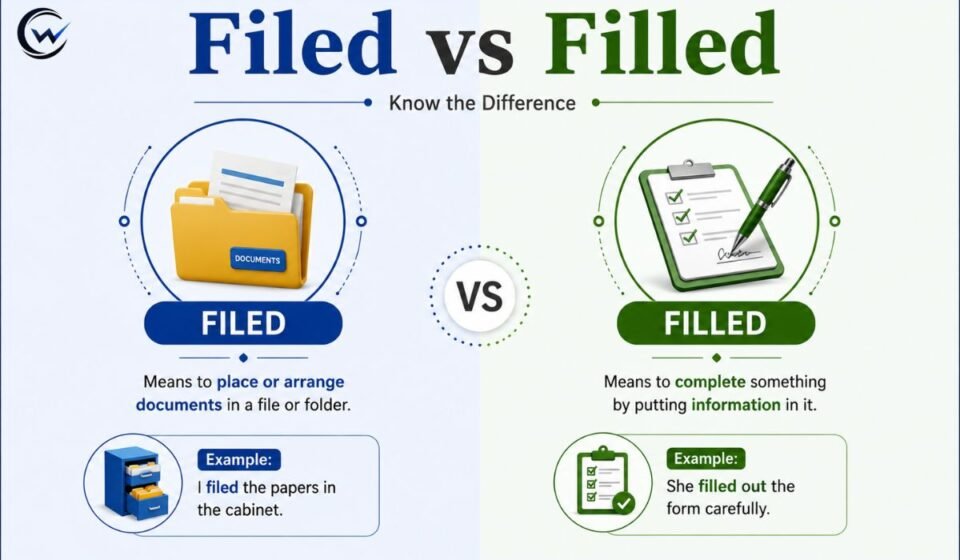
Filed means you submitted, organized, or recorded something, usually a document. Think taxes, reports, or paperwork sorted into folders.
Filled means you made something full or completed a space, like filling a cup, a job opening, or a prescription.
If you’re talking about paperwork or legal action, use filed. If you’re talking about capacity or completion, use filled.
Filed vs Filled at a Glance
| Word | Meaning | Common Use | Example |
| Filed | Submitted or organized documents | Legal, tax, admin work | She filed the lawsuit on Monday. |
| Filled | Made full or completed | Objects, jobs, prescriptions | He filled the tank before the trip. |
Short version: filed is about paperwork and records. Filled is about volume and completion.
What “Filed” Actually Means
Filed is the past tense of “file.” When you file something, you submit it officially or place it into a system for record keeping. This word shows up constantly in legal, financial, and administrative contexts. You file taxes. You file a police report. You file paperwork with the county clerk.
There’s also a physical sense. Old school offices had literal filing cabinets, and clerks filed documents into folders by category. That image is where the word gets most of its weight even today.
Filed always connects to documentation, submission, or record management. If there’s a form, a claim, or an official process involved, filed is your word.
More Confusing Words Made Simple: Signer or Signor
What “Filled” Actually Means
Filled is the past tense of “fill.” It means something became full, complete, or occupied.
You fill a glass with water. A dentist fills a cavity. A store fills an order. A company fills an open position. The core idea never changes: empty space becomes full space, or a requirement gets satisfied.
Filled works across almost every physical and metaphorical context you can think of. Rooms, tanks, jobs, prescriptions, silence, even feelings. If capacity or completion is the theme, filled is correct.
Where These Two Words Came From
Both words trace back to old sources, but they went in different directions.
File comes from the French word “filer,” meaning to string documents together on a thread or wire, which is literally how old offices organized paperwork centuries ago. That thread and string imagery eventually shifted into the modern sense of submitting or organizing records.
Fill comes from Old English “fyllan,” related to “full.” It’s a much older, more basic word tied directly to the concept of completeness.
So one word grew out of a physical office tool. The other grew out of a fundamental concept about space and capacity. That’s part of why they function so differently despite looking similar on paper.
Filed in Real Sentences
Seeing these words in context makes the difference click faster than any definition.
She filed her tax return three days before the deadline.
The company filed for bankruptcy after months of declining sales.
He filed a complaint with HR about the scheduling issue.
Reporters filed their stories minutes after the press conference ended.
Notice the pattern. Every single example involves submitting something official, whether it’s paperwork, a claim, or written content headed somewhere specific.
Filled in Real Sentences
Now compare that to how filled actually behaves in a sentence.
The barista filled my cup right to the brim.
They finally filled the marketing position after six weeks of interviews.
The pharmacist filled the prescription in under ten minutes.
Her essay was filled with vivid, specific details.
Again, a clear pattern. Something goes from empty or incomplete to full or done. No documents, no legal action, no submission process required.
The Fastest Way to Remember Which One to Use
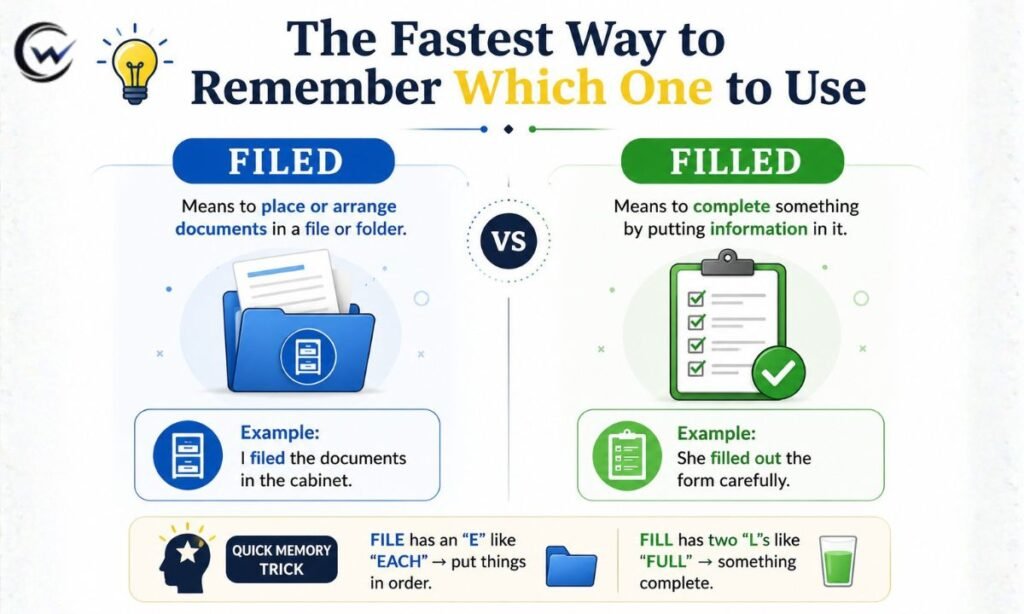
Here’s a trick that works almost every time.
Ask yourself: is this about paperwork or process? Use filed.
Ask yourself: is this about space, capacity, or completion? Use filled.
Another quick test: try swapping in “submitted.” If “submitted” works in the sentence, filed is your word. If “submitted” sounds ridiculous, you need filled.
“She submitted her tax return” works fine. “She submitted my cup with water” sounds absurd. That instantly tells you which word belongs.
Common Mistakes People Make
The mix ups usually follow a predictable pattern, and once you see it, you’ll notice it everywhere.
Mistake 1: Writing “she filled a police report” instead of “filed.” Reports get filed, not filled, since there’s no capacity involved.
Mistake 2: Writing “he filed the tank with gas” instead of “filled.” Tanks get filled. Nobody submits a tank to an office.
Mistake 3: Confusing the sound similarity in fast speech and typing the wrong word on autopilot, especially in emails written quickly.
Mistake 4: Assuming both words relate to paperwork because filing cabinets involve folders being “filled” with documents. That’s a trap. The action of organizing those documents is filing, not filling.
If you catch yourself unsure, run the submitted test from the last section. It solves this instantly.
Filed vs Filled in Professional and Legal Writing
This distinction matters even more in professional settings where precision counts.
In legal writing, filed has a specific procedural meaning. A motion is filed with a court. A patent is filed with an office. Getting this wrong in a legal document isn’t just a grammar slip, it can create real confusion about what action actually took place.
In business writing, filled often relates to staffing, inventory, or operations. A role gets filled. An order gets filled. Mixing these up in a report can make it sound like paperwork happened when really a job opening closed, or vice versa.
Clients and readers notice these errors more than you’d think, especially in industries where documentation carries legal weight.
Filed vs Filled in Everyday Conversation
Outside of office settings, filled shows up far more often than filed simply because daily life involves a lot more filling than filing.
You fill your car with gas. You fill your plate at dinner. Your schedule gets filled with meetings. Your heart gets filled with dread before a big presentation.
Filed sticks mostly to formal or administrative moments. Unless you’re talking about taxes, reports, or legal action, you probably won’t need it much in casual conversation.
A Simple Memory Trick That Actually Works
Picture a filing cabinet. Documents get filed away in folders, one by one, in an organized system.
Now picture a glass of water. It gets filled up until there’s no room left.
One image involves organization and process. The other involves volume and space. Hold onto those two pictures and you’ll rarely mix these words up again.
More Confusing Words Made Simple: Long Term or Long-Term
Frequently Asked Questions
Is it “filed” or “filled” for taxes?
It’s filed. You file your taxes with the IRS, meaning you submit your tax return through the official process before the deadline.
Is it “filed” or “filled” for a prescription?
It’s filled. A pharmacist fills your prescription by preparing and giving you the medication, completing the order.
Can “filled” ever mean the same thing as “filed”?
No, they serve different purposes. Filled relates to completion or capacity, while filed relates strictly to submitting or organizing documents.
Is it “filed a complaint” or “filled a complaint”?
It’s filed a complaint. Complaints, like other official reports, get submitted through a formal process, so filed is correct here.
Why do people confuse filed and filled so often?
The words look nearly identical and sound similar in fast speech, especially since both are common past tense verbs used constantly in daily and professional writing.
Bottom Line
Filed and filled aren’t actually complicated once you separate the two ideas behind them.
- Filed means you submitted or organized something official.
- Filled means something reached capacity or got completed.
Next time you’re stuck between the two, just ask what’s actually happening in your sentence. Are you dealing with paperwork, or are you dealing with space getting used up? That single question will point you to the right word almost every time.