

You typed out a sentence, then paused. Should it be mine as well, might as well, or mind as well? All three sound almost identical when spoken fast, which is exactly why this mix up happens so often. Only one version is grammatically correct, and the other two are simply spelling errors based on how the phrase gets slurred in casual speech.
Once you know which word actually belongs in this idiom, you’ll never second guess it again. Here’s the clear answer, plus why the other two spellings keep tripping people up.
Quick Answer
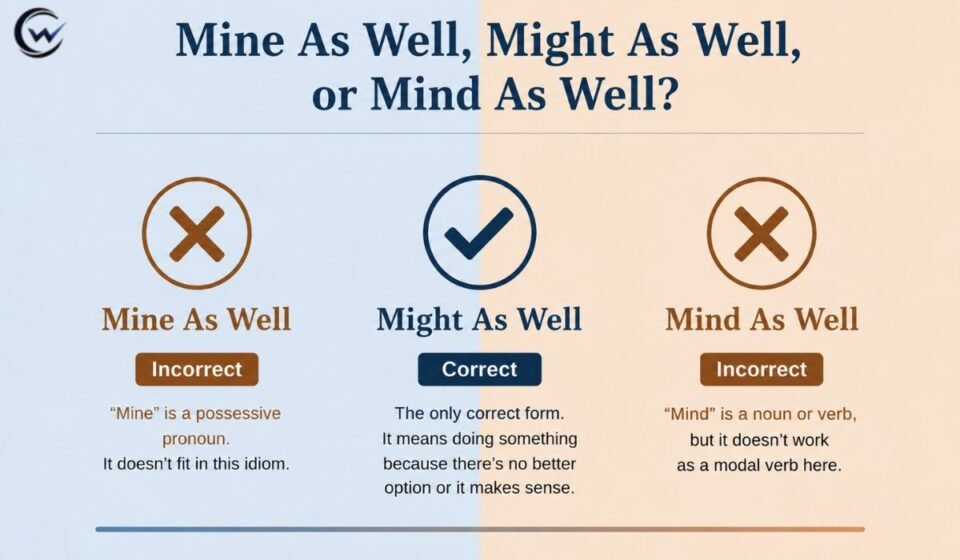
“Might as well” is the only correct form. It means doing something because there’s no better option, or because the situation makes it a reasonable choice. “Mine as well” and “mind as well” are both incorrect spellings based on how the phrase sounds when spoken quickly.
Why This Phrase Confuses So Many People
Say “might as well” out loud in a normal, relaxed sentence. Notice how the “t” almost disappears? It comes out sounding closer to “mite as well” or even “mine as well” when you’re talking fast.
This is a classic case of eye dialect catching up with ear dialect. Your ears hear one thing, your brain tries to spell what it heard, and the result is a phrase that looks nothing like the original words.
Mind as well shows up for a different reason. Some people genuinely believe the phrase involves the word “mind,” as in using your mind to decide something. It’s a logical guess, but it’s not how the expression actually works.
What “Might As Well” Actually Means
“Might as well” is an idiom built from three real words: might, as, and well. Together, they express that doing something is a reasonable choice, often because there’s little reason not to, or because an alternative isn’t really better.
You use it when:
- There’s no strong reason to avoid an action
- The outcome will likely be similar either way
- You’re making the best of a situation
Example: “The store is already closed, so we might as well head home.”
Example: “Since you’re already up, you might as well grab the mail.”
Notice the tone. It’s not enthusiastic. It’s practical, sometimes a little resigned, like you’re settling on the path of least resistance.
Why “Mine As Well” Is Wrong
“Mine as well” is usually a mistake for “might as well.” The confusion happens because might as well can sound like “mine as well” when spoken quickly. In the idiom, might works as a modal verb, while mine is a possessive pronoun that shows ownership. So, “I mine as well go” is grammatically incorrect.
However, “mine as well” can be correct in a different context when mine expresses possession. For example, if you’re comparing two things that belong to you, the phrase may make sense. The key is understanding the meaning: use might as well for the common expression meaning “it would be reasonable to do so,” and use mine only when referring to ownership.
Why “Mind As Well” Is Also Wrong
“Mind” carries real meaning as both a noun and a verb. You can “mind your manners” or use “mind” to refer to your brain. But swap it into this idiom and the sentence loses its grammatical footing.
“I mind as well stay home” doesn’t parse correctly in standard English. “Mind” isn’t a modal verb like “might,” “should,” or “could,” so it can’t do the job this phrase needs.
Some regional dialects and casual speech patterns lean into “mind as well,” which is part of why the error spreads. Hearing it from others reinforces the mistake.
More Confusing Words Made Simple: Jobsite or Job Site
Comparison Table
| Phrase | Correct? | Why |
| Might as well | Yes | Standard idiom using the modal verb “might” |
| Mine as well | No | “Mine” is a possessive pronoun, not a modal verb |
| Mind as well | No | “Mind” doesn’t function as a modal verb here |
The Grammar Behind “Might”
“Might” is a modal verb, part of the same family as “could,” “should,” “would,” and “may.” Modal verbs express possibility, permission, or suggestion rather than a direct action.
That’s exactly what “might as well” is doing. It’s suggesting an action is reasonably possible and worth doing, given the circumstances. This is the grammatical backbone that makes “might as well” the only version that actually functions as a sentence.
How to Remember the Correct Spelling
If you tend to slip into “mine as well” or “mind as well,” try connecting the phrase back to other common “might” expressions you already know.
Think of:
- “I might go to the party.”
- “It might rain later.”
- “You might as well try.”
All three use the same modal verb. If “might go” and “might rain” look right to you, “might as well” should follow the same pattern.
Another trick: replace “might” with “could” in your head. “I could as well go” sounds strange but confirms you’re dealing with a modal verb slot, not a possessive pronoun or a noun about your brain.
Common Sentences Using “Might As Well”
Seeing the phrase in different contexts helps cement the correct usage.
Casual conversation: “We’re already stuck in traffic, so we might as well turn on some music.”
Workplace context: “Since the meeting got pushed back an hour, I might as well finish this report.”
Decision making: “You’ve already paid for the ticket. You might as well go and enjoy the show.”
Slightly reluctant tone: “Nobody else wants to do it, so I might as well handle it myself.”
Each example shows the same underlying logic: given the situation, this action makes sense.
Might As Well vs. Similar Phrases
It helps to see how “might as well” compares to phrases people sometimes confuse it with.
Might as well vs. should: “Should” implies a stronger recommendation or obligation. “Might as well” is more relaxed and situational.
Might as well vs. why not: “Why not” is more of a rhetorical question inviting action. “Might as well” is a statement, not a question.
Might as well vs. may as well: This one’s tricky because “may as well” is also grammatically correct. Both “might” and “may” are modal verbs, and “may as well” carries nearly the same meaning. It’s slightly more formal and less commonly used in everyday American speech, but you’ll see it in writing.
Is “May As Well” the Same Thing?
Yes, mostly. “May as well” and “might as well” are interchangeable in almost every context. The difference is subtle and mostly about tone.
“May as well” can sound a touch more formal or old fashioned to American ears. “Might as well” is the more common choice in casual writing, texting, and everyday conversation across the US.
Neither one is more grammatically correct than the other. Pick whichever fits the tone of what you’re writing.
Common Mistakes to Avoid
Beyond the mine and mind confusion, a few other errors show up around this phrase.
Dropping “as”: Writing “might well go” instead of “might as well go” removes a necessary word and changes the rhythm of the sentence.
Overusing it in formal writing: “Might as well” is casual. In a cover letter or business proposal, swap it for something like “it would be practical to” or “there’s little reason not to.”
Autocorrect errors: Some phone keyboards will “correct” might as well into odd variations if you’re typing fast. Always glance back before hitting send.
More Confusing Words Made Simple: Targetted or Targeted
FAQs
Is “mine as well” ever correct?
No, it’s always wrong. “Mine” is a possessive pronoun, so it can’t work as a modal verb here.
Is “mind as well” grammatically valid?
No, it isn’t. “Mind” doesn’t function as a modal verb, so the phrase breaks down grammatically when written that way.
Does “might as well” mean the same as “may as well”?
Yes, nearly identical. Both are correct, though “might as well” sounds more natural in everyday American conversation and texting.
Why do people confuse “might” with “mine” or “mind”?
Casual speech softens the “t” sound, making “might as well” blend together and sound like the other two spellings.
Is “might as well” appropriate for formal writing?
Not really. It’s casual phrasing, so formal writing usually calls for alternatives like “it would be practical to.”
Final Thoughts
Only one version of this phrase holds up under actual grammar rules: might as well. Both “mine as well” and “mind as well” come from mishearing a phrase that gets slurred together in fast, casual speech.
Once you connect “might” to the other modal verbs you already use correctly, like “could” and “should,” the right spelling tends to stick for good.