
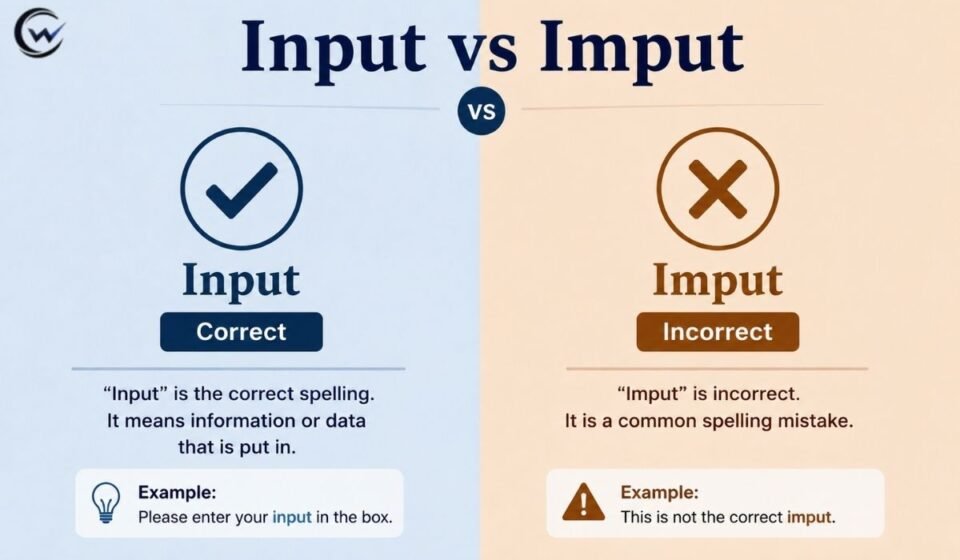

You typed a word into a search bar. Then you second guessed yourself. Is it “input” or “imput“? Autocorrect didn’t flag it, so now you’re stuck staring at the screen wondering if you’ve been writing it wrong your whole life.
Good news: this one has a clean, simple answer, and it takes about ten seconds to clear up for good.
Quick Answer: Input vs Imput
Input is the only correct spelling. Imput is not a word in standard English, in any dictionary, or in any professional writing context.
People write “imput” because it sounds like it could follow the same pattern as words like “impute” or “important.” It doesn’t. If you remember one thing from this article, remember this: input, never imput.
| Input | Imput | |
| Correct spelling | Yes | No |
| Found in dictionaries | Yes | No |
| Common typo | N/A | Yes |
| Safe to use in writing | Yes | Never |
Why “Imput” Feels Like It Should Be Right
Nobody invents a typo out of nowhere. “Imput” sticks around because English has plenty of words that follow an “im” pattern before certain letters. Think “impute,” “impose,” or “impact.” Your brain sees “input” starting with a vowel sound plus a consonant, and it quietly nudges you toward a spelling that feels more familiar.
There’s also the pronunciation angle. Say “input” out loud fast enough and the “n” can blur toward an “m” sound, especially if you’re typing quickly or texting. That small slip in speech turns into a small slip on the page.
What Input Actually Means
“Input” is a noun and a verb with a few related meanings, all built around the idea of putting something into a system, process, or conversation.
- As a noun, input refers to information, energy, or material fed into something. You give input on a project. A computer receives input from a keyboard. A recipe needs certain inputs like flour and eggs.
- As a verb, to input something means to enter or feed it into a system. You input data into a spreadsheet. You input your password on a login screen.
Both uses show up constantly in tech, business, and everyday conversation, which is exactly why getting the spelling right matters so much.
The Origin of the Word Input
“Input” is a compound word built from “in” and “put,” and it’s been part of English since at least the 18th century in its earliest technical sense, referring to money or resources put into a business venture.
The word picked up its modern computing meaning in the mid-20th century, once engineers needed a term for data fed into a machine. That’s the sense most people know today, but the underlying logic hasn’t changed. Something goes “in,” and it gets “put” there. Simple as that.
“Imput” never had a parallel history. It’s not an old variant, a regional spelling, or a shortened form of anything. It’s a straightforward misspelling that gained traction because it sounds plausible, not because it has any linguistic roots.
Compare that to a word like “impute,” which really does start with “im.” That one comes from Latin “imputare,” meaning to charge or attribute something to someone. It’s a completely different word with a completely different history, and the only thing it shares with “input” is a similar sound. That overlap is probably the biggest reason the typo persists.
How to Use Input Correctly in a Sentence
Once you know the spelling, using it correctly is easy. Here are a few natural examples across different contexts.
- Everyday conversation: “I’d love your input before I send this email.”
- Academic writing: “The study measured how sensory input affects reaction time.”
- Professional or business writing: “Please input your billing details on the next page.”
- Technical or computing context: “The device accepts audio input through a USB port.”
Notice how the word barely changes shape across these examples. Whether it’s casual or formal, the spelling stays exactly the same. That consistency is one of the easiest ways to catch a mistake if you’re ever unsure.
Input as a Noun vs Input as a Verb
The spelling doesn’t change between the two forms, but the grammar does. As a noun, input is typically uncountable, so you wouldn’t usually say “an input” unless you’re referring to a specific technical component, like an input on a mixing board.
As a verb, input follows regular conjugation in most modern usage: input, inputs, inputting. Some older or more formal texts use “inputted,” and both “input” and “inputted” are accepted as past tense forms, though “input” is more common in tech and business writing today.
Common Mistakes Beyond “Imput”
“Imput” isn’t the only stumble people make with this word. A few related errors show up just as often.
Inpu or inputt, usually from a rushed typo where a letter gets dropped or doubled.
In put as two separate words, which changes the meaning entirely and reads as awkward or incorrect in most contexts.
Confusing “input” with “output” in casual speech, especially when talking about data or feedback loops, where the two get mixed up under pressure.
None of these are as common as “imput,” but they’re worth knowing so you can catch them in your own writing before they slip through.
Why This Mistake Happens So Often in Typing
Keyboards make this error easier than you’d think. The “n” and “m” keys sit right next to each other, so a fast typist can hit the wrong one without noticing. Add autocorrect, which sometimes lets non-dictionary words slide if they’re close enough to a recognized pattern, and “imput” can survive a full paragraph without getting flagged.
Voice-to-text tools add another layer. Since “input” and “imput” sound nearly identical when spoken quickly, dictation software occasionally transcribes the wrong one, especially in noisy environments or with certain accents.
Quick Ways to Remember the Correct Spelling
If you want a fast mental check, break the word into its two original pieces: in and put. You put something in. That’s it. There’s no “m” anywhere in either piece, so there’s no reason for one to show up in the combined word.
Another trick: if you can picture typing something into a computer, that’s your cue. Input, into, insert. All the “in” words that involve entering something keep the “n.” None of them swap it for an “m.”
Input in Technology and Everyday Devices
Beyond writing and business, “input” shows up constantly in the physical world. Your TV has HDMI inputs. Your phone accepts touch input. A thermostat reads temperature input from a sensor before adjusting the heat.
This widespread use is part of why the correct spelling matters so much. Get it wrong in a manual, a form, or a product description, and it can read as unpolished or even confusing to someone trying to follow instructions.
It also matters for search and accessibility. Screen readers, voice assistants, and search engines all rely on standard spelling to interpret text correctly. A misspelled word like “imput” can throw off how a page ranks or how well it reads aloud, which is a small but real cost for something that’s this easy to fix.
Input in Resumes, Forms, and Professional Documents

Job applications, feedback forms, and workplace emails are some of the most common places this word shows up, and also where a typo stands out the most. A hiring manager reading “I provided imput on three major projects” notices the error before the accomplishment.
Spell check catches most instances, but not all. Older software, quick messaging apps, and platforms with limited dictionaries can let “imput” slide through unflagged. A quick manual scan before hitting submit is still worth the ten seconds it takes.
More Confusing Words Made Simple: Tear or Tare
FAQs
Is “imput” ever an accepted alternative spelling of input?
No. “Imput” doesn’t appear in any major dictionary and isn’t recognized as a variant, regional spelling, or informal form of input.
Why do so many people misspell input as imput?
It likely comes from the “im” pattern in similar words like impute or impact, combined with how easily “n” and “m” blend in quick speech or typing.
Is “input” one word or two words?
Input is always one word. Writing it as “in put” is incorrect and changes the meaning of the sentence.
What’s the past tense of input?
Both “input” and “inputted” are accepted as past tense forms, though “input” is more commonly used in modern technical and business writing.
Can input be used as both a noun and a verb?
Yes. As a noun it refers to information or material entered into something, and as a verb it means the act of entering that information.
The Bottom Line
Input is the word. Imput isn’t, and it never has been. The mix-up comes down to how the word sounds when you’re typing fast or talking quickly, not anything rooted in actual English spelling rules.
Next time your fingers hesitate between the two, just remember: you put something in, and that’s exactly how the word is built.