
You typed it out, stared at it for a second too long, and now you’re not sure if it’s “targetted” or “targeted.” You’re not alone.
This is one of the most common double letter mix-ups in English, and autocorrect doesn’t always save you.
Here’s the answer, plus everything you need to spell it right every time.
Quick Answer: Targeted Is Correct
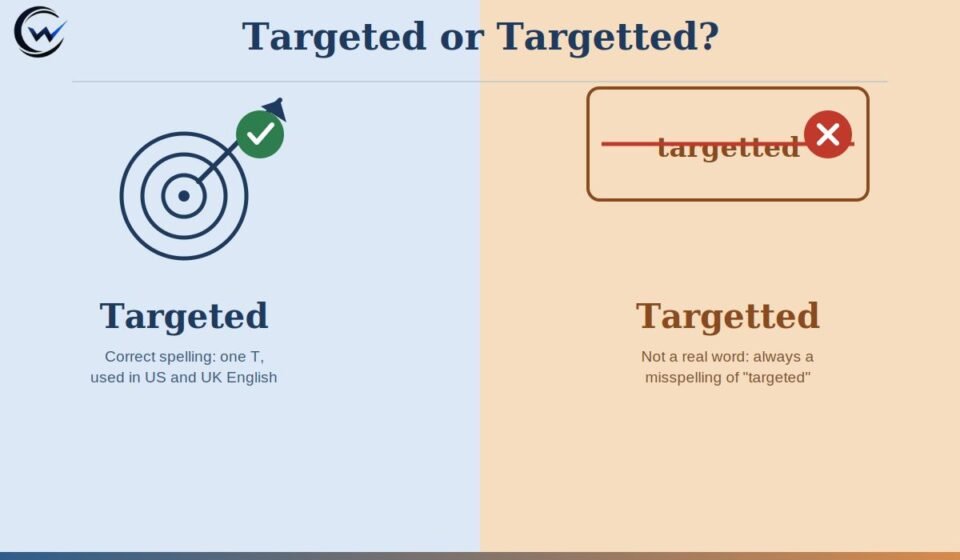
Targeted is the correct spelling in both American and British English. Targetted with two T's is a common misspelling and should be avoided in all formal and professional writing. The rule comes down to syllable stress: since “target” ends in an unstressed syllable, you don’t double the final consonant when adding “ed.”
Targetted vs Targeted: Quick Comparison Table
| Spelling | Correct? | Usage |
| Targeted | Yes | Standard spelling in US and UK English |
| Targetted | No | Common misspelling, avoid in writing |
| Target (base word) | Yes | Root verb and noun |
| Targeting | Yes | Present participle, one T |
Why People Get This Wrong
The confusion makes sense once you see the pattern. English has plenty of words where you double the last consonant before adding “ed,” like “stopped” or “planned.” Your brain sees “target” and wants to apply the same rule.
But “target” doesn’t follow that pattern. It’s a two syllable word, and the stress falls on the first syllable: TAR-get, not tar-GET. That single detail changes everything.
More Confusing Words Made Simple: Juxtaposition vs Oxymoron
The Simple Spelling Rule Behind “Targeted”
Here’s the actual grammar rule, stripped of jargon. When a word ends in a single consonant after a single vowel, you only double that consonant before adding “ed” or “ing” if the stress falls on the final syllable.
Think of “permit” (per-MIT), which becomes “permitted.” Compare that to “target” (TAR-get), which stays “targeted.” Same structure on paper, totally different outcome because of where the emphasis lands.
This rule also explains other words people misspell the same way, like “marketed,” “budgeted,” and “focused.” None of these double the final letter.
Etymology: Where “Target” Came From
“Target” traces back to the Old French word “targe,” meaning a small shield. By the 1300s, English speakers had adopted it to describe a round shield used in combat.
Centuries later, the word shifted meaning entirely. By the 1700s, “target” started referring to something you aim at, like a shooting range marker. That’s the meaning that stuck, and it’s why we now use “targeted” for anything aimed with intention, from arrows to ad campaigns.
How to Use “Targeted” in a Sentence
“Targeted” works as both a verb and an adjective, which is part of why people run into it so often.
- As a verb, it describes an action already completed. Example: “The company targeted young professionals with its new campaign.”
- As an adjective, it describes something specific and intentional. Example: “We ran a targeted ad campaign for the launch.”
Both uses follow the same single T spelling. There’s no version of this word, in any context, that takes two T’s.
Targeted Marketing, Ads, and Business Use
If you work in marketing, you’ll see “targeted” constantly. Targeted advertising means ads shown to a specific audience based on interests, behavior, or demographics. Targeted marketing means the entire strategy is built around a defined group rather than a general audience.
This is one of the biggest reasons the misspelling “targetted” shows up so often online. People are typing fast in ad platforms, spreadsheets, and campaign briefs, and the double T slips in without anyone catching it.
British English vs American English: Any Difference?
Here’s some good news. Unlike words such as “colour” versus “color,” there’s no regional split here. Targeted is the accepted spelling in both American and British English.
Some British dictionaries do list “targetted” as a rare variant, but it’s not standard and it’s not recommended. If you’re writing for a global audience, stick with “targeted” every time.
Common Mistakes to Avoid
The double T isn’t the only slip up people make with this word. Here are a few others worth knowing.
Mistake 1: Writing “targetted” in professional emails or reports. This is the most frequent error and it’s an easy one for editors to catch.
Mistake 2: Confusing “targeting” with “targetting.” Same rule applies here. It’s one T, always.
Mistake 3: Using “target” as a plural noun incorrectly, like “targets” when you mean a single goal. This isn’t a spelling issue, but it trips up the same writers who struggle with the “ed” form.
Mistake 4: Assuming spell check will always catch it. Some browser extensions and older software still flag “targeted” as wrong. Trust the grammar rule, not the red squiggly line.
Why This Spelling Trips Up Even Experienced Writers
It’s not a lack of skill. It’s pattern matching. Your brain has memorized dozens of words where doubling the consonant is correct, so it applies that shortcut here too.
The fix isn’t memorizing every exception. It’s remembering one thing: check where the stress falls. First syllable stress means no doubling. That’s it.
Quick Memory Trick to Never Misspell It Again
Try this. Say the word “target” as two clean syllables: TAR and get. Notice how the emphasis lands hard on “TAR” and softens on “get”?
That soft ending is your signal. Soft, unstressed endings don’t get doubled letters. Lock that pattern in and you’ll spell “targeted,” “marketed,” and “budgeted” correctly without a second thought.
More Confusing Words Made Simple: Writing or Writting
Real World Examples of “Targeted” in Use
Seeing the word in context helps it stick. Here are a few natural examples across different settings.
- News: “The city launched a targeted cleanup effort in three neighborhoods.”
- Business: “Our targeted outreach increased signups by 40 percent.”
- Everyday speech: “That comment felt pretty targeted, not gonna lie.”
Notice how the spelling never changes, no matter the tone or setting. One T, every time.
FAQ
Is targetted a word?
No, “targetted” is not a recognized word in standard English. It’s a common misspelling of “targeted,” which is the only correct form used in dictionaries and professional writing today.
Why is it targeted and not targetted?
Because “target” has stress on its first syllable, English spelling rules don’t require doubling the final consonant before adding “ed,” unlike words with final syllable stress.
Is it targeting or targetting?
“Targeting” is correct, with just one T. The same stress based spelling rule applies here as it does with “targeted,” so no doubling is needed.
Does British English spell it differently?
No, British English also uses “targeted” as the standard spelling. Some dictionaries list “targetted” as a rare variant, but it’s not considered correct usage anywhere.
What’s an easy way to remember the correct spelling?
Remember that “target” stresses its first syllable, not its second. Unstressed endings skip the doubled consonant, so “targeted” only ever needs one T.
Bottom Line
There you go. Targeted wins, every time, no debate. The mix-up happens because “target” looks like it should double its final letter, but the stress sits on “TAR,” not “get,” so the rule never applies.
British and American English agree here too, which is rare for this kind of question. Say the word slowly next time you write it. Feel where the emphasis lands. That one habit fixes the spelling permanently, along with cousins like “marketed” and “budgeted.”