
You’re writing a sentence. You need to connect two ideas. And now you’re stuck staring at the screen, wondering if you need “and” or “or.” It happens more than you’d think, especially in legal documents, instructions, and even casual texts where one wrong word changes the entire meaning.
Getting “and vs or” wrong can turn a simple requirement into a confusing mess. The good news is the rule is a lot simpler than it feels.
Quick Answer: And vs Or in One Sentence
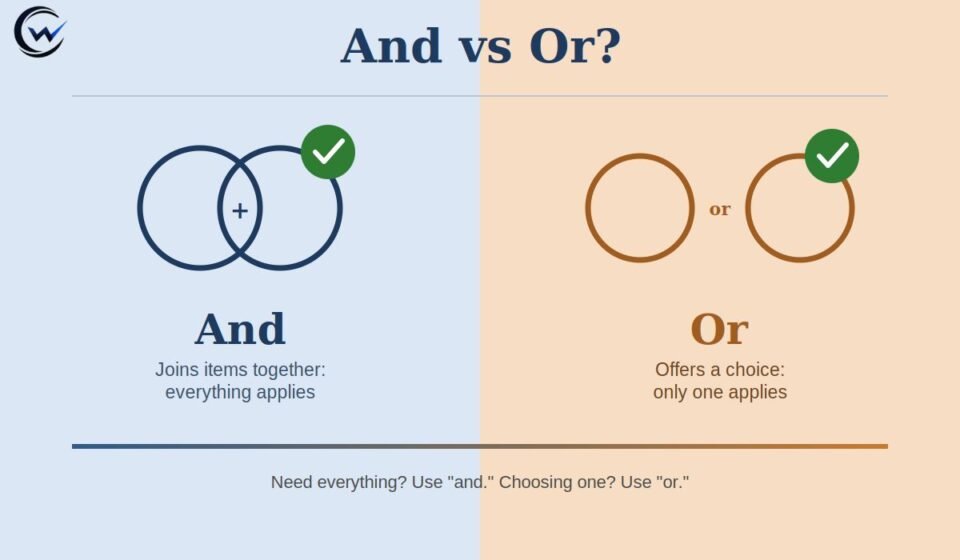
“And” adds items together, meaning all of them apply. “Or” presents a choice, meaning only one (or some, but not necessarily all) applies. If you need everything on the list, use “and.” If you’re choosing between options, use “or.”
That’s it. That’s the whole rule. Everything below just shows you how it plays out in real sentences.
And vs Or Comparison Table
| Feature | And | Or |
| Function | Joins items, all apply | Presents options, one applies |
| Logic type | Conjunctive (addition) | Disjunctive (choice) |
| Example | Bring a pen and paper | Bring a pen or paper |
| Meaning | You need both | You need either one |
| Common use | Lists, requirements, instructions | Choices, alternatives, conditions |
What “And” Actually Means
“And” is a coordinating conjunction that links words, phrases, or clauses so they work together as a single unit. When you use “and,” you’re telling the reader every item listed is included.
Say “I ordered coffee and tea.” Both drinks showed up. Nothing got left off the table.
This word shows up constantly in instructions and requirements. “Fill out the form and sign at the bottom” means you do both steps. Skip one, and the task isn’t finished.
What “Or” Actually Means
“Or” is also a coordinating conjunction, but it works the opposite way. It separates options instead of combining them, and it signals that picking one satisfies the condition.
“I’ll have coffee or tea” means you’re choosing one drink, not ordering both. The waiter isn’t bringing two cups.
Legal and technical writing lean on “or” heavily because precision matters. “Submit a passport or driver’s license” tells you exactly one document will do. You don’t need a stack of both.
More Confusing Words Made Simple: Themself or Themselves
Where “And vs Or” Gets Confusing
Here’s where things get messy. English lets you use “and/or” together, and plenty of people use “or” when they technically mean “and,” or vice versa.
Take this sentence: “Employees must wear a badge or ID card.” Does that mean either one works? Or does the company actually want both? Context has to fill in the gap, and that’s exactly why sloppy word choice creates real problems in contracts and policies.
Another tricky spot is inclusive versus exclusive “or.” In everyday speech, “or” often means you can pick one or the other, but not usually both. In logic and math, “or” is inclusive by default, meaning either option, or both, can be true. That mismatch between casual English and formal logic causes a lot of confusion.
Etymology and Origin
Both words trace back to Old English. “And” comes from the Old English “and” or “ond,” which itself descends from Proto-Germanic roots meaning to join or add. It’s been doing the same job of connecting things for well over a thousand years.
“Or” developed from the Old English “oþþe,” which shortened over time into “or” by the Middle English period. Its core function, offering alternatives, has stayed consistent the entire way through.
Neither word has changed jobs much since medieval England. They’re some of the most stable, high-frequency words in the language, which is part of why getting them wrong stands out so much to readers.
And vs Or in Everyday Sentences
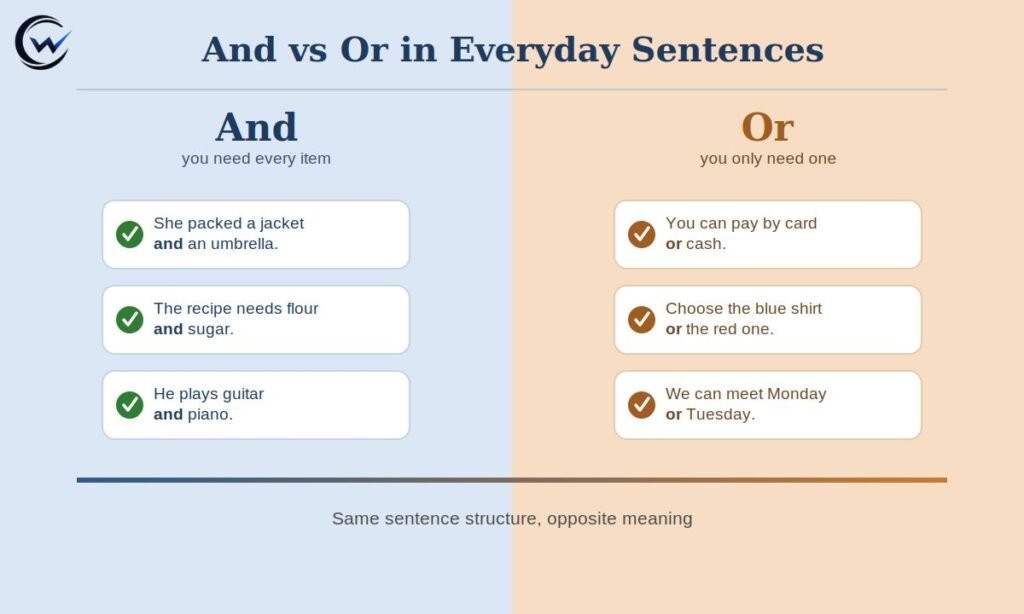
Let’s look at real examples side by side so the difference sticks.
Using “and”:
- She packed a jacket and an umbrella.
- The recipe needs flour and sugar.
- He plays guitar and piano.
Each sentence needs every item mentioned. Leave one out, and the sentence no longer describes what actually happened.
Using “or”:
- You can pay by card or cash.
- Choose the blue shirt or the red one.
- We can meet Monday or Tuesday.
Each sentence only needs one option chosen. Picking both isn’t wrong in some cases, but the sentence itself only requires one.
And vs Or in Legal and Technical Writing
Contracts, terms of service, and technical manuals treat “and vs or” as a serious matter, not a grammar footnote. A single swapped word can change who owes what to whom.
“The buyer shall provide payment and documentation” requires both items before the deal closes. Swap in “or,” and the buyer could hand over just one and technically comply.
This is why legal writers sometimes use “and/or” to cover both possibilities at once, even though style guides often discourage it for regular writing. It reads clunky, but it closes loopholes.
If you’re drafting anything with real consequences, a lease, a job offer, a set of instructions with safety implications, slow down on every “and” and “or.” The stakes are higher than they look.
And vs Or in Math and Logic
In formal logic, “and” is called a conjunction, and it’s only true when every connected statement is true. “It’s raining and it’s cold” is only accurate if both conditions hold.
“Or” is called a disjunction, and it’s true if at least one connected statement is true. “It’s raining or it’s cold” holds even if just one of those is happening, and technically even if both are.
This inclusive version of “or” trips people up because everyday English usually treats “or” as exclusive. When someone says “you can have cake or ice cream,” they usually mean pick one, not both. Math doesn’t work that way unless you specify “exclusive or,” often written as XOR.
More Confusing Words Made Simple: Trailer or Trailor
Common Mistakes With And vs Or
Mistake 1: Using “or” in a list that requires everything. “Bring your ID or insurance card or proof of address” sounds like any one document works, when the actual requirement might be all three.
Mistake 2: Using “and” when only one option is needed. “Choose paper and plastic” implies you need both bags, when the intent was probably a choice between materials.
Mistake 3: Forgetting punctuation clarity in complex lists. “I invited my parents, Sarah and Jake” reads like Sarah and Jake are your parents. Adding a comma before “and” (the Oxford comma) usually clears this up.
Mistake 4: Overusing “and/or” in casual writing. It has its place in contracts, but stacking it into everyday sentences makes writing feel stiff and lawyer-ish for no reason.
How to Choose the Right Word Every Time
Ask yourself one question: do I need all of these things, or just one? All of them, use “and.” Just one, use “or.”
If you’re still unsure, try reading the sentence out loud with each word and see which version matches what you actually mean. Nine times out of ten, your ear will catch it faster than your brain will.
For anything with legal or safety weight, don’t guess. Rewrite the sentence so there’s zero ambiguity, even if it takes a few extra words.
FAQ‘s
Is “and/or” grammatically correct to use?
Yes, “and/or” is grammatically accepted, especially in legal and business writing where precision matters more than style. Most style guides recommend avoiding it in casual or creative writing since it reads awkwardly and a clearer rewrite usually works better.
Can “or” mean both options are true?
Yes, in formal logic “or” is inclusive by default, meaning it’s true if one, the other, or both conditions apply. In everyday speech, people usually mean exclusive “or,” where only one option applies at a time.
What’s the difference between “and” and “or” in a list?
“And” means every item in the list is included or required. “Or” means only one item from the list needs to be chosen or true for the statement to hold.
Does the Oxford comma affect “and vs or” usage?
The Oxford comma doesn’t change whether you use “and” or “or,” but it does affect clarity in lists. Adding a comma before the final “and” or “or” in a series helps prevent the list from being misread.
Why do contracts use “and/or” instead of picking one word?
Contracts use “and/or” to cover every possible combination and avoid loopholes. It removes the ambiguity of whether one, the other, or both conditions need to be met, which protects both parties from disputes over interpretation.
The Bottom Line
“And vs or” isn’t complicated once you strip away the confusion. Need everything on the list? Use “and.” Only need one thing? Use “or.”
The tricky part isn’t the grammar, it’s making sure your sentence actually says what you mean, especially when the stakes are higher than a casual text to a friend.