

You read “deafening silence” in a poem and your teacher calls it an oxymoron. Then you read a scene where a wedding happens next to a funeral and someone calls that juxtaposition too. Now you’re stuck wondering if these are just two fancy words for the same thing.
They’re not. Mixing them up in an essay or a content brief makes your writing look sloppy, and it’s an easy mistake to keep making if nobody ever breaks it down in plain English. Here’s the fix, minus the textbook jargon.
Quick Answer: Juxtaposition vs Oxymoron
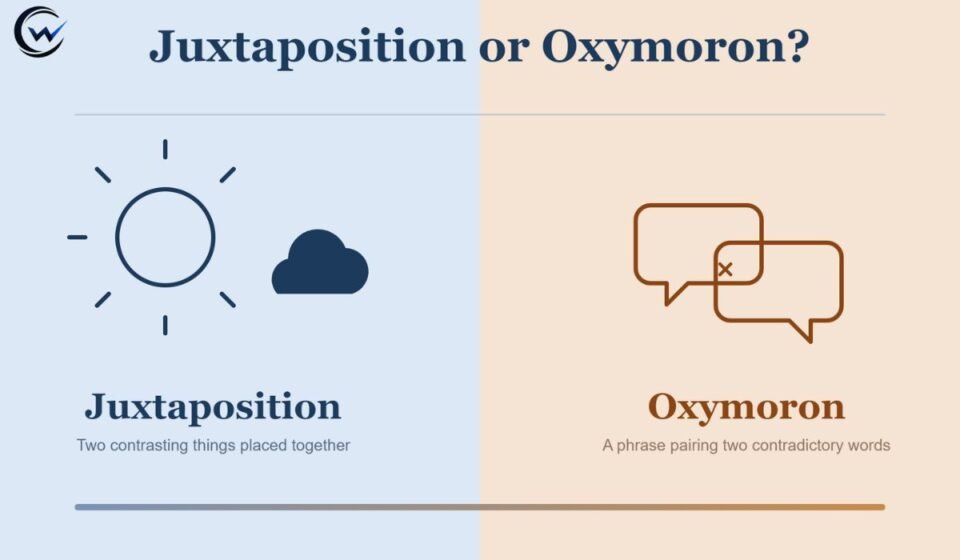
Juxtaposition is placing two things side by side to highlight contrast. Oxymoron is a phrase that pairs two contradictory words together.Juxtaposition works at the level of ideas, scenes, or images. An oxymoron works at the level of a single phrase. Every oxymoron technically involves a form of contrast, but not every juxtaposition is an oxymoron. Think of oxymoron as one specific tool inside the bigger toolbox called juxtaposition.
Quick Comparison Table
| Feature | Juxtaposition | Oxymoron |
| Definition | Placing two contrasting things near each other | A phrase combining two contradictory words |
| Scope | Ideas, images, characters, scenes | Just two or three words |
| Purpose | Highlight difference or create tension | Create a striking, often clever contradiction |
| Example | Rich neighborhood next to a slum | “Jumbo shrimp” |
| Length | Can span a sentence, paragraph, or whole scene | Usually a two or three word phrase |
More Confusing Words Made Simple: Trash vs Garbage
What Juxtaposition Actually Means
Juxtaposition happens when a writer puts two different things right next to each other so the reader notices how they clash. That’s really it. No hidden trick.
You’ve seen this in movies plenty of times. A scene of a peaceful garden cuts straight to a battlefield. The contrast does the storytelling for you, no narrator needed.
Writers use juxtaposition to make a point without stating it outright. Put a character’s wealth next to another character’s poverty in the same scene, and the reader draws their own conclusion about inequality. It doesn’t need contradictory wording at all. It’s about arrangement, not vocabulary.
What Oxymoron Actually Means
An oxymoron squeezes contradiction into a tight little phrase. Two words that shouldn’t logically go together end up stuck side by side anyway, and somehow it works.
“Original copy.” “Awfully good.” “Living dead.” Each one sounds like a contradiction on paper, but your brain still gets the meaning instantly.
Oxymorons show up everywhere in everyday speech, not just literature. People say “act naturally” or “small crowd” without even noticing they’re using a figure of speech.
The whole appeal of an oxymoron is the tiny jolt it gives the reader. Two words fight each other for half a second before the meaning clicks.
Where the Words Come From
Juxtaposition traces back to Latin, combining juxta (meaning “near”) with positio (meaning “position”). Put together, it literally means placing things near one another. English adopted it in the early 1600s largely through art and rhetoric.
Oxymoron comes from Greek, and this one’s actually a little joke. It combines oxys (sharp) and moros (dull or foolish). So the word oxymoron is, fittingly, an oxymoron itself. Sharp and foolish smashed into one term.
Knowing the roots makes the difference stick better than any rule ever could. Juxtaposition is about position. Oxymoron is about a self-contradicting pair.
How Each One Works in a Sentence
Juxtaposition doesn’t need special wording. You just place two contrasting elements together and let the contrast breathe.
Example: “The children laughed in the playground while smoke rose from the factory across the street.”
Nothing contradictory in the wording itself. The contrast comes from the scene, not the vocabulary. An oxymoron lives entirely inside a short phrase, usually two words that seem to cancel each other out.
Example: “She gave me some seriously funny advice.”
“Seriously funny” is the oxymoron here. It’s compact, and it’s baked directly into the phrase rather than spread across a sentence.
Real Examples You’ll Recognize
Juxtaposition in daily life:
- A luxury car parked outside a run-down apartment building
- A comedy scene right after a tragic one in a TV show
- Describing a soldier’s gentle hands and their violent job in the same paragraph
Common oxymorons people use without thinking twice:
- Bittersweet
- Pretty ugly
- Deafening silence
- Same difference
- Open secret
Notice how the oxymorons are barely two words long, while the juxtaposition examples stretch across a full image or scene. That size difference alone tells you which one you’re dealing with most of the time.
Common Mistakes Writers Make
The biggest mix-up? Calling every contrast an oxymoron. If two ideas clash across a whole paragraph, that’s juxtaposition, not an oxymoron. Some people also assume oxymorons must be intentional literary devices. Plenty of them are just casual speech, like “pretty ugly” or “alone together.”
Another slip is thinking juxtaposition always requires opposites. It doesn’t. You can juxtapose two similar things too, just to highlight subtle differences between them, not just dramatic contrasts.
Last one worth flagging: people sometimes call a contradiction an oxymoron when it’s actually just irony or paradox. An oxymoron is specifically two contradictory words stuck together. A paradox is a statement that contradicts itself logically but might still be true. Different tool, different job.
More Confusing Words Made Simple: Ofcourse or Of Course
A Simple Way to Remember the Difference
Here’s the shortcut. If it’s two words fighting each other in one phrase, it’s an oxymoron. If it’s two whole ideas or images placed side by side, it’s juxtaposition.
Oxymoron fits in your pocket. Juxtaposition needs the whole room.
Why This Distinction Matters for Writers
Getting this right matters more than you’d think if you write for a living. Using “oxymoron” when you mean “juxtaposition” signals to an editor or a reader that you’re guessing at literary terms instead of actually knowing them.
It also affects how you analyze or critique writing. If you’re breaking down why a scene works, calling it an oxymoron when it’s really a juxtaposed contrast muddies your entire argument.
For content writers specifically, precise terminology builds trust with readers who already know the difference. Get it wrong once, and sharp readers will question everything else you write too.
FAQ’s
Is oxymoron a type of juxtaposition?
Yes. An oxymoron is essentially juxtaposition compressed into a single short phrase, where the two contrasting words sit directly next to each other instead of being spread across a scene or sentence.
Can a sentence contain both juxtaposition and an oxymoron?
Absolutely. A sentence can juxtapose two characters or settings while also including an oxymoron somewhere in the phrasing, since the two devices operate on different scales at once.
What is the easiest example of juxtaposition?
Placing a wealthy character and a homeless character in the same scene without commentary is one of the clearest, most commonly cited examples of juxtaposition in fiction and film.
Why is oxymoron itself considered ironic?
The word oxymoron combines Greek roots meaning “sharp” and “dull,” making the term a built-in contradiction, which many language lovers find fitting given what the word actually describes.
Do oxymorons always sound weird or wrong?
Not really. Many oxymorons like “bittersweet” or “act naturally” have become so common in everyday English that most speakers don’t even register the contradiction anymore.
The Bottom Line
Juxtaposition and oxymoron both rely on contrast, but they operate at completely different scales. One works across scenes and sentences. The other works inside two or three words.
Once you see that size difference, you’ll never confuse them again. Next time you spot “jumbo shrimp” or a peaceful scene cutting to chaos, you’ll know exactly which term fits.