

You type a sentence, then freeze. Nighttime or night time? Both look fine on screen, and spell check stays silent either way. That silence is the problem. Guessing wrong in an email, a resume, or a published article makes your writing look careless, even when the rest of it is sharp.
It’s a small word, but it shows up constantly, in weather reports, work schedules, parenting routines, travel writing. Get it wrong enough times and readers start noticing a pattern, not just a typo. The good news is the rule behind it is short enough to remember for good.
Let’s dive in.
Quick Answer: Nighttime or Night Time?
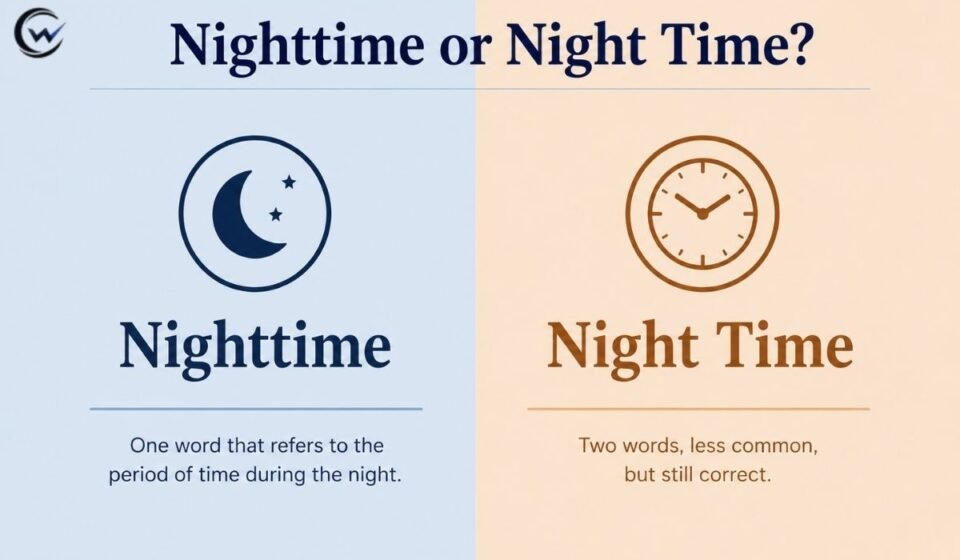
“Nighttime” (one word) is the standard, correct spelling in modern American English. It’s a noun and adjective meaning the hours of darkness.
“Night time” (two words) isn’t wrong grammatically, since “night” and “time” are both real words. But major dictionaries and style guides treat “nighttime” as the accepted form. Stick with one word unless you have a specific reason not to.
What “Nighttime” Means
Nighttime is a noun referring to the period between sunset and sunrise. It’s also used as an adjective, like in “nighttime routine” or “nighttime driving.”
Merriam-Webster and the Associated Press Stylebook both list it as a single word. That’s the version you’ll see in newspapers, novels, and professional writing across the US.
What “Night Time” Means
“Night time” as two separate words technically describes the same concept. You’re just pairing the noun “night” with the noun “time.”
Grammatically, nothing stops you from writing it that way. It just isn’t the preferred or dictionary-recognized spelling for this concept anymore. Think of it the same way you’d think of “daytime” versus “day time.” One is standard. The other looks a little dated or informal.
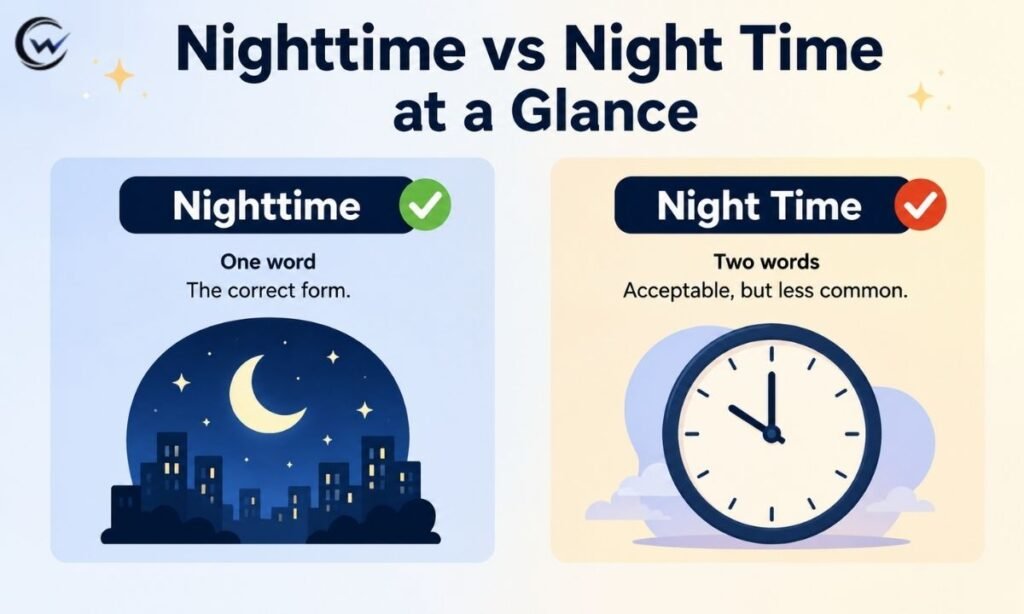
Nighttime vs Night Time at a Glance
| Form | Correct Usage | Example |
| Nighttime | Standard, dictionary-recognized | “The store closes at nighttime hours.” |
| Night time | Grammatically valid but non-standard | “I like the night time better than morning.” |
| Night-time | Rare, mostly British usage | “Night-time driving can be risky.” |
Where “Nighttime” Comes From
English loves to smash two words together once they get used enough as a pair. “Nighttime” followed the same path as “daytime,” “sometimes,” and “anytime.”
Centuries ago, writers used “night time” as two words because that’s literally what it was: a phrase, not a compound. Over time, repeated pairing turned it into a single, fused word. Dictionaries eventually caught up and standardized it that way.
This is a common pattern in English. Words that start as phrases (like “any one” or “every day”) often merge once usage cements the meaning.
When to Use “Nighttime”
Use “nighttime” when you’re referring to the general concept of night as a noun or describing something with it as an adjective.
- “Nighttime temperatures dropped below freezing.”
- “She works the nighttime shift at the hospital.”
- “Nighttime is when the city feels quietest.”
This is the version to default to in blog posts, business writing, resumes, and pretty much any formal or semi-formal context.
When to Use “Night Time”
There’s really only one situation where “night time” as two words makes more sense: when you’re emphasizing “time” as its own concept, separate from “night.”
For example: “What time is it? It’s night time now.” Here you’re contrasting “time” with something else, like “day time” or “morning time.” It’s rare, and honestly, most native speakers wouldn’t naturally write it this way even then.
Casual texting or conversational writing is the other place you’ll see “night time” pop up. It’s not incorrect there. It just won’t hold up in a professional document.
Read Also: Mine As Well, Might As Well, or Mind As Well: Which One Is Correct?
What About “Night-Time” With a Hyphen?
You’ll occasionally spot “night-time” with a hyphen, especially in British English publications. American style guides don’t recognize the hyphenated version as standard.
If you’re writing for a US audience, skip the hyphen. Go with the single, unhyphenated “nighttime” every time.
Nighttime in Everyday Sentences
Seeing the word in context makes the rule stick faster than any explanation. Here are a few natural examples:
- “The nighttime sky was full of stars.”
- “My dog gets anxious during nighttime storms.”
- “Nighttime snacking is my biggest weakness.”
- “We switched to nighttime feedings for the baby.”
Notice how in every case, “nighttime” reads smoothly as a single descriptive word. Try swapping in “night time” and you’ll feel the sentence get a little clunky.
Nighttime in Professional and Business Writing
If you’re writing for work, a website, or any published content, “nighttime” is the safer, more polished choice. It matches what style guides, editors, and dictionaries expect.
This matters more than people realize. A resume that says “managed night time operations” instead of “managed nighttime operations” can read as a small, avoidable error to a hiring manager or editor.
Publications like the New York Times and the AP consistently use the single word form. Match that standard and your writing will look sharper by default.
Common Mistakes to Avoid
A few patterns trip people up again and again:
Mistake 1: Writing “night time” out of habit instead of “nighttime.” Fix it by treating “nighttime” like “daytime,” since they follow the same rule.
Mistake 2: Adding a hyphen (“night-time”) in American writing. Drop it unless you’re specifically writing in British English.
Mistake 3: Capitalizing “Nighttime” mid-sentence when it’s not a proper noun or the start of a sentence. It’s a common noun, so lowercase it unless grammar rules say otherwise.
More Confusing Words Made Simple: Themself or Themselves
Question and Answer
Is “nighttime” one word or two words?
“Nighttime” is one word. It’s the dictionary-standard spelling used across American English writing, from news articles to business documents.
Is “night time” grammatically wrong?
No, it’s not technically wrong. It’s just non-standard and less accepted than the single word “nighttime” in formal or professional writing.
What is the AP Stylebook rule for nighttime?
AP Style treats “nighttime” as one word, matching Merriam-Webster’s entry and the format used by most major US publications.
Is it “night-time” with a hyphen?
The hyphenated form appears mainly in British English. American style guides prefer “nighttime” without a hyphen.
Can I use “night time” in casual writing or texting?
Yes, casual and conversational contexts are more forgiving. For anything formal, published, or professional, stick with “nighttime.”
Final Answer
“Nighttime” wins as the correct, standard spelling for American English writing. “Night time” isn’t a grammar crime, but it reads as the older, less polished version.
Next time you’re unsure, picture “daytime.” If you wouldn’t split that one into two words, don’t split “nighttime” either.