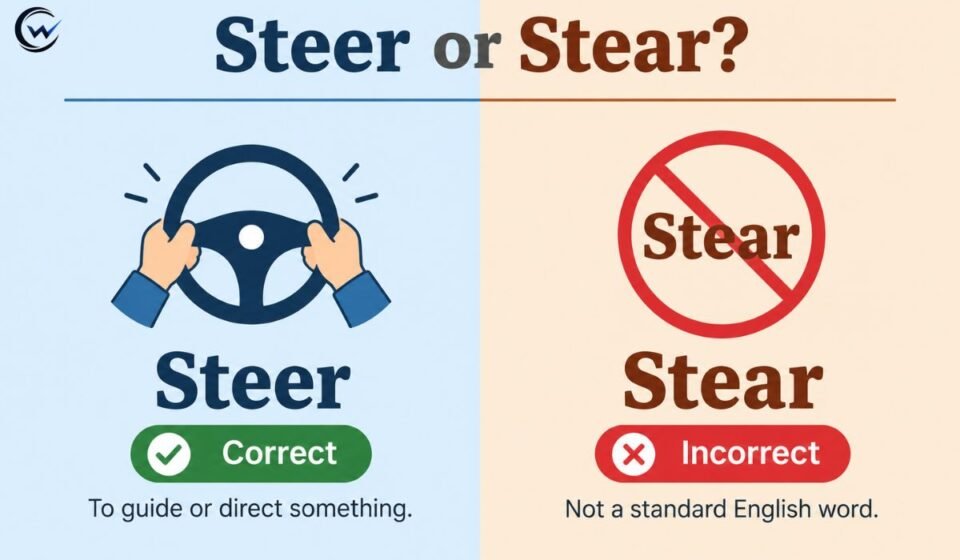

If you’re unsure whether to write steer or stear, you’re not alone. These two spellings look close, but only one is correct when you’re talking about guiding or controlling something.
Steer is the standard English spelling used for driving a car, directing a boat, or guiding a conversation. Stear is a common spelling mistake and shouldn’t be used in normal English writing. Let’s look at the difference, see how steer works in sentences, and clear up this spelling question for good.
Quick Answer: Steer or Stear
Steer is the correct spelling. It’s a real English word meaning to guide or control the direction of something, like a car, a boat, or a conversation.
Stear is not a word in standard English. It’s simply a misspelling of steer, most likely caused by mixing up the vowel pattern with words like “wear” or “bear.”
If you remember nothing else from this page, remember this: use steer, every time.
Steer or Stear: Quick Comparison Table
| Word | Correct? | Meaning | Example |
| Steer | Yes | To guide or direct something | She steered the boat toward the dock. |
| Stear | No | Not a real word | (Always replace with “steer”) |
What Does Steer Actually Mean?
Steer has a few related meanings, and they all circle back to the idea of direction. As a verb, it means to control the course of a vehicle, vessel, or object. You steer a car by turning the wheel. You steer a bike by leaning and turning the handlebars.
It also works in a broader, more figurative sense. You can steer a conversation away from an awkward topic. A manager might steer a project back on track after it goes sideways.
There’s also a noun form. A steer is a young, castrated male bull raised for beef. Completely different context, same spelling, and yes, it trips people up in crossword puzzles more than you’d expect.
More Confusing Words Made Simple: Filed vs Filled
Why Do People Misspell It as Stear?
The mistake usually comes from the way steer sounds. The long “ee” sound appears in many English words with different spellings. For example, meet and meat sound alike but use different vowel patterns. That can make steer easy to second-guess.
Some people expect the word to be spelled with “ea” instead of “ee.” However, the correct spelling is always steer when you’re talking about guiding or directing something. Remembering the double e is the easiest way to avoid the mistake.
Where Does the Word Steer Come From?
Steer has old roots. It traces back to the Old English word “stieran,” which meant to guide or direct, particularly a ship.
That connects to the Old Norse “styra” and the German “steuern,” both carrying the same core idea of controlling direction. Sailing and navigation were a big part of daily life for centuries, so it makes sense that a word for guiding a vessel would stick around and expand to cover cars, conversations, and decisions.
The noun meaning, referring to cattle, actually comes from a completely different Old English root, “steor,” which just happened to describe a young ox. Two separate word histories that landed on the same spelling over time.
How to Use Steer in a Sentence
Steer shows up constantly in everyday speech, both literally and figuratively. Here are some natural examples.
Literal use (physical direction):
- He steered the truck carefully around the pothole.
- The instructor taught her how to steer with one hand on tight turns.
- The captain steered the ship through the narrow channel.
Figurative use (guidance or influence):
- Her advice steered me toward a better career choice.
- The coach tried to steer the team’s focus back to defense.
- Good marketing can steer customer opinion without anyone noticing.
As a noun (young bull):
- The rancher sold twelve steers at auction last week.
Notice how flexible the word is. Same spelling, same pronunciation, wildly different contexts depending on the sentence.
Common Mistakes to Avoid
Beyond the basic stear typo, a few related mix-ups are worth flagging.
Steer vs. Steward. These aren’t related, but people sometimes blend them when talking about “guiding” a project. A steward manages or oversees something. Steer is the action of directing it.
Steer vs. Stir. Another sound-alike trap, especially when speaking quickly. You stir a pot of soup. You steer a car. Mixing these up in writing is more common in casual texting than formal writing, but it happens.
Steer clear. This common phrase means to avoid something entirely, like “steer clear of that road, it’s closed.” Some people misspell it “stear clear,” which carries the same error as the base word.
Once you lock in that steer always has the double “e,” these mix-ups mostly disappear on their own.
Steer Clear: A Popular Phrase Worth Knowing
“Steer clear of” deserves its own quick mention because it’s one of the most common ways this word shows up outside of literal driving contexts. It means to deliberately avoid something, whether that’s a person, a topic, a bad decision, or a sketchy shortcut on a hiking trail.
Example: “I’d steer clear of that restaurant, the reviews have gone downhill fast.”
It’s a useful, natural-sounding phrase for everyday conversation and writing, and it’s a good one to have in your back pocket once the spelling is locked in.
More Confusing Words Made Simple: Oversite or Oversight
Is Stear Ever Correct in Any Context?
Stear isn’t a standard English spelling when you mean to guide, direct, or control something. It isn’t used as the correct form of the verb steer in standard English.
You may occasionally see Stear as a surname or proper name, but that’s different from its use as an English word. For normal English writing, steer is the correct spelling.
Frequently Asked Questions
Is stear a real word in any dictionary?
No. Stear does not appear in any major English dictionary as a standard word. It’s a common misspelling of steer and should always be corrected in writing.
What part of speech is steer?
Steer works as both a verb, meaning to guide or direct, and a noun, referring to a young male bull raised for beef production purposes.
Why does steer have a double e instead of ea?
Steer traces back to Old English “stieran,” which used the “ie” sound that later evolved into the modern double “e” spelling used today.
Can steer be used to describe guiding a conversation?
Yes. Steer is commonly used figuratively, such as steering a conversation, a project, or someone’s decision in a particular direction without physical movement involved.
What’s a simple trick to remember the correct spelling?
Think of “steer” like “deer,” both use double e. Picture steering around a deer on the road to lock in the spelling.
Wrapping Up
When choosing between steer or stear, the correct spelling is steer. It means to guide, direct, or control the direction of something, and it works in both literal and figurative contexts. Stear isn’t the standard English spelling and should be avoided in normal writing.
The easiest way to remember the difference is to focus on the double e in steer. Once you know this simple spelling rule, you won’t need to second-guess the word again.