

You’ve probably wondered about Girlie or Girly while texting or writing online. You might use one spelling in a text, then the other without noticing. Then comes that familiar doubt: is one of them actually wrong? It’s a small detail, but nobody wants to look careless over spelling.
The good news is that neither spelling is automatically wrong. Both girlie and girly are real words with slightly different uses. Once you know the difference, choosing the right one gets much easier.
Here’s the answer, straight up, without any confusing language or guessing games.
Quick Answer: Girlie or Girly?
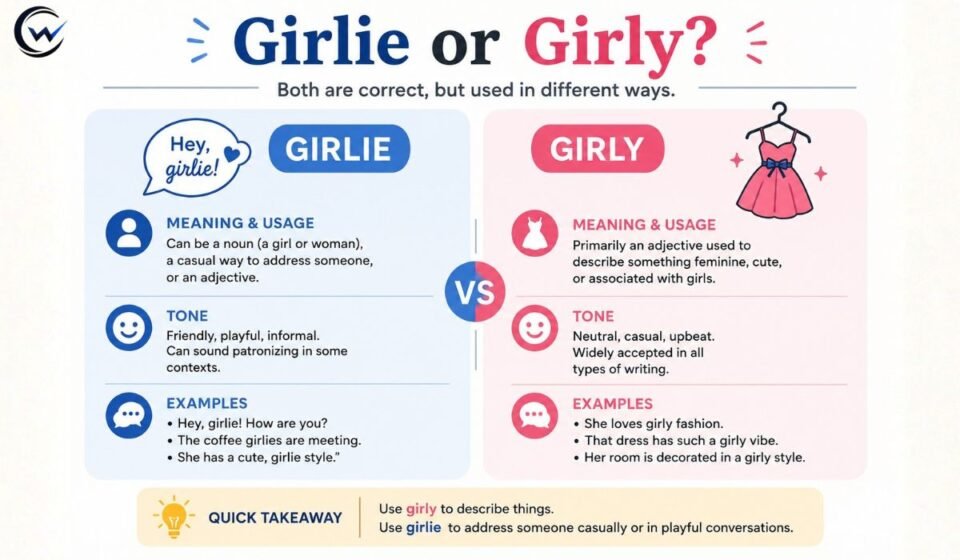
Both girlie and girly are correct spellings, but they don’t always work the same way. Girly is usually the better choice when you’re describing something feminine, cute, or traditionally associated with girls.
Girlie has a wider range of uses. It can appear as a casual noun or friendly form of address, especially in online conversations, while older uses can sound dated today. So, the right spelling depends on what you mean and how you’re using it.
What Does “Girlie” Mean?
“Girlie” shares the same core meaning but shows up less often in casual adjective form today. Historically, it functioned as a noun, an informal (and now somewhat dated) term for a young woman.
It also survives in a handful of fixed expressions, most notably “girlie magazine,” a term from the mid-20th century referring to publications featuring pinup style photos.
So while “girlie” isn’t wrong, it leans older, and in some contexts, it can sound a bit patronizing if used to address a real person directly.
What Does “Girly” Mean?
“Girly” is an adjective. It describes something associated with traditional femininity, think pink colors, ruffles, glitter, or anything stereotypically marketed toward girls and women.
You’ll see it everywhere: girly movies, girly drinks, girly bedrooms, girly humor. It’s casual, upbeat, and doesn’t carry much baggage.
Dictionaries like Merriam-Webster list “girly” as the primary spelling, which is exactly why it dominates modern usage in blogs, social media, and everyday conversation.
Girlie vs Girly: Quick Comparison Table
| Feature | Girly | Girlie |
|---|---|---|
| Main role | Adjective | Noun, adjective, or informal address |
| Modern use | Very common | Common in casual online language |
| Typical meaning | Feminine or traditionally associated with girls | A casual term for a girl or woman, or feminine in some contexts |
| Tone | Usually casual and neutral | Friendly, playful, informal, or sometimes patronizing |
| Example | “She loves girly fashion.” | “Hey, girlie, how are you?” |
Where Did These Words Come From?
Both words trace back to “girl,” which entered English in the 1300s and originally referred to a young person of either gender before narrowing to mean specifically a young female.
The “y” suffix, the one you see in words like sunny, funny, and messy, turns nouns into adjectives that describe a quality or resemblance. Add it to “girl” and you get “girly,” meaning “having the qualities associated with a girl.”
“Girlie” popped up as an informal variant sometime in the 19th century. Language historians note it picked up steam as a casual nickname or address term before later attaching itself to that specific “girlie magazine” usage in the 1940s and 50s.
More Confusing Words Made Simple: Seal vs Seel
When to Use “Girly”
Reach for “girly” almost every time you’re describing something feminine, cute, or stereotypically associated with girls. It works in:
- Product descriptions (“girly stationery set”)
- Fashion and style content (“girly aesthetic”)
- Casual conversation (“her room is so girly”)
- Marketing copy and social captions
This is the spelling that shows up in dictionaries as the main entry, and it’s what most style guides and editors expect in modern content.
When to Use “Girlie”
Use girlie when the context calls for a casual, playful, or conversational tone. It’s especially common in social media language and informal conversations between friends.
For example:
- “Hey, girlie! How have you been?”
- “The coffee girlies are meeting Saturday.”
- “She loves that cute girlie aesthetic.”
You may also encounter girlie in older expressions or historical references. In those cases, the spelling has a different tone and meaning from its modern social-media use.
Be careful when using girlie to address someone directly. Between friends, it may sound affectionate, but toward a stranger or colleague, it could come across as overly familiar or condescending.
Girlie vs Girly in British vs American English
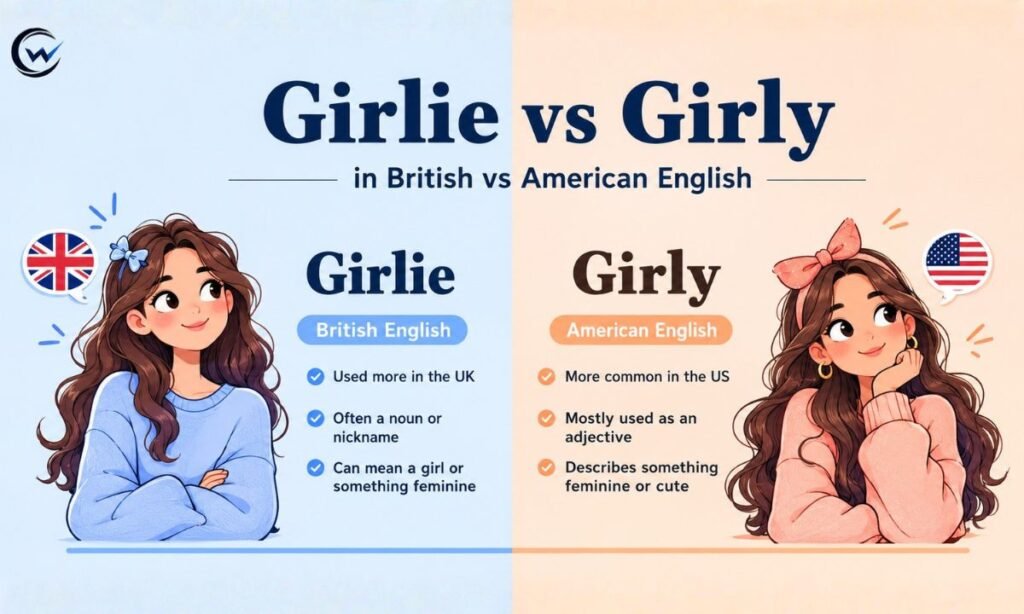
There isn’t a hard regional split here the way there is with “colour” versus “color.” Both American and British English use “girly” as the more frequent spelling today.
That said, “girlie” shows up slightly more often in older British texts and in that specific magazine terminology, which originated in both UK and US publishing around the same era. If you’re writing for a US audience, “girly” is your safest, most natural default.
Common Mistakes People Make
The biggest mistake isn’t confusing the meanings, it’s assuming one spelling is flat out wrong. Neither is. They’re both real, dictionary recognized words.
Another common slip is using “girlie” to describe someone in a way meant to be sweet, but it lands as dismissive instead. Context matters a lot with this one.
Some writers also autocorrect themselves into inconsistency, using “girly” in one paragraph and “girlie” in the next. Pick one spelling per piece of content and stick with it unless you’re quoting something directly.
Real-Life Examples in Sentences
Here’s how girly and girlie can appear in different contexts.
Girly: “She decorated her room with a soft, girly aesthetic.”
Girly: “That pink dress has such a girly vibe.”
Girlie: “Hey, girlie! Are you coming tonight?”
Girlie: “The coffee girlies are planning a weekend brunch.”
Girlie: “She has a cute, girlie style.”
Girlie: “The old magazine was marketed as a girlie publication.”
The key difference is context. Girly usually describes something, while girlie can also refer to a person or create a deliberately casual tone.
Which Spelling Should You Use in Writing?
For blogs, social media, product copy, and basically all modern content, default to girly. It’s the dictionary preferred spelling, it reads as current, and it won’t confuse readers or trip up spell check.
Save “girlie” for direct quotes, historical references, or intentional stylistic choices where the older tone actually serves the writing.
More Confusing Words Made Simple: Tieing or Tying
Frequently Asked Questions
Is girly or girlie the correct spelling?
Both girly and girlie are legitimate English words. Girly is the usual choice for describing something feminine, while girlie has additional informal and conversational uses.
What is the difference between girly and girlie?
Girly mainly works as an adjective for something feminine or traditionally associated with girls. Girlie can describe something too, but it can also refer to a girl or woman in casual speech.
Is girlie a slang word?
It can be used as informal slang, especially when addressing someone casually or referring to a group of women online. Its tone depends on the relationship between the speakers and the context.
Is it okay to call someone girlie?
It depends on the situation. Friends may use girlie affectionately, but using it toward a stranger, coworker, or someone who doesn’t appreciate the term can sound patronizing.
Should I use girly or girlie in formal writing?
Use girly when you need the adjective meaning feminine or traditionally associated with girls. Girlie is better reserved for informal dialogue, quotations, names, or contexts where its specific tone is intentional.
Bottom Line
So, girlie or girly? Both are correct, but they fit different situations. Use girly when you’re describing something feminine, cute, or traditionally associated with girls.
Choose girlie when you’re using a casual nickname, addressing someone informally, or matching a playful online tone. Just remember that its tone can change depending on who you’re talking to.
Once you understand that difference, choosing between girlie and girly becomes much easier. You can use whichever spelling fits your meaning and the conversation.