
Typing fast and suddenly second guessing yourself? You write “seel” instead of “seal” and now the whole sentence looks wrong. That little red squiggle under your word doesn’t help either.
Here’s the good news: this mix up is easy to fix once you see both words side by side, and seal vs seel stops being confusing in about thirty seconds.
Quick Answer – Seal vs Seel
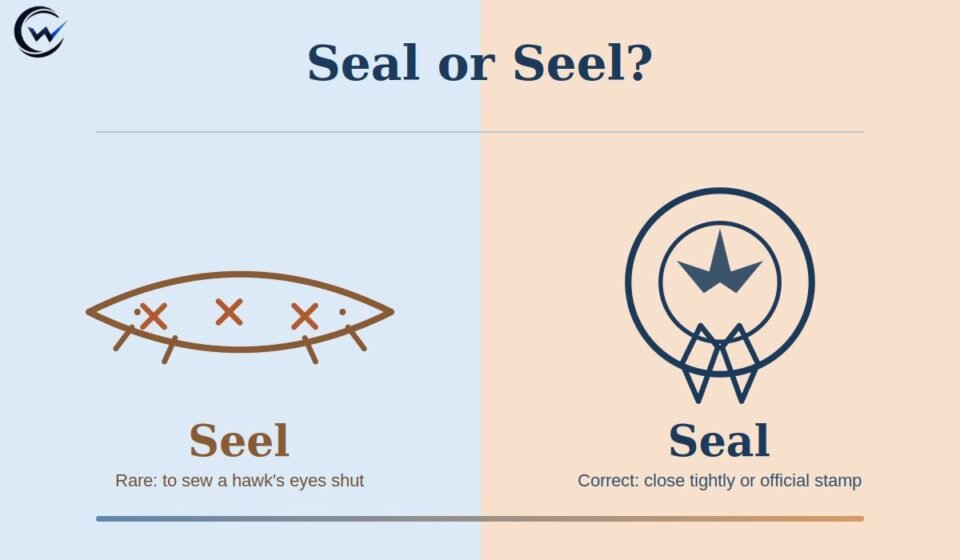
Seal is the correct spelling almost every single time you need it. It means to close something tightly, an official stamp or emblem, or the marine animal that barks and swims.
Seel is a real word too, but it’s rare and archaic. It means to sew an animal’s eyes shut, a term from falconry, or more broadly to blind or close up. Unless you’re writing about medieval hawking or quoting Shakespeare, you want seal.
Seal vs Seel at a Glance
| Word | Part of Speech | Meaning | Common Use |
| Seal | Noun, Verb | To close tightly; an official stamp; the marine animal | Everyday writing, business, science |
| Seel | Verb (archaic) | To sew shut an animal’s eyes; to close or blind | Falconry, poetry, historical texts |
What Does “Seal” Mean?
Seal is one of those words that does a lot of heavy lifting in English. As a verb, it means to close something so tightly that nothing gets in or out. You seal an envelope. You seal a deal. You seal a leaky pipe with tape.
As a noun, seal can mean an official mark of authority, like a notary seal or a wax seal on an old letter. It also names the flippered marine mammal you’d spot lounging on rocks near the coast.
Three meanings, one spelling. That’s why seal shows up constantly in writing, from legal documents to kids’ books about the zoo.
More Confusing Words Made Simple: Hobo vs Vagrant
What Does “Seel” Mean?
Seel looks like a typo, but it isn’t one. It’s an old English verb tied to falconry. Trainers used to sew a hawk’s eyelids partly shut with thread to calm the bird during training. That specific act was called seeling.
Over time, writers borrowed the word for a broader sense of blinding or closing something off, often in a poetic or dramatic way. You won’t hear it in casual conversation. You’ll find it in older literature instead.
Where “Seel” Comes From (Etymology)
Seel traces back to Old French “ciller” and Latin roots connected to eyelids and closing the eyes. It entered English through the practice of falconry sometime in the medieval period, when hawking was a serious pursuit among nobility.
Shakespeare used a version of the word in Macbeth, describing “seeling night” as darkness that blinds the day. That single literary reference is probably the biggest reason seel still exists in dictionaries at all.
Seal, on the other hand, comes from the Latin “sigillum,” meaning a small image or mark, which is exactly how we still use it today for stamps and closures. The animal sense comes from a completely separate Old English word, “seolh.”
Why People Mix Up Seal and Seel
Honestly? It’s the sound. Both words rhyme, both end in similar letters, and English spelling doesn’t always follow logic. Add autocorrect suggesting whichever word it recognizes, and mistakes happen fast.
There’s also the fact that “seel” simply looks like a plausible way to spell “seal” if you’re going purely by ear. Nobody teaches this word in school, so most people have never actually seen it written down before.
Seal in Everyday Use
Here’s where seal shows up in real writing you’ll actually produce:
- “Please seal the package before shipping it.”
- “The notary added her official seal to the document.”
- “A seal swam right up to the boat during our tour.”
- “Make sure the jar is sealed tight so the sauce doesn’t spoil.”
Notice how naturally it fits into ordinary sentences. That’s a strong sign this is the word you need.
Seel in Real Use
Seel almost never appears outside historical fiction, poetry, or direct references to falconry. A modern falconer might still use the term when discussing training methods from centuries ago. A novelist writing a medieval scene might have a character “seel” a hawk before a hunt.
Outside those narrow contexts, you’ll rarely see it. If your writing isn’t about birds of prey or quoting classic literature, you almost certainly don’t need this word.
Seal as a Noun vs Verb
Since seal carries multiple meanings, it helps to separate them by function. As a verb, it’s about the action of closing. As a noun, it can mean either the mark of authority or the animal.
Context makes the meaning obvious almost every time. “Seal the bag” is clearly the verb. “The seal barked at the tourists” is clearly the animal. Readers rarely get confused once seal is on the page correctly.
Common Mistakes to Avoid
The biggest mistake is using seel when you actually mean seal, usually because it “sounds right” while typing quickly. Spell check often won’t catch this since seel is a legitimate dictionary word, not a nonsense string of letters.
Another mistake is assuming seel is just an alternate or casual spelling of seal. It isn’t. They’re two different words with two different histories, and swapping them changes the meaning of your sentence entirely, even if nobody notices at a glance.
More Confusing Words Made Simple: Vender or Vendor
Quick Grammar Tricks to Remember the Difference
Try this: seal has an “a,” just like “animal” and “authority,” two of its main meanings. That little memory hook links the spelling to what it actually represents.
For seel, remember it rhymes with “kneel,” another word about bending or closing something down, like eyelids sewn shut in falconry. If you’re not writing about hawks, skip it entirely and reach for seal instead.
Test Your Spelling: Seal vs Seel Quiz
Seal or Seel?
5 quick ones. No pressure, just spelling.
FAQ’s
Is “seel” a real word or just a misspelling?
Seel is a real, dictionary recognized word. It’s archaic and rare, referring mainly to sewing a hawk’s eyes shut during falconry training or closing something in a poetic sense.
Which spelling should I use in everyday writing?
Use seal for nearly all everyday writing. It covers closing things, official stamps, and the marine animal, which are the meanings people need almost all the time.
Does spell check catch the seal vs seel mistake?
Not reliably. Since seel is a legitimate word, spell check often won’t flag it, so you have to proofread manually to catch this specific error.
Why does Shakespeare use the word “seel”?
Shakespeare used “seeling night” in Macbeth to describe darkness that blinds daylight, borrowing the falconry term for a dramatic, poetic effect about blindness and concealment.
Can “seal” also be used as a metaphor?
Yes. People say things like “seal your fate” or “seal a friendship,” using the closing and finalizing sense of the word in a figurative, non literal way.
Conclusion
Ninety nine times out of a hundred, seal is the word you’re reaching for, whether you mean closing something up, an official stamp, or the animal on the beach.
Seel survives only in falconry talk and old literature, so unless you’re writing about hawks or quoting Shakespeare, leave it alone and stick with seal.