

You’re mid sentence, fingers moving fast, and then it happens. You freeze right on that one word, staring at “tieing or tying” like it’s a trick question your third grade teacher never covered. Both versions look strangely acceptable, which is exactly the problem. Spell check sometimes shrugs and lets it slide too.
That tiny pause before you hit send or publish can wreck your confidence in an otherwise solid sentence. Good news, the answer is short, simple, and you’ll never second guess it again after this.
Quick Answer: Is It “Tieing” or “Tying”?
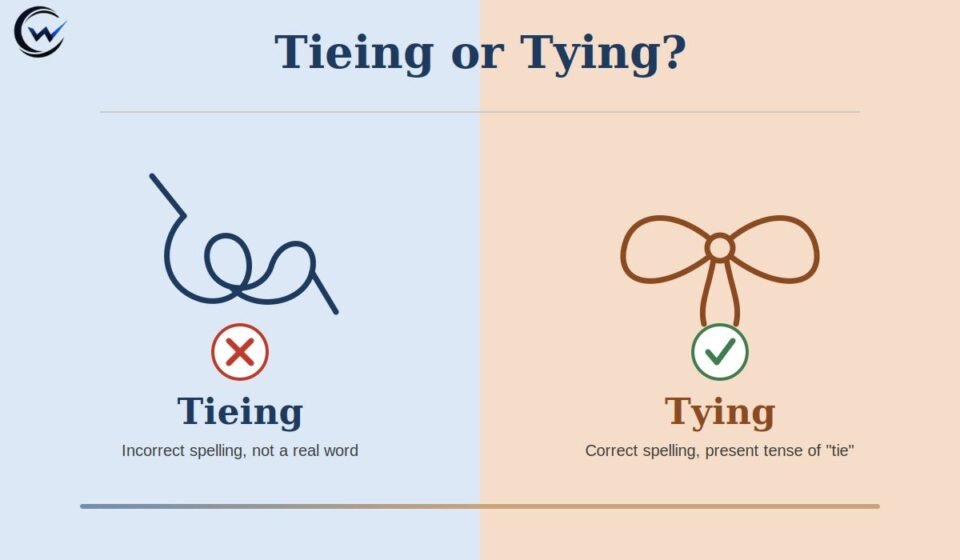
“Tying” is the correct spelling. “Tieing” is not a real word in standard English, no matter how natural it might look.
When you add “ing” to the verb “tie,” the “ie” changes to a “y,” giving you “tying.” You’ll see this spelling in dictionaries, style guides, and every professionally edited piece of writing.
Tieing vs Tying at a Glance
| Tieing | Tying | |
| Correct spelling | No | Yes |
| Found in dictionaries | No | Yes |
| Follows English spelling rules | No | Yes |
| Safe to use in writing | Never | Always |
That table alone settles most people’s doubts. But the “why” is worth knowing too, because it clears up a whole category of similar words.
What Does “Tying” Mean?
“Tying” is the present participle of the verb “tie.” It describes the act of fastening, securing, or joining something using string, rope, ribbon, or a similar material.
It also shows up outside the literal sense. Two teams can be tying the score. A decision might be tying your hands. Someone could be tying loose ends before a project wraps up.
Why “Tieing” Looks Right But Isn’t
People default to “tieing” because most verbs just tack “ing” onto the base word without touching a single letter. Think “play” to “playing” or “walk” to “walking.” No changes needed there.
“Tie” doesn’t play by that pattern. It ends in “ie,” and English has a specific rule for that ending. Ignoring the rule is exactly how “tieing” sneaks into texts, emails, and social posts.
More Confusing Words Made Simple: And vs Or
The Spelling Rule Behind “Tying”
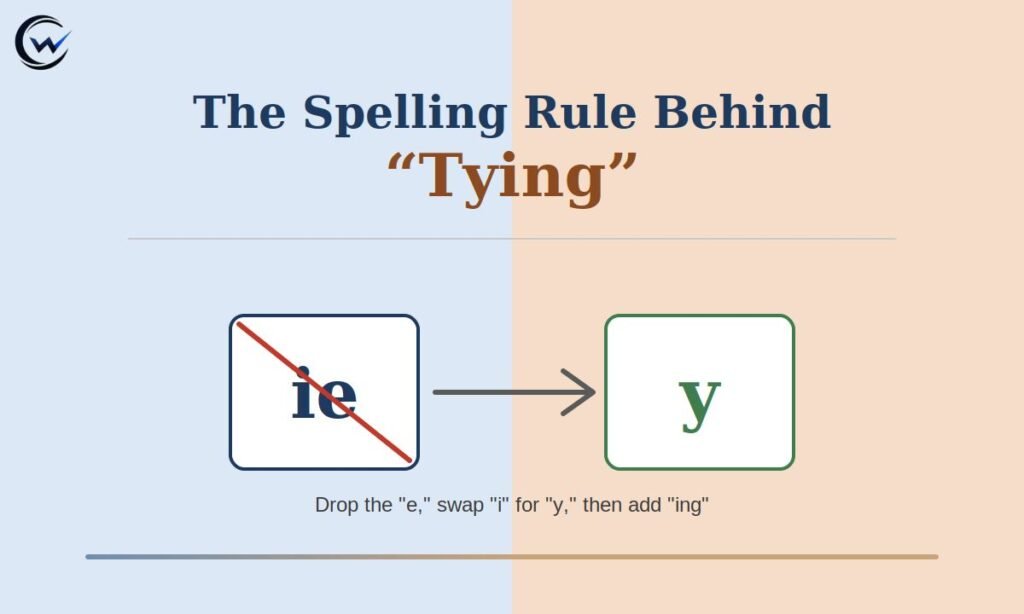
Here’s the actual mechanic. When a verb ends in “ie,” you drop the “e” and swap the “i” for a “y” before adding “ing.”
So “tie” becomes “ty” plus “ing,” which gives you “tying.” Same thing happens with “die” (dying), “lie” (lying), and “vie” (vying).
This rule exists mostly for readability. Two vowels stacked together before “ing,” like “tieing,” look clunky and break the natural rhythm of English spelling patterns.
Where Does “Tying” Come From? (Etymology)
“Tie” traces back to Old English “tēag” or “tīgan,” meaning to fasten or bind. As English spelling standardized over centuries, verbs ending in “ie” settled into the “y” pattern for their “ing” form.
This wasn’t random. Grammarians and early dictionary makers noticed the “ieing” combination was rare and awkward across the language, so the “y” swap became the accepted standard. It stuck, and it’s been that way for a very long time.
How to Use “Tying” in a Sentence
Seeing the word in action makes it stick better than any rule ever could.
- She spent five minutes tying her daughter’s shoelaces before the bus arrived.
- The two runners ended up tying for first place.
- He kept tying and untying the knot, unsure if it would hold.
- Negotiations are tying the two companies closer together every quarter.
Notice the pattern. No matter the context, literal or figurative, the spelling never shifts.
“Tying” in Different Contexts
The word flexes across a surprising number of situations, and that versatility is part of why people search for it so often.
Physical tying: shoelaces, ropes, bows, ties, bandages.
Sports and competition: tying a score, tying a record, tying a match.
Business and relationships: tying a deal together, tying a partnership, tying incentives to performance.
Idiomatic use: tying the knot (getting married), tying up loose ends, hands tied.
Each use case relies on that same core idea: connecting or fastening two things, whether they’re physical objects or abstract outcomes.
Common Mistakes People Make With “Tying”
Beyond the “tieing” mix-up, a few other errors show up constantly.
People sometimes write “tyeing,” which mashes both wrong patterns into one word. Others confuse “tying” with “tieing” specifically in headlines or captions, where fast typing skips a mental spell check entirely.
Autocorrect helps less than you’d think here, since “tieing” isn’t always flagged depending on the keyboard or app.
A Simple Trick to Remember the Correct Spelling
Picture a shoelace turning into a “y” shape once it’s tied. Silly, sure, but visual tricks like this stick better than memorizing grammar rules cold.
Or just remember this short phrase: “ie” becomes “y” before “ing.” Say it once out loud and it tends to lodge in memory fast.
Other Words That Follow the Same “ie to y” Rule
Once you know the pattern, you’ll spot it everywhere.
- Die → Dying
- Lie → Lying
- Vie → Vying
- Untie → Untying
Every single one drops the “e,” swaps “i” for “y,” and adds “ing.” No exceptions in standard English.
More Confusing Words Made Simple: Of or Off
FAQ’s
Is “tieing” ever correct in any form of English?
No. “Tieing” isn’t recognized in American or British dictionaries. It’s a common misspelling, not an alternate or regional spelling.
Why does “tie” change to “tying” instead of just adding “ing”?
English drops the silent “e” and swaps “i” for “y” when a verb ends in “ie,” mainly to avoid the awkward double vowel combination “ieing.”
Is “tying” used the same way in British and American English?
Yes. Both dialects use “tying” as the standard present participle of “tie,” with no spelling differences between them.
Does spell check always catch “tieing” as wrong?
Not always. Some browsers and apps miss it, especially in fast typing or casual messaging, so it’s worth double checking manually.
What’s the correct past tense of “tie”?
The past tense is “tied,” as in “She tied her shoes.” Only the “ing” form changes the “ie” to “y,” not the past tense.
Bottom Line
“Tying” is the spelling you want, every time, in every context. “Tieing” might feel intuitive, but it breaks a spelling rule that’s been standard in English for centuries.
Once you picture that “ie to y” swap, the mistake gets a lot harder to make. Next time your fingers hesitate over the keyboard, you’ll already know which way to go.