
You’re typing a text. You pause. Is it “turn of the lights” or “turn off the lights“? Your brain freezes for a second, and suddenly two words you’ve used a thousand times feel like strangers.
That mix-up between of or off happens more than people admit, and it’s an easy one to fix once you see the pattern.
Quick Answer: Of or Off in One Sentence
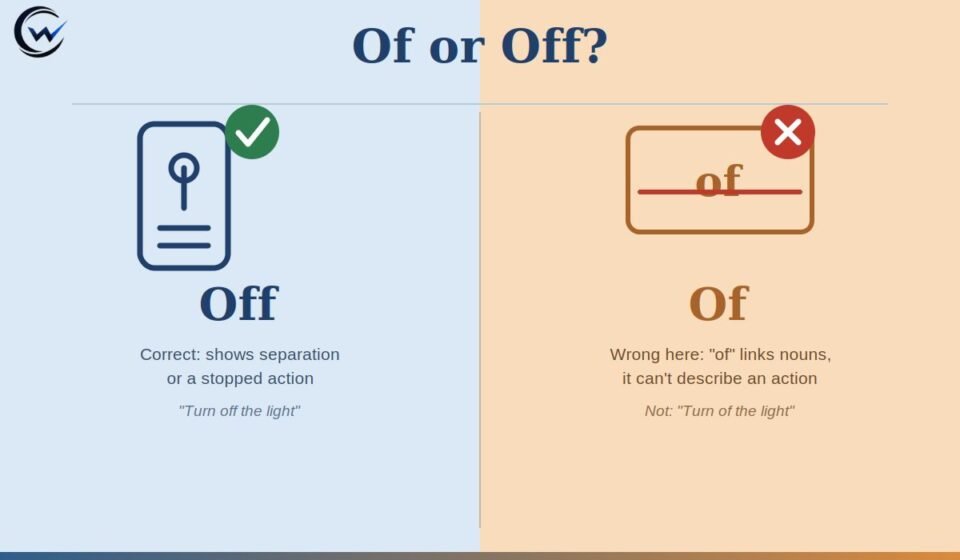
“Of” shows a relationship or connection between things (a piece of cake, the color of the sky), while “off” shows separation, distance, or stopping something (get off the bus, turn off the lamp).
If you can replace the word with “belonging to” or “from,” use “of.” If you can replace it with “away” or “not on,” use “off.”
What Does “Of” Actually Mean?
“Of” is a preposition, and it never stands alone as an action. It connects two nouns to show possession, origin, or a part-to-whole relationship.
Think of it as a linking word. It tells you how one thing relates to another.
Examples:
- A cup of coffee
- The roof of the house
- One of my friends
- A sense of humor
Notice something? “Of” almost always sits between two nouns. It never describes movement or a physical action.
What Does “Off” Actually Mean?
“Off” works differently. It can be a preposition, an adverb, or even part of a verb phrase called a phrasal verb. Its core job is showing separation, distance, or the end of something.
Examples:
- She fell off the ladder
- Turn off the TV before bed
- The meeting is off
- He gets off work at five
You’ll notice “off” often pairs with verbs (turn off, get off, back off), which gives it action energy that “of” simply doesn’t have.
More Confusing Words Made Simple: Targetted or Targeted
Of or Off: Quick Comparison Table
| Feature | Of | Off |
| Part of speech | Preposition only | Preposition, adverb, adjective |
| Shows | Connection, possession, part of a whole | Separation, distance, stopping |
| Common pairing | Noun + of + noun | Verb + off |
| Sound | Soft “v” sound | Hard “f” sound |
| Example | Cup of tea | Turn off the tea kettle |
| Can it start a sentence? | Rarely, sounds awkward | Yes, in casual speech (“Off we go”) |
Where “Of” and “Off” Come From
Here’s the twist that trips people up: “of” and “off” were originally the same word.
In Old English, “of” covered both meanings we now split between the two. Over centuries, English speakers started stressing the word differently depending on context.
The stressed version hardened into “off” (separation), while the unstressed version softened into “of” (connection).
By the 1600s, the two had split into separate words with separate jobs. That’s why they look so similar today. They’re basically siblings who grew up and moved into different houses.
How to Use “Of” Correctly in a Sentence
Since “of” always connects two nouns, check your sentence for that noun-of-noun pattern before you commit to it.
Right: She’s a friend of mine.
Right: The cause of the delay was traffic.
Wrong: Turn of the radio.
That last one fails because “turn” is a verb needing an action word, not a connector. Your brain wants “off” there, not “of.”
A simple trick: if you can swap the word for “belonging to,” “from,” or “made from,” you’re safely in “of” territory.
How to Use “Off” Correctly in a Sentence
“Off” attaches to actions. If your sentence involves stopping, leaving, removing, or disconnecting something, “off” is almost always your answer.
Right: Please turn off the stove.
Right: The flight took off on time.
Wrong: He drove of the road.
That second example should be “off the road,” since it describes leaving a surface or path.
Quick test: if you can swap the word for “away” or “not connected,” go with “off.”
“Turn Of” vs “Turn Off”: The Most Confused Pair
This is probably the single biggest source of the “of or off” mix-up, so it deserves its own spotlight.
“Turn off” means to stop or disconnect something. Lights, engines, faucets, phones. All of them get turned off.
“Turn of” isn’t really a standalone phrase on its own. It only shows up correctly in set expressions like “turn of the century” or “turn of events,” where “of” links two nouns (turn, century) rather than describing an action.
So unless you’re talking about a historical era or a plot twist, you almost certainly want “turn off.”
“Kind Of” vs “Kind Off”
Another common trap. “Kind of” is correct, always. It means “somewhat” or describes a category (“what kind of dog is that?“).
“Kind off” doesn’t exist as a phrase. If you’ve typed it, autocorrect probably let you down. Just remember: kindness connects to a description, so it takes “of.”
“Off Of”: Is It Ever Correct?
You’ll hear people say “get off of the table” in casual conversation, and it’s common enough in spoken American English. But in formal writing, it’s considered redundant.
“Off” alone already does the job. Drop the “of” and your sentence tightens up.
Casual: Get off of my lawn.
Cleaner: Get off my lawn.
Both get the point across, but the second one reads better in an email, essay, or article.
Common Mistakes People Make With “Of or Off”
Let’s run through the slip-ups that show up constantly in emails, texts, and even published articles.
- “Log of the account” should be “log off the account.”
- “Shake of the dust” should be “shake off the dust” (unless referring to dust literally covering something and being brushed away, where “of” could describe origin in rare cases).
- “Cut of the power” should be “cut off the power.”
- “A couple of feet of” (“a couple of feet off the ground”) mixes both correctly, showing they can coexist in one sentence.
Notice the pattern? Almost every mistake involves swapping “off” for “of” after an action verb. Once you spot that pattern, the errors get easy to catch.
A Simple Trick to Never Mix Them Up Again
Here’s a mental shortcut that works almost every time.
Ask yourself: is something happening, or is something connecting?
If an action is stopping, leaving, or separating, go with “off.” If two nouns are linking together, go with “of.”
Say the sentence out loud, too. “Off” has a sharper, harder sound. “Of” almost disappears when you say it fast, which is honestly part of why people misspell it so often.
More Confusing Words Made Simple: Juxtaposition vs Oxymoron
Why This Mix-Up Happens So Often
Part of the confusion comes down to pronunciation. In fast, casual speech, “of” often sounds like “uh” or blends into surrounding words. That makes it easy to type “of” when your brain actually meant the crisper, more deliberate “off.”
Autocorrect doesn’t always catch it either, since both are valid English words. The tool assumes you meant what you typed, not what you intended.
FAQs About “Of or Off”
Is it “get of my back” or “get off my back”?
It’s “get off my back.” The phrase means to stop bothering someone, and it always uses “off” because it describes separation or stopping an action.
Is it “log of” or “log off”?
“Log off” is correct when referring to signing out of a computer or account. “Log of” would only make sense in an unrelated context, like “a log of daily activities.”
Why do “of” and “off” sound so similar?
They share the same Old English root and only split into separate words centuries ago. That shared history explains why they still look and sound alike today.
Can “off” ever mean the same thing as “of”?
Not in modern English. They serve completely different grammatical roles now, even though they once came from the same word.
Is “kind of” or “kind off” correct?
“Kind of” is always correct. “Kind off” isn’t a recognized phrase in English.
Wrapping Up the Of or Off Debate
The fix here really is simple once it clicks. “Of” connects nouns. “Off” describes separation or stopping an action.
Next time you pause mid sentence, ask if something is linking together or breaking apart. That one question solves the “of or off” puzzle almost every single time.