
You typed “in-person or in person” into Google because something felt off. Maybe autocorrect flagged your hyphen. Maybe a coworker’s email used the other version and now you’re second guessing everything you’ve ever written.
Good news. The rule is simpler than it looks, and once you see the pattern, you’ll never fumble it again.
Quick Answer: In-Person or In Person
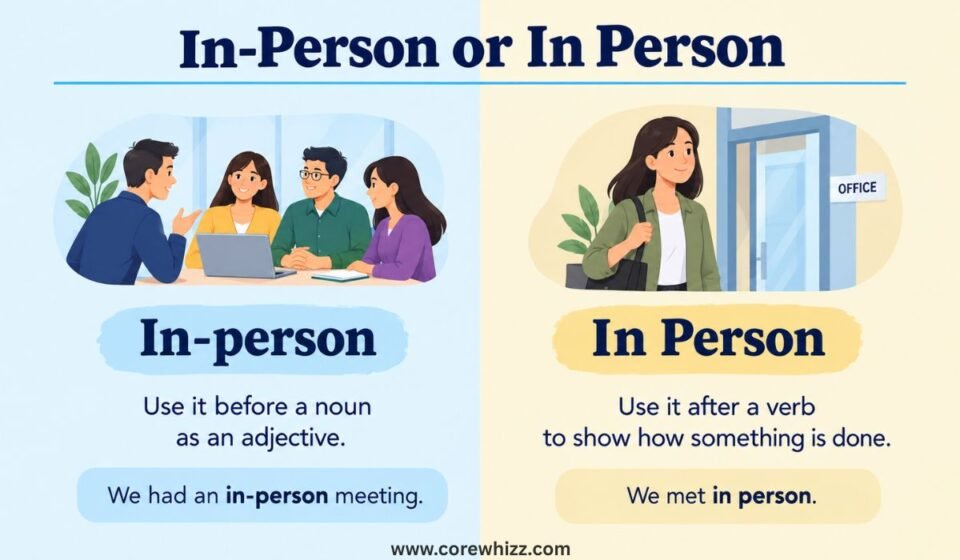
In-person (with a hyphen) is an adjective that describes a noun, like “in-person meeting” or “in-person interview.”
In person (no hyphen, two words) is an adverb phrase describing how something happens, like “we met in person.” The hyphen shows up before a noun, not after one.
What “In-Person” Means as an Adjective
When “in-person” sits directly before a noun, it becomes a compound adjective. Compound adjectives get hyphenated so readers instantly see the two words as one descriptive unit.
Think of “well known author” versus “well-known author.” Same logic applies here.
Examples:
- The company scheduled an in-person orientation for new hires.
- She prefers in-person classes over online ones.
- Our team held an in-person strategy session last week.
In each case, “in-person” is modifying a noun right next to it. That’s your signal to hyphenate.
What “In Person” Means as an Adverb Phrase
In person without a hyphen describes an action. It tells you how something happened, not what kind of thing it is.
Examples:
- I’d rather explain this in person.
- Please deliver the documents in person.
- We finally met in person after months of video calls.
Notice there’s no noun directly following “in person” in these sentences. It’s standing alone, doing adverb work.
The Origin of “In Person”
The phrase “in person” has roots going back centuries in English, originally meaning to appear physically rather than through a representative or written correspondence. Legal and formal writing used it to distinguish someone appearing themselves from someone sending an agent on their behalf.
The hyphenated adjective form came later, once English writers adopted the broader convention of hyphenating compound modifiers before nouns. This convention solidified through the 19th and 20th centuries as style guides like Chicago and AP formalized hyphenation rules for clarity.
More Confusing Words Made Simple: Chubby vs Fat: What’s the Real Difference?
Grammar Breakdown: Adjective vs Adverb
Here’s the grammatical mechanism in plain terms.
Adjectives describe nouns. When two words work together as a single adjective right before a noun, style guides recommend hyphenating them so the reader doesn’t misread the phrase.
Adverbs describe verbs, telling you how, when, or where an action happens. “In person” functions as an adverbial phrase, and adverbial phrases made of small function words generally don’t get hyphens.
A fast test: if you can swap in another hyphenated adjective and the sentence still makes sense, use “in-person.” If you can swap in “personally” and it still works, use “in person.”
Try it: “We met personally” makes sense, so “We met in person” is correct. But “It was a personally meeting” sounds wrong, confirming “in-person meeting” needs the hyphen.
Practical Usage in Professional Writing
Business writing leans on this distinction constantly, especially in job postings, HR communication, and event marketing.
- “This is an in-person role requiring daily office attendance.”
- “Candidates should be prepared to interview in person.”
- “The in-person portion of the conference runs three days.”
- “Registration closes Friday for those attending in person.”
Getting this right matters more in professional contexts because sloppy hyphenation reads as careless, even when the meaning is technically clear.
Practical Usage in Casual Writing
Texting a friend or writing a quick note? The stakes are lower, but the rule doesn’t change.
- “Can we just talk in person instead of texting this whole thing?”
- “It’s an in-person party, not a Zoom thing.”
- “I’ll explain everything in person tomorrow.”
Casual tone doesn’t mean casual grammar. The hyphen rule still applies the same way.
Comparison Table: In-Person vs In Person
| Form | Part of Speech | Placement | Example |
| In-person | Adjective | Before a noun | in-person meeting |
| In person | Adverb phrase | After a verb, standalone | met in person |
| In-person | Adjective | Before a noun | in-person training |
| In person | Adverb phrase | End of sentence | show up in person |
Common Mistakes People Make
- Hyphenating when there’s no noun following: “We talked in-person” (wrong, should be “in person”)
- Skipping the hyphen before a noun: “an in person meeting” (wrong, should be “in-person meeting”)
- Assuming hyphenation is optional stylistic choice rather than a grammar rule
- Mixing both forms inconsistently within the same document
The most frequent error by far is dropping the hyphen before a noun, especially in job listings and marketing copy where writers move fast and skip proofreading.
Real-Life Example: A Costly Typo
A recruiter at a mid-size company once posted a job listing that read “in person interview required.” No hyphen. A candidate assumed this meant something informal, maybe a casual coffee chat rather than a structured evaluation. She showed up in jeans expecting a quick conversation.
It was, in fact, a formal panel interview with four executives. The missing hyphen didn’t cause the misunderstanding by itself, but it added to a listing that already felt vague and unpolished. She didn’t get the job. Small grammar choices shape first impressions more than people realize.
Data and Trends: How Common Is This Mistake
Search data consistently shows thousands of monthly queries for variations like “in person or in-person,” “is in person hyphenated,” and “in-person vs in person grammar.” This volume signals a widespread, ongoing point of confusion rather than a rare edge case.
Style guide editors report that compound modifier hyphenation, including this exact phrase, ranks among the most frequently corrected errors in professional documents, job postings, and marketing materials. The mistake isn’t limited to casual writers. It shows up in corporate communications from companies with entire editorial teams.
Memory Trick to Remember the Difference
Here’s a trick that sticks. If the phrase touches a noun directly, glue the words together with a hyphen, like gluing two puzzle pieces before placing them next to a picture.
If the phrase stands alone describing an action, let it breathe as two separate words, the way you’d naturally say “in person” out loud with a pause between them.
Another trick: read the sentence and ask “in-person what?” If there’s a clear noun answering that question sitting right next to the phrase, hyphenate it.
Step-by-Step Guide to Using It Correctly
- Find the word immediately after “in person” or “in-person” in your sentence
- Check if that word is a noun (meeting, class, event, interview, training)
- If yes, hyphenate: “in-person meeting”
- If there’s no noun directly following, or the phrase comes at the end of a sentence, leave it unhyphenated: “meet in person”
- Read the sentence aloud. Adverb phrases often sound more natural at the end
- Proofread job postings and formal documents twice, since this is the highest-risk zone for errors
Mini Quiz: Test Your Knowledge
Answer each question, then check below.
- “We scheduled an ___ meeting for Tuesday.” (in-person / in person)
- “She’d rather discuss the offer ___.” (in-person / in person)
- “The ___ event sold out in two hours.” (in-person / in person)
- “Please submit the form ___.” (in-person / in person)
- “This is a fully ___ training program.” (in-person / in person)
- “He showed up ___ instead of calling.” (in-person / in person)
- “Our ___ workshop starts at 9 AM.” (in-person / in person)
Answers:
- in-person
- in person
- in-person
- in person
- in-person
- in person
- in-person
FAQ
Is “in-person” always hyphenated?
No. It’s hyphenated only when it directly precedes a noun, functioning as a compound adjective describing that noun.
Is “in person” two words or one?
It’s two separate words with no hyphen when used as an adverb phrase describing how an action happens.
Which style guides confirm this rule?
Both AP Style and Chicago Manual of Style treat “in-person” as a hyphenated compound modifier before nouns, and “in person” as unhyphenated elsewhere.
Can “in-person” ever come after the noun it modifies?
Rarely, but if it functions predicatively after a linking verb describing the noun, some style guides still hyphenate it, though usage varies.
Why does this phrase confuse so many writers?
Compound modifier rules aren’t intuitive, and both forms sound identical when spoken, so writers rely on visual memory rather than a clear rule.
Wrapping It Up
The hyphen rule for “in-person” and “in person” comes down to one simple check: is a noun sitting right next to it. If yes, hyphenate. If not, leave it as two words.
Once that pattern clicks, this becomes one of the easier grammar rules to apply consistently, even under deadline pressure.
Explore More: