
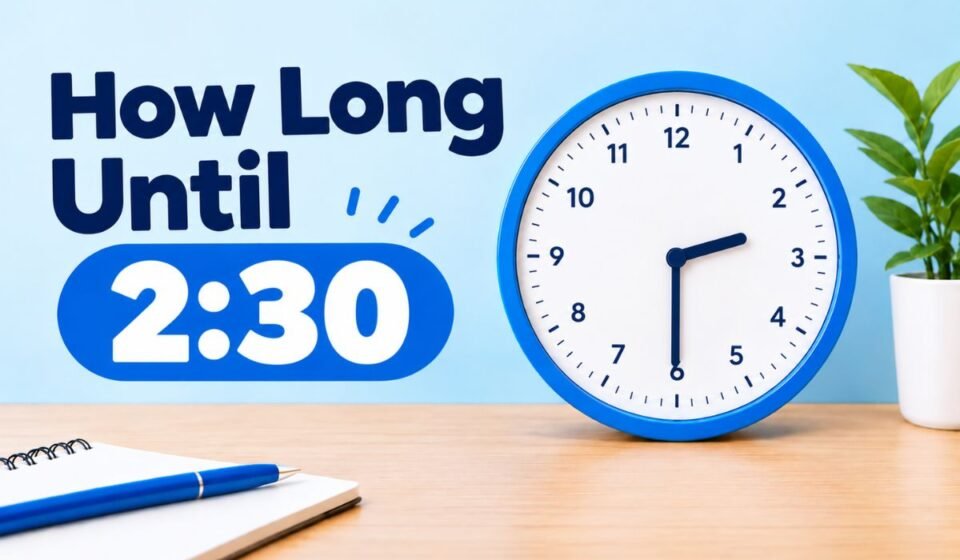

You glance at the clock and wonder, how long until 2:30? Maybe a meeting starts then. Maybe your flight boards, your shift ends, or the cake comes out of the oven.
The good news: you can work it out in about five seconds once you know the trick. This guide gives you the instant answer, a simple formula, and two ready-made tables so you never have to count on your fingers again.
Quick Answer: How Long Until 2:30?
To find how long until 2:30, subtract the current time from 2:30. If it is 12:00 PM, there are 2 hours and 30 minutes left until 2:30 PM. If it is already past 2:30, count forward to 2:30 the next day, which adds 24 hours to the gap.
That is the whole idea. Everything below just makes it faster and safer to use.
Here is the speed version:
- Note the current time.
- Decide if you mean 2:30 AM or 2:30 PM.
- Subtract, borrowing 60 minutes when needed.
- Convert the result into hours and minutes.
What Does “2:30” Mean (AM or PM)?
On its own, “2:30” is ambiguous. It can mean 2:30 AM (middle of the night) or 2:30 PM (early afternoon). People usually mean PM when they talk about meetings, lunch breaks, or classes, and AM when they talk about early flights or overnight shifts.
On a 24-hour clock, there is no confusion:
- 2:30 AM is written as 02:30
- 2:30 PM is written as 14:30
If you are setting an alarm or booking something important, always add the AM or PM. It takes one second and saves a lot of trouble.
Quick rule of thumb: if the time is during daylight business hours, assume PM. If it is dark outside, assume AM.
The Simple Formula to Calculate Time Until 2:30
The formula is short:
Time remaining = Target time − Current time
The only tricky part is minutes. Since an hour has 60 minutes, you sometimes need to borrow.
Method 1: Count to the Half Hour
This is the easiest mental trick. Break the trip into two jumps:
- Count the minutes to the next full hour.
- Add the hours and minutes from there to 2:30.
Example: It is 11:40 AM. From 11:40 to 12:00 is 20 minutes. From 12:00 to 2:30 is 2 hours 30 minutes. Total: 2 hours 50 minutes.
Method 2: Convert to Minutes
This works best when the numbers feel messy.
- Convert 2:30 PM to minutes from midnight: 14 × 60 + 30 = 870.
- Convert the current time the same way. For 11:40 AM: 11 × 60 + 40 = 700.
- Subtract: 870 − 700 = 170 minutes, which is 2 hours 50 minutes.
Both methods land on the same answer. Pick the one that feels natural to you.
When the Time Has Already Passed
Say it is 3:15 PM and you want the next 2:30 AM. Count from 3:15 PM to midnight (8 hours 45 minutes), then add 2 hours 30 minutes. The answer is 11 hours 15 minutes.
The pattern is simple: if 2:30 has already gone by today, you are really counting to tomorrow’s 2:30.
Also Read This Blog: How Long Until 12:15?
Quick Reference Table: Time Remaining Until 2:30 PM
Use this table when your target is the afternoon. Find the current time in the left column and read across.
| Current Time | Time Left Until 2:30 PM |
| 6:00 AM | 8 hours 30 minutes |
| 8:00 AM | 6 hours 30 minutes |
| 9:00 AM | 5 hours 30 minutes |
| 10:00 AM | 4 hours 30 minutes |
| 11:00 AM | 3 hours 30 minutes |
| 12:00 PM | 2 hours 30 minutes |
| 12:30 PM | 2 hours |
| 1:00 PM | 1 hour 30 minutes |
| 1:30 PM | 1 hour |
| 2:00 PM | 30 minutes |
| 2:15 PM | 15 minutes |
| 2:25 PM | 5 minutes |
Tip: bookmark this page. Most people check the same few times every day, and the table covers them.
Quick Reference Table: Time Remaining Until 2:30 AM
This table is for overnight targets, like early flights, night shifts, or late-night study sessions.
| Current Time | Time Left Until 2:30 AM |
| 6:00 PM | 8 hours 30 minutes |
| 8:00 PM | 6 hours 30 minutes |
| 9:00 PM | 5 hours 30 minutes |
| 10:00 PM | 4 hours 30 minutes |
| 11:00 PM | 3 hours 30 minutes |
| 12:00 AM (midnight) | 2 hours 30 minutes |
| 12:30 AM | 2 hours |
| 1:00 AM | 1 hour 30 minutes |
| 1:30 AM | 1 hour |
| 2:00 AM | 30 minutes |
Notice the pattern: the gaps match the PM table exactly. Only the clock labels change.
2:30 AM vs 2:30 PM: Key Differences
The numbers are identical, but the meaning is not. Here is how they compare.
| Feature | 2:30 AM | 2:30 PM |
| 24-hour format | 02:30 | 14:30 |
| Part of the day | Deep night | Early afternoon |
| Daylight | Dark almost everywhere | Full daylight |
| Typical use | Red-eye flights, night shifts, alarms | Meetings, classes, lunch breaks |
| Hours after midnight | 2.5 hours | 14.5 hours |
| Common mix-up | Mistaken for afternoon | Mistaken for night |
The biggest takeaway: they sit exactly 12 hours apart. If you know the gap to one, add or subtract 12 hours to get the other.
Real-Life Scenarios: When People Ask This
People rarely ask this question for fun. There is almost always a deadline behind it. Here are the situations where it comes up most.
Work & School Countdowns
A 2:30 PM bell or end-of-shift is one of the most common targets. Students watch the clock for dismissal. Office workers count down to a 2:30 call.
A useful habit is to check the time at the top of each hour. At 1:00 PM, you know you have 1 hour 30 minutes left. That is enough to finish one task and prep for the next.
Travel & Flight Timing
For flights, always confirm the time zone and whether the ticket uses the 24-hour format. A departure listed as 14:30 is 2:30 PM, not AM.
Travelers also need to work backward. If boarding closes at 2:30 PM and you want to be at the gate 45 minutes early, your real target is 1:45 PM. Calculate to that time instead.
Appointments & Meetings
Doctor visits, interviews, and video calls often start at 2:30 PM. Many people lose track of time because they assume they have longer than they do.
Try this: set a reminder 15 minutes before the target. If your appointment is at 2:30 PM, set the alert for 2:15 PM. You will arrive calm instead of rushed.
Cooking & Timers
In the kitchen, “until 2:30” often means a countdown, not a clock time. If a roast needs to rest until 2:30 PM and it is 1:50 PM, you have 40 minutes.
For anything with a precise finish, use a timer rather than doing the math in your head. Heat and distraction are bad partners for mental arithmetic.
Also Read This Blog: How Long Until 10:15?
Common Mistakes to Avoid
Most errors come from the same handful of slips. Watch for these.
- Forgetting AM and PM. This is the number one mistake. A 12-hour error is a big one.
- Not borrowing 60 minutes. Going from 1:50 to 2:30 is 40 minutes, not 80. Subtract carefully when the minutes are larger than 30.
- Treating minutes like decimals. 2:30 is 2.5 hours, not 2.3 hours. Time runs on base 60, not base 10.
- Ignoring midnight. When you cross 12:00 AM, the day changes. Add the hours before and after midnight separately.
- Overlooking time zones. A call at 2:30 PM in another city is not 2:30 PM where you are.
- Forgetting daylight saving shifts. On the days clocks change, a night can be 23 or 25 hours long. Double-check before relying on your math.
Do’s and Don’ts Table
Keep this quick checklist in mind whenever you count down to a time.
| Do | Don’t |
| Add AM or PM to every time you write down | Assume everyone reads “2:30” the same way |
| Use the 24-hour format (14:30) for travel and schedules | Mix 12-hour and 24-hour times in one plan |
| Count to the next full hour first, then add the rest | Subtract minutes without borrowing |
| Set a reminder 10 to 15 minutes early | Plan to arrive exactly at 2:30 |
| Check the time zone for calls and flights | Trust your local clock for remote events |
| Use a timer for cooking and short tasks | Rely on mental math when you’re stressed |
Related Time Terms You Should Know
A few related terms show up around this topic. Knowing them makes time questions much easier.
- Half past two: another way to say 2:30. In British English, you might hear “half two.”
- 24-hour clock (military time): a format that runs 00:00 to 23:59, so 2:30 PM becomes 14:30.
- Elapsed time: the amount of time that passes between two moments, such as 1 hour 30 minutes.
- Time remaining: the gap between now and a future moment. This is what you are calculating.
- Time zone offset: the difference between local time and a standard reference, usually UTC.
- Noon and midnight: 12:00 PM and 12:00 AM. They are the anchors that separate AM from PM.
- Countdown timer: a tool that counts down to a set time or duration automatically.
- Daylight saving time (DST): the seasonal clock shift that can add or remove an hour.
Final Takeaway
Figuring out how long until 2:30 comes down to one move: subtract the current time from 2:30, and always be sure which 2:30 you mean.
Here is what to remember:
- 2:30 AM and 2:30 PM are 12 hours apart.
- Count to the next full hour first, then add the remaining time.
- Remember that 2:30 is 2.5 hours, not 2.3.
- Use the tables above for instant answers.
- Set a reminder early so you are never caught off guard.
Save this page, check the table, and you will have your answer in seconds every time.


[…] check the clock and wonder, how long until 3:10? Maybe a meeting starts then. Maybe school lets out, a pill is due, or a flight boards. […]