


You check the clock and wonder, how long until 3:10? Maybe a meeting starts then. Maybe school lets out, a pill is due, or a flight boards. Whatever the reason, you want a number fast.
This guide gives you that number in seconds. You get a quick formula, a reference table, a worked example, and a mental shortcut. You also learn the traps that trip people up, from AM/PM mix-ups to daylight saving shifts.
Quick Answer: How Long Until 3:10?
To find how long until 3:10, subtract your current time from 3:10 and express the result in hours and minutes. If it is 2:10 now, you wait exactly one hour. If it is 3:00, you wait ten minutes. If 3:10 has already passed today, count forward to 3:10 tomorrow.
Always check whether you mean 3:10 AM or 3:10 PM. That single detail changes the answer by twelve hours.
At-a-Glance: Time Remaining Until 3:10
The table below shows the wait until 3:10 PM from common afternoon start times. Find your current time in the left column and read across.
| Current Time | Time Left Until 3:10 PM |
| 12:00 PM | 3 hours 10 minutes |
| 12:30 PM | 2 hours 40 minutes |
| 1:00 PM | 2 hours 10 minutes |
| 1:10 PM | 2 hours |
| 1:45 PM | 1 hour 25 minutes |
| 2:00 PM | 1 hour 10 minutes |
| 2:15 PM | 55 minutes |
| 2:30 PM | 40 minutes |
| 2:45 PM | 25 minutes |
| 3:00 PM | 10 minutes |
| 3:05 PM | 5 minutes |
| 3:10 PM | 0 minutes (it’s time) |
Waiting for the overnight version? Here is the same idea for 3:10 AM.
| Current Time | Time Left Until 3:10 AM |
| 10:00 PM | 5 hours 10 minutes |
| 12:00 AM (midnight) | 3 hours 10 minutes |
| 1:00 AM | 2 hours 10 minutes |
| 2:00 AM | 1 hour 10 minutes |
| 2:50 AM | 20 minutes |
Your exact minute probably sits between two rows. No problem. The next section shows how to fill the gap.
How to Calculate the Exact Time Until 3:10
You calculate the wait in four steps: confirm AM or PM, switch to 24-hour time, subtract, and split the result into hours and minutes. The method works for any target time, not just 3:10. Learn it once and you can skip every online calculator.
Step 1: Confirm Whether You Mean AM or PM
Decide first whether your target is 3:10 in the morning or 3:10 in the afternoon. Most people mean PM during the workday and AM when they talk about alarms, flights, or overnight shifts.
Think of it like picking the right bus before boarding. Both buses say “3:10” on the front. Only one goes where you need.
Step 2: Convert Both Times to a 24-Hour Format

Convert your current time and your target to 24-hour time so the math stays clean. The 24-hour clock removes the AM/PM guesswork entirely.
- 3:10 AM becomes 03:10
- 3:10 PM becomes 15:10
- For any PM time, add 12 to the hour (except 12 PM, which stays 12)
- For 12 AM, use 00
So 11:47 AM stays 11:47. And 8:25 PM becomes 20:25.
Step 3: Subtract Your Current Time From the Target Time
Subtract the current time from 3:10 (in 24-hour form) to get the gap. Work with hours and minutes separately.
Here’s the catch: minutes run out at 60, not 100. When the target minutes are smaller than your current minutes, borrow one hour and add 60 minutes to the target. For example, 15:10 becomes 14 hours and 70 minutes. Now you can subtract without negative numbers.
If the result is negative, 3:10 has already passed today. Add 24 hours to the target and subtract again.
Step 4: Break the Result Into Hours and Minutes
Write the answer as hours plus minutes, such as “3 hours 23 minutes.” If you need decimals, divide the minutes by 60. So 23 minutes equals about 0.38 hours.
Want total minutes instead? Multiply the hours by 60 and add the leftover minutes. For 3 hours 23 minutes, that gives 203 minutes.
Also Read This: How Long Until 11pm?
Step-by-Step Example Calculation
At 11:47 AM, you have 3 hours and 23 minutes until 3:10 PM. Here is the full walk-through.
- Confirm the target. You mean 3:10 PM.
- Convert to 24-hour time. Your target is 15:10 and your current time is 11:47.
- Handle the minutes. Ten is less than 47. Borrow an hour, so 15:10 turns into 14 hours and 70 minutes.
- Subtract. 70 minus 47 equals 23 minutes. Then 14 minus 11 equals 3 hours.
- State the result. 3 hours and 23 minutes.
Now try an overnight case. It is 8:25 PM, and you want 3:10 AM.
- Current time in 24-hour format: 20:25
- Target on the next day: 03:10 plus 24 hours, which is 27:10
- Subtract: 27:10 minus 20:25 equals 6 hours 45 minutes
A quick sanity check helps. From 20:25 to midnight takes 3 hours 35 minutes. Add the 3 hours 10 minutes after midnight, and you land on 6 hours 45 minutes again. The math holds up.
AM vs PM: Why the Distinction Matters So Much
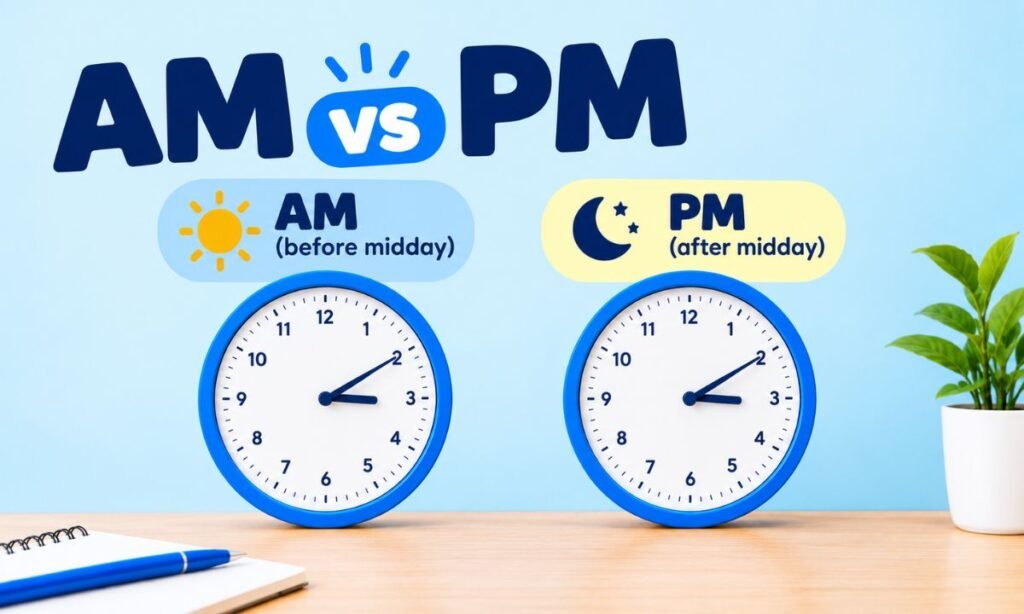
AM and PM matter because they flip your answer by twelve hours. A mistake here doesn’t cause a small error. It sends you to the wrong half of the day.
AM stands for ante meridiem, meaning before midday. PM stands for post meridiem, meaning after midday. Midnight starts the AM half. Noon starts the PM half.
The confusion peaks around 12:00. Many people call noon “12 AM” by mistake. In reality, 12:00 AM is midnight and 12:00 PM is noon.
Imagine setting a medication reminder for 3:10 and picking the wrong half. You would take a dose twelve hours off schedule. That risk is why careful people double-check the suffix, or simply switch to 24-hour time.
Common Real-Life Reasons People Search “How Long Until 3:10”
People search this phrase because 3:10 marks a real deadline, handoff, or appointment in their day. The query looks simple. The need behind it varies a lot.
- School pickup. Many schools dismiss students in the mid-afternoon, so parents watch the clock closely.
- Work meetings. A 3:10 call or shift change needs a countdown, especially for remote teams.
- Medication and health routines. Dosing windows depend on exact timing.
- Travel. Trains, buses, and flights often depart at odd minutes like 3:10.
- Exams and study blocks. Students pace themselves against a finish time.
- Cooking and timers. Some tasks end at a set clock time instead of a duration.
- Overnight work. Nurses, drivers, and security staff count down to early-morning handoffs.
- Curiosity and trivia. Some people simply like countdowns.
Each case has a different cost for being wrong. A missed school pickup stings. A missed flight costs far more.
Terminology & Related Concepts
These terms show up whenever you work with clock math. Knowing them makes any time calculator easier to read.
| Term | Plain-English Meaning |
| Time difference | The gap between two clock times |
| Elapsed time | How much time has already passed |
| Time remaining | How much time is left until a target |
| 24-hour clock (military time) | A system that counts hours from 00 to 23 |
| 12-hour clock | A system that uses AM and PM |
| Countdown timer | A tool that counts down to a set moment |
| Time zone | A region that shares one standard time |
| UTC | The global reference time used to compare zones |
| Daylight saving time (DST) | A seasonal shift that moves clocks by one hour |
| Midnight rollover | The point where one date ends and the next begins |
Related searches often include “time until,” “minutes until,” “hours from now,” and “time left today.” They all rest on the same subtraction skill.
Do’s and Don’ts When Calculating Time Differences
Follow a few simple habits and you will avoid nearly every time-math error. The lists below keep them handy.
Do’s
- Do confirm AM or PM before you calculate anything.
- Do convert to 24-hour time when the span crosses noon or midnight.
- Do borrow 60 minutes (not 100) when the minutes don’t line up.
- Do check your answer by counting forward from the current time.
- Do account for time zones if the event happens somewhere else.
- Do verify against a trusted clock when the stakes are high.
Don’ts
- Don’t treat minutes like decimals. Ten minutes is not 0.10 hours.
- Don’t assume the target falls on the same date.
- Don’t mix 12-hour and 24-hour values in one equation.
- Don’t forget that 12 AM is midnight and 12 PM is noon.
- Don’t ignore a daylight saving change between now and the target.
- Don’t rely on a rough guess for medical, travel, or legal deadlines.
Also Read This: How Long Until 12:15?
Common Mistakes People Make (And How to Avoid Them)
The most common mistakes are AM/PM swaps, bad borrowing, and forgetting the date change. Each one has a quick fix.
- Swapping AM and PM. You read 3:10 as afternoon when the alarm meant early morning. Fix: say the full phrase aloud, such as “3:10 in the afternoon.”
- Subtracting minutes the decimal way. Some people compute 3:10 minus 1:45 as 1.65 hours. That is wrong. Fix: convert to hours and minutes only, and borrow 60.
- Skipping the midnight rollover. At 11 PM, “3:10 AM” is tomorrow. Fix: add 24 hours to the target whenever the answer comes out negative.
- Confusing noon and midnight. Writing 12:30 AM when you mean lunchtime shifts everything. Fix: use 00:30 and 12:30 in 24-hour time.
- Ignoring time zones. A call at “3:10” may run on someone else’s clock. Fix: ask which zone applies, then convert before you subtract.
- Rounding too early. Dropping a few minutes feels harmless until it adds up. Fix: round only at the end.
Quick Mental Math Trick
Count to the next full hour first, then add the remaining hours and the final ten minutes. This “stepping stone” method beats formal subtraction when you’re in a hurry.
Suppose it is 1:48 PM. Here is how it plays out:
- From 1:48 to 2:00 takes 12 minutes.
- From 2:00 to 3:00 takes 1 hour.
- From 3:00 to 3:10 takes 10 minutes.
- Add them up: 12 + 60 + 10 = 82 minutes, or 1 hour 22 minutes.
Think of it as hopping across stones in a creek. You never leap the whole gap. You land on the hour, and then you move on.
Here’s a second shortcut. If the current time is past :10 (say 1:35), the wait is the remaining minutes to the hour plus 10. So 25 + 10 = 35 minutes after the 2:00 mark. If it’s before :10 (say 1:05), the answer is the hours left plus the small difference.
Frequently Overlooked Factor: Daylight Saving Time
Daylight saving time can add or remove an hour from your countdown if a clock change falls between now and 3:10. Most people forget this because it only matters twice a year.
In the United States, clocks jump forward on the second Sunday of March. They fall back on the first Sunday of November. This year, the fall-back date is Sunday, November 1, 2026. Both changes happen at 2:00 AM local time, which sits right next to a 3:10 AM target.
Here is what that means in practice:
- Spring forward: At 1:00 AM, you wait only 1 hour 10 minutes until 3:10 AM. The clock skips from 2:00 straight to 3:00.
- Fall back: At 1:00 AM, you wait 3 hours 10 minutes until 3:10 AM. The 1:00 hour repeats once.
Devices usually adjust on their own. Manual math doesn’t. If your countdown crosses a changeover night, add or subtract that extra hour yourself. Also remember that many regions, including much of Arizona and Hawaii, don’t observe DST at all.
Conclusion
To know how long until 3:10, confirm AM or PM, convert to 24-hour time, subtract, and split the answer into hours and minutes. Use the reference table for a fast read. Use the stepping-stone trick when you only have a few seconds.
You now have a repeatable system. It works for school pickups, shift changes, flights, and midnight alarms alike. Watch for the three big traps too: AM/PM swaps, minute borrowing, and daylight saving shifts.
Next time 3:10 looms on your schedule, run the four steps. In under a minute, you will know exactly how much time you have left.