
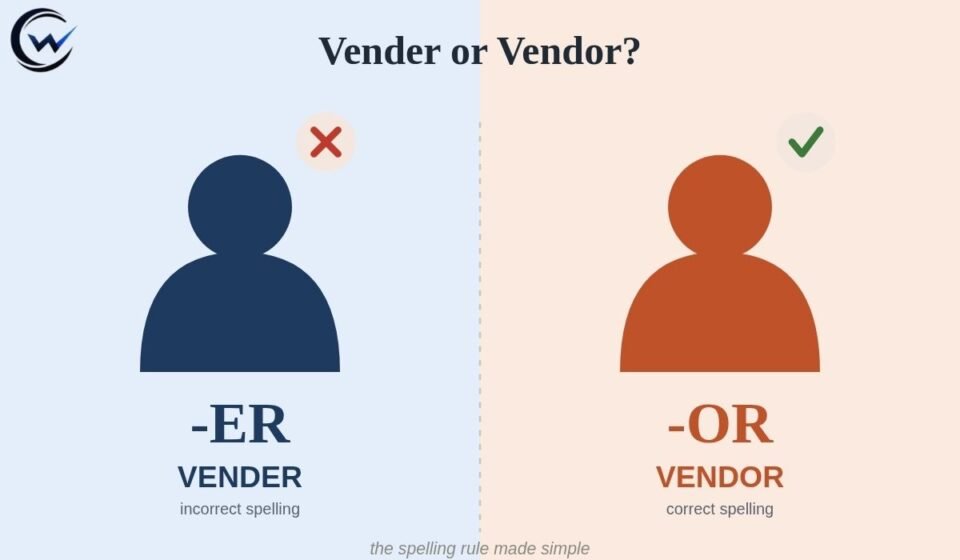

You typed it, stared at it, and now it looks wrong. Is it “vender” or “vendor“? Autocorrect keeps flipping it, your coworker spells it differently than you, and now you’re not sure which one belongs in your email.
Here’s the good news: this mix-up has a simple, permanent fix.
Quick Answer: Vender or Vendor?
Vendor is the correct spelling in standard American and British English. It means a person or business that sells goods or services.
Vender is an old, rarely used variant that most dictionaries now label as outdated or nonstandard. If you’re writing anything today, business email, a contract, a blog post, use vendor.
Vendor vs Vender at a Glance
| Feature | Vendor | Vender |
| Standard spelling | Yes | No |
| Used in modern English | Yes | Rarely |
| Found in dictionaries | Primary entry | Listed as archaic variant |
| Business and legal use | Correct | Incorrect |
| Common in | Contracts, retail, tech, marketing | Old texts, some legal archives |
The table makes it obvious. One spelling does all the work in modern writing, and it’s not vender.
What Does “Vendor” Mean?
A vendor is any person or company that sells something. That could be a street food cart, a software company selling licenses, or a supplier delivering parts to a factory.
The word covers a huge range of business relationships. A vendor might sell you a taco from a cart, or they might be a Fortune 500 company supplying cloud servers to a bank.
In business contracts, “vendor” specifically refers to the seller named in the agreement, the party providing goods or services in exchange for payment.
Where Did the Word “Vendor” Come From?
“Vendor” traces back to the Latin word vendere, which means “to sell.” That root traveled through Old French before settling into English, keeping its “or” ending along the way.
English has a habit of keeping Latin agent nouns with “-or” endings, think actor, director, and creator. Vendor followed the same pattern.
“Vender” popped up as a phonetic spelling variant centuries ago, back when English spelling wasn’t standardized yet. It survived in some old documents, but it never became the accepted form.
What Does “Vender” Mean (and When Is It Actually Correct)?
Here’s the honest answer: vender almost never shows up correctly in modern writing. It’s not a different word with a different meaning. It’s simply an outdated spelling of vendor.
You might spot “vender” in older printed material, some non-English languages that borrowed the Latin root differently, or in the occasional typo that spellcheck missed. That’s really it.
If you see “vender” used seriously in a business document today, treat it as a spelling error, not a stylistic choice.
Vendor in a Sentence: Real Examples
Seeing the word in context helps it stick. Here are a few natural examples:
- The vendor delivered the new inventory a day early.
- Our legal team is finalizing the contract with the software vendor.
- She runs a small jewelry vendor booth at the weekend market.
- The city requires every food vendor to carry a health permit.
Each sentence uses vendor the same way English speakers have used it for generations: as the seller in a transaction.
More Confusing Words Made Simple: Parent’s or Parents’? The Simple Rule You’ll Never Forget
Vender in a Sentence: Real Examples
Since vender is outdated, there’s no modern sentence where it’s the preferred choice. But here’s what it would have looked like in older writing:
- The traveling vender sold spices along the road.
That kind of phrasing feels dated on purpose. If you wrote that sentence today, most editors would flag it immediately and swap in vendor.
Why People Mix Up Vender and Vendor
Part of the confusion comes from pronunciation. Both words sound almost identical when spoken out loud, so the ear doesn’t catch the difference.
Autocorrect tools sometimes make it worse. Older spellcheck databases occasionally kept “vender” listed as a valid word, which gave people false confidence.
There’s also a language crossover effect. Spanish speakers might notice “vendedor” (seller) looks close to “vender,” and that visual similarity nudges some writers toward the wrong English spelling.
Common Mistakes to Avoid
A few patterns show up again and again in vendor related writing. Watch for these:
Mistake 1: Writing “vender” in business contracts or invoices. Always use vendor.
Mistake 2: Confusing vendor with “vending,” as in a vending machine. They share a root but function differently in a sentence.
Mistake 3: Assuming vender is a regional British spelling. It isn’t. British English also uses vendor.
Mistake 4: Mixing up vendor with vendee. A vendee is the buyer, not the seller, so these two words sit on opposite sides of a deal.
Vendor vs Seller vs Supplier: Quick Clarification
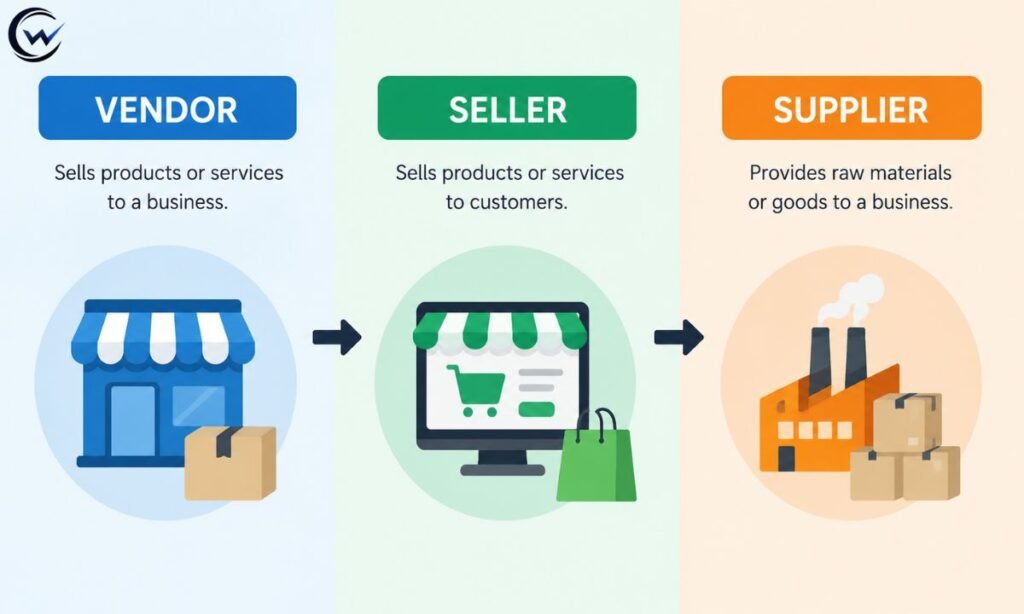
These three words get tossed around like they’re interchangeable, but there are small differences worth knowing.
- A seller is the broadest term, anyone offering something for sale, in any setting.
- A vendor usually implies a more formal or ongoing business relationship, especially in retail, events, or contracts.
- A supplier typically provides raw materials or products to another business rather than directly to the end customer.
So a vendor could technically be a seller, but not every seller earns the vendor label in a professional context.
How to Remember the Right Spelling
Here’s a trick that actually works. Think of other “-or” job titles: actor, director, sponsor, inventor. Vendor fits right into that family.
If a word ending sounds like it belongs with those professional titles, it almost always takes “-or,” not “-er.” That small mental shortcut saves you from ever typing vender again.
FAQs About Vender or Vendor
Is “vender” a real word?
Technically yes, but it’s an archaic spelling of vendor that modern dictionaries mark as outdated. It shouldn’t appear in current professional or academic writing.
Which spelling does Merriam-Webster use?
Merriam-Webster lists vendor as the standard spelling. “Vender” doesn’t appear as a recommended or primary entry.
Is vendor spelled differently in British English?
No. British English also uses vendor, so there’s no regional variation to worry about here.
What’s the difference between a vendor and a vendee?
A vendor sells the goods or services, while a vendee is the buyer in that same transaction. They represent opposite sides of a sale.
Can I use “vendor” and “supplier” as synonyms?
Sometimes, but not always. Vendor tends to describe someone selling directly, while supplier usually refers to a business providing materials or products further up the supply chain.
Final Thoughts
The spelling debate between vender and vendor really isn’t a debate at all. Vendor wins, every single time, in every professional, academic, or casual context you’ll run into.
Vender had its moment centuries ago, but English moved on, and so should your writing. Stick with vendor, and you’ll never second guess that word again.