
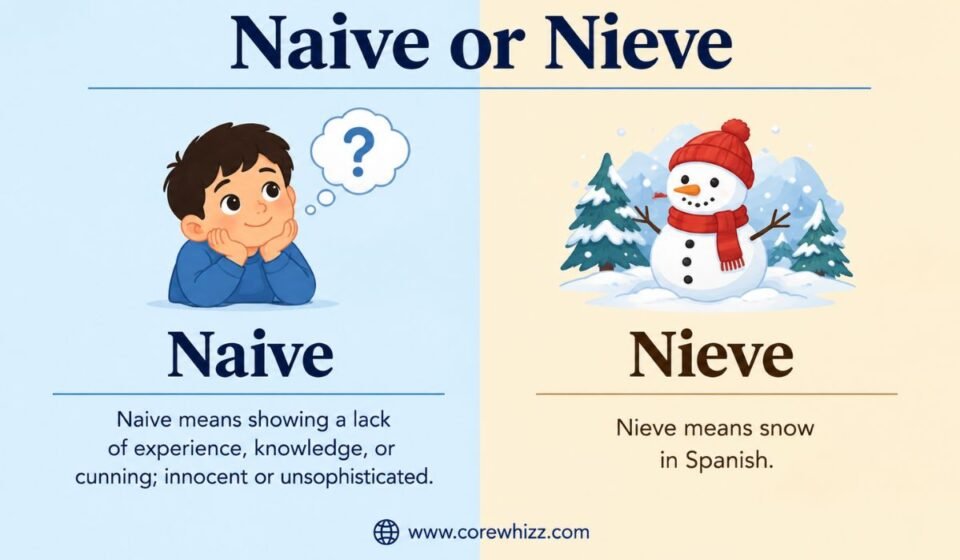

You typed the word, paused, and stared at it. Something looked off. Is it naive or nieve? If you have ever hesitated over this spelling, you are not alone. The two vowels can make this simple word surprisingly confusing, especially when you are unsure which letter comes first.
The correct spelling is naive, not nieve. In this article, you will learn the difference, understand what naive means, and see simple examples to help you remember the correct spelling.
Quick Answer: Naive or Nieve?
Naive is the correct spelling. Nieve is a misspelling in English and does not exist as an English word.
Naive is an adjective meaning innocent, inexperienced, or overly trusting. It comes from French and keeps its original vowel order, which is a before i.
- So the sentence is “He was naive about the offer,” never “He was nieve about the offer.”
Worth knowing: nieve is a real word, just not in English. In Spanish it means snow.
What Does Naive Actually Mean?
Naive describes someone who lacks experience, judgment, or suspicion. It suggests a person who believes things too easily because they have not been burned yet.
The tone shifts with context. Sometimes it means charmingly innocent. Other times it means gullible, and that version stings a little. A child who thinks the tooth fairy negotiates rates is naive in the sweet way. An adult who wires money to a stranger promising a 400 percent return is naive in the expensive way.
Naive vs Nieve: Quick Comparison Table
| Feature | Naive | Nieve |
| Correct in English? | Yes | No |
| Part of speech | Adjective | Not an English word |
| Meaning | Innocent, inexperienced, overly trusting | Spanish noun meaning “snow” |
| Pronunciation | nye-EEV | nee-EH-veh (Spanish) |
| Vowel order | a, i, e | i, e, e |
| Example | “That was a naive assumption.” | Incorrect in English writing |
Why So Many People Write “Nieve”
The mistake comes from sound, not carelessness. English speakers hear “nye-EEV” and their brain reaches for the familiar ie pattern found in words like believe, relieve, and achieve. That instinct is reasonable. It is also wrong here, because naive never went through English spelling rules in the first place.
Autocorrect deserves some blame too. On many keyboards, nieve passes as a valid Spanish word and slips through without a red underline.
Where Naive Came From
Naive entered English in the 1650s from the French word naïve, the feminine form of naïf. French took it from the Latin nativus, meaning natural or innate.
That Latin root is the same one behind native. Both words trace back to the idea of something in its original, untouched state.
Knowing this helps the spelling stick. The nat in native softened into nai in French, so the a comes first for the same reason it does in native.
Here we have more helpful guides on Grammar:
How to Pronounce Naive Correctly
Say it as nye-EEV, with the stress on the second syllable. Two syllables total, not three.
The first syllable rhymes with “eye.” The second rhymes with “leave.”
Common slip ups include “nay-eev” and “neev.” Both sound off to a native ear, and the second one is likely what pushes people toward that phantom nieve spelling.
Naive, Naïve, or Naif: Which Spelling Should You Use?
Use naive for standard American English. It is the dominant form in US publications, news outlets, and everyday writing.
Naïve, with the two dots over the i, is the original French spelling. Those dots are called a diaeresis, and they signal that the a and i are pronounced separately instead of blending. You will see it in literary writing and in some British publications. It is not wrong, just formal.
Naif is a rarer variant, usually used as a noun for an unsophisticated person. Most writers can safely skip it.
Pick one style and hold it steady across a document. Mixing naive and naïve on the same page looks sloppy.
How to Use Naive in a Sentence
Naive works as an adjective, so it describes a person, a belief, an assumption, or an approach. Place it before a noun or after a linking verb. Both positions are natural.
Examples that show the range:
- “She had a naive faith in the company’s promises.”
- “It would be naive to expect a refund after six months.”
- “His naive optimism carried the team further than anyone expected.”
- “I was young and naive, and I signed without reading page two.”
Notice that naive can be affectionate or critical depending entirely on the sentence around it.
Naivety, Naiveté, or Naiveness? The Noun Forms
Naive has three noun forms, and two of them are common.
Naivety is the standard everyday noun. “Her naivety cost her the deposit.”
Naiveté is the French borrowing, pronounced nah-eev-TAY. It carries a slightly more elegant, literary feel and shows up often in essays and criticism.
Naiveness exists in dictionaries but almost nobody uses it. Avoid it unless you enjoy sounding like a translated instruction manual.
The adverb is naively, as in “He naively assumed the meeting would run short.”
Is Naive an Insult?
Not automatically, but it lands harder than most people expect. Calling someone’s idea naive is a critique of their judgment, which is a personal thing to question. In a work email, that word can turn a discussion into a defense.
Softer options include optimistic, idealistic, or untested. Sharper options include gullible or credulous. When describing yourself, though, naive is disarming and often charming. “I was naive back then” invites sympathy. “You are being naive” invites an argument.
Common Mistakes People Make With Naive
Writing nieve. The big one. Reversing the vowels makes it a Spanish noun, not an English adjective. Writing naiive or naieve. Extra vowels sneak in when people overcorrect after being told the spelling is unusual.
Using it as a noun. “He is a naive” does not work. Say “He is naive” or “He is a naif.” Mispronouncing it as “neev.” This single syllable version feeds the misspelling directly. Adding the diaeresis inconsistently. Writing naïve in your headline and naive in your body copy signals a rushed edit.
Easy Memory Tricks to Never Misspell Naive Again
Link it to native. Both start with na, both come from the same Latin root, and both describe something in its natural state. If you can spell native, you can spell naive.
Try the phrase “A naive Ivy.” The word hides the letters i and v in order, and the A leads the way.
Or remember the snow rule: if you write nieve, you just described weather in Spanish. Unless your character is literally standing in a snowdrift, fix the vowels.
Frequently Asked Questions
Is nieve ever correct in English?
No. Nieve is not an English word. It only appears in Spanish, where it means snow.
What is the difference between naive and naïve?
None in meaning. Naïve is the French spelling with a diaeresis, while naive is standard in American English.
Is naive a negative word?
It can be. Directed at another person, naive usually criticizes their judgment or suggests they are too trusting.
How do you spell the noun form of naive?
Use naivety for general writing. Naiveté is the French form, and naiveness is technically correct but rarely used.
What is a good synonym for naive?
Innocent, inexperienced, credulous, gullible, idealistic, unworldly, and trusting all work depending on the tone you want.
Final Thoughts
Naive is one of those words that looks wrong even when it is right, which is exactly why so many writers hesitate over it.
Keep the anchor simple. The word follows French rules, not English ones, so the a comes before the i, just like in native.
Once that clicks, nieve stops looking tempting. You will spot it in other people’s writing and quietly wonder how you ever typed it yourself.