
Ever paused while writing because showed or shown suddenly looked confusing? It happens more often than you might think, especially when both forms sound natural. The real difference comes down to how each word works in a sentence.
Showed is the simple past form, while shown is the past participle and usually needs a helping verb. Once you understand that small difference, choosing the right one feels almost effortless.
In this guide, we’ll break it down with simple rules, natural examples, and everyday sentences you can actually use.
Quick Answer: Showed or Shown?
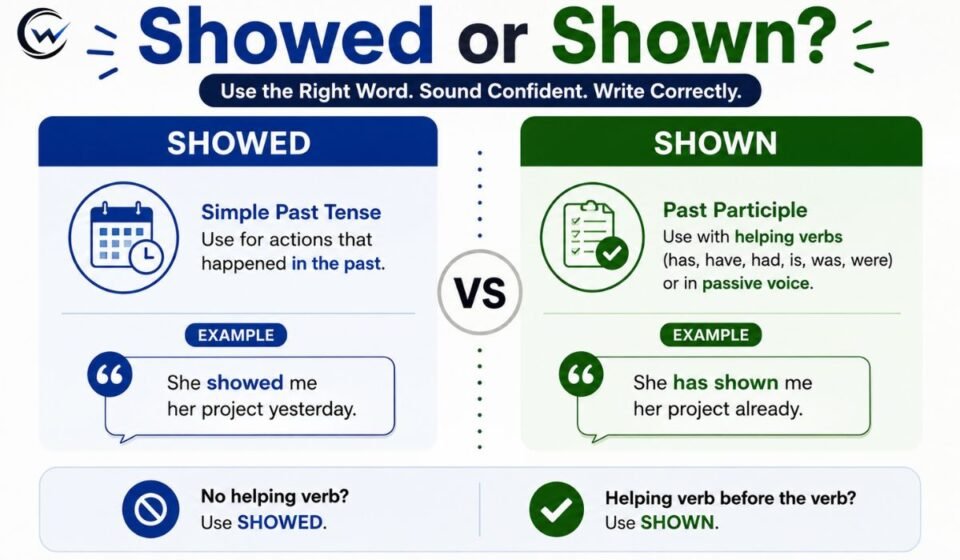
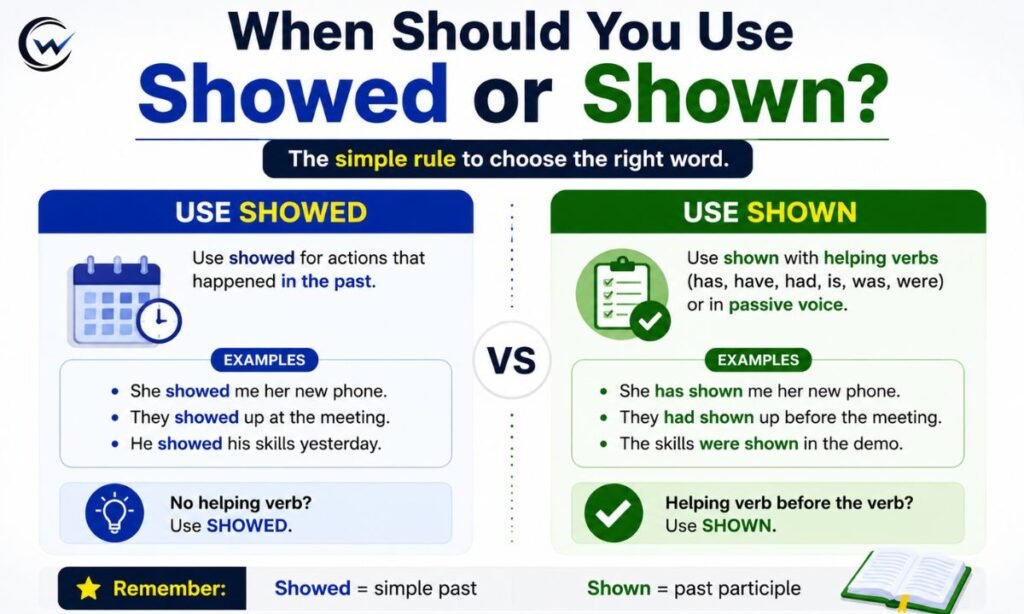
Showed is the simple past tense of show and can stand alone.
Shown is the past participle of show and normally needs a helping verb such as has, have, had, is, are, was, or were.
For example:
- She showed me the report yesterday.
- She has shown me the report already.
- The report was shown to the manager.
So, if you’re talking about a completed past action and there’s no helping verb, use showed. If a helping verb comes before it, shown is usually the correct choice.
The Basic Difference Between Showed and Shown
The easiest way to understand these words is to look at their grammatical jobs.
Showed describes an action that happened in the past.
Shown is a past participle, so it generally appears with another verb.
Think of it this way:
| Word | Grammar | Typical Pattern | Example |
| Showed | Simple past | Subject + showed | He showed the picture. |
| Shown | Past participle | Subject + has shown | He has shown the picture. |
| Shown | Past participle | Subject + had shown | He had shown the picture. |
| Shown | Passive form | Subject + was shown | The picture was shown. |
There’s one useful detail here. Shown doesn’t always follow has, have, or had. It can also appear in passive constructions with forms of be, such as was shown, were shown, or is shown.
More Confusing Words Made Simple: Oversite or Oversight
What Does Showed Mean?
Showed is the simple past form of the verb show. You use it when someone performed the action at a definite point in the past. The action is already finished.
For example:
- Marcus showed me his new car.
- She showed us the finished project.
- They showed their tickets at the entrance.
- I showed him where the office was.
- The teacher showed the class an example.
Notice something important in each sentence. Showed doesn’t need another verb before it. That’s the main reason it’s so easy to recognize.
You can say:
She showed me the answer.
You wouldn’t say:
She shown me the answer.
That second sentence is grammatically incorrect because shown cannot normally function as the simple past form by itself.
What Does Shown Mean?
Shown is the past participle form of show. A past participle usually works with a helping verb.
For example:
- She has shown great patience.
- He had shown me the document.
- They have shown strong interest.
- The movie was shown at the theater.
- The results were shown on the screen.
Here, shown isn’t carrying the tense alone. The helping verb does that job.
Compare these two sentences:
He showed me the photo.
He has shown me the photo.
The first sentence uses the simple past. The second uses the present perfect. That’s why changing showed to shown can also change the entire verb structure.
Showed vs Shown in a Simple Comparison
If you only remember one section from this article, make it this one.
| Situation | Correct Word | Example |
| A finished past action | Showed | She showed me her notes. |
| Present perfect | Shown | She has shown me her notes. |
| Past perfect | Shown | She had shown me her notes. |
| Passive voice | Shown | Her notes were shown to me. |
| Simple past without a helper | Showed | She showed her notes yesterday. |
Here’s the shortcut:
No helping verb? Usually use showed. Helping verb before the verb? Usually use shown. This simple test handles most everyday writing situations.
When Should You Use Showed?
Use showed when you’re describing something that happened in the past.
Common time expressions include:
- yesterday
- last night
- last week
- two hours ago
- in 2024
- when I was younger
- earlier that day
Examples:
- Jake showed me the email yesterday.
- Sarah showed up late last night.
- The coach showed us the new strategy.
- I showed my parents the results.
- She showed remarkable improvement last year.
You can also use showed without an obvious time expression.
For example:
He showed me the way home.
The sentence still clearly describes a completed past action.
When Should You Use Shown?
Use shown when the sentence requires a past participle. The most common pattern is with has, have, or had.
Examples:
- She has shown tremendous improvement.
- They have shown interest in the proposal.
- He had shown the documents before the meeting.
- We have shown that the method works.
- The study has shown promising results.
You can also use shown in passive sentences.
For example:
- The video was shown to the students.
- The evidence was shown during the trial.
- The results were shown on the screen.
- The advertisement was shown during the game.
So don’t rely on the rule that shown must always follow has, have, or had. The broader rule is more accurate: shown is a past participle and needs a suitable auxiliary or helping verb in standard constructions.
Showed and Shown in Everyday Sentences
Real examples make this distinction much easier to remember.
Consider these pairs:
Simple past:
She showed me her new apartment.
Present perfect:
She has shown me her new apartment.
Another pair:
Simple past:
Tom showed everyone his collection.
Past perfect:
Tom had shown everyone his collection before dinner.
And another:
Active voice:
The teacher showed the students the experiment.
Passive voice:
The experiment was shown to the students.
The meaning can remain closely related, but the grammar changes. That’s why the correct choice depends on the sentence around the word.
Common Mistakes With Showed and Shown
The most common mistake is using shown as though it were the simple past.
Incorrect:
She shown me the picture yesterday.
Correct:
She showed me the picture yesterday.
Another common mistake is using showed after a helping verb when shown is required.
Incorrect:
He has showed me the report.
Correct:
He has shown me the report.
The same pattern applies to had.
Incorrect:
They had showed us the results.
Correct:
They had shown us the results.
A quick grammar check can save you here. Look at the word before showed or shown. If you see has, have, or had, shown is normally the form you want.
Why People Confuse Showed and Shown
The confusion makes sense because many English verbs have different past forms.
For example:
- go, went, gone
- see, saw, seen
- write, wrote, written
- take, took, taken
- show, showed, shown
With show, the simple past and past participle aren’t as obviously different as they are with go or write. That’s where people get caught. Someone might know that shown is a past form but forget that it needs a helping verb.
The safest approach isn’t to memorize complicated grammar terminology. Instead, check how the verb functions in the sentence.
The Grammar Behind Showed and Shown
English verbs can have several forms that perform different grammatical jobs.
For show, the main forms are:
- show: present form
- shows: third person singular present
- showed: simple past
- shown: past participle
- showing: present participle
The key distinction here is between showed and shown.
The simple past can normally stand alone:
She showed the manager the file.
The past participle generally works with an auxiliary:
She has shown the manager the file.
This distinction is common across English grammar. Understanding it will also help you with verbs such as write, take, eat, and see.
Where Did Show, Showed, and Shown Come From?
The verb show has a long history in English. It comes from Old English scēawian, meaning to look at, inspect, or see. Over time, the word developed into the modern English verb show.
Its older forms also help explain why English has both showed and shown. Modern English eventually settled on showed as the regular simple past form, while shown remained the traditional past participle.
That gives us the modern pattern:
show → showed → shown
It’s not an arbitrary spelling difference. Each form has a different grammatical role.
More Confusing Words Made Simple: Signer or Signor
A Fast Trick to Remember the Difference
Here’s an easy memory trick.
Think:
- Showed = happened.
- Shown = has been shown.
If you’re describing something that happened in the past, showed will often fit.
She showed me the message.
If another verb is helping create the verb phrase, shown may be needed.
She has shown me the message.
You can also ask yourself:
Can I remove the helping verb?
If removing it leaves a normal simple past sentence, you may need showed instead.
For example:
He showed the document.
That works.
He shown the document.
That doesn’t.
But:
He has shown the document.
That works perfectly.
Showed or Shown in Formal Writing
The same grammar rules apply in emails, essays, reports, applications, and professional documents.
For example:
The results showed a significant difference.
This is correct because showed is the main past tense verb.
You could also write:
The results have shown a significant difference.
That’s correct too, but the tense has changed.
The first sentence reports a completed past finding. The second connects the finding with the present. In professional writing, choosing the right form helps make your meaning precise.
Frequently Asked Questions
Is “showed” the past tense of show?
Yes, showed is the simple past tense of show. Use it for completed actions that happened earlier.
Is “shown” the past tense of show?
No, shown is the past participle. It usually follows helping verbs like has, have, had, or was.
Should I say “I showed him” or “I shown him”?
Use I showed him because showed works as the simple past without needing a helping verb.
Is “has showed” or “has shown” correct?
Has shown is correct because has requires the past participle form, which is shown.
Is “was shown” grammatically correct?
Yes, was shown is correct. Was acts as the helping verb, while shown works as the past participle.
Final Answer: Showed or Shown?
The difference between showed and shown becomes simple once you identify the verb form.
Use showed for the simple past:
She showed me the picture.
Use shown as a past participle with an appropriate helping verb:
She has shown me the picture.
You can also use shown in passive constructions:
The picture was shown to everyone.
So, when you’re stuck, look at the sentence structure rather than the word alone. Showed can stand on its own as the past tense. Shown normally needs a helping verb. That one rule will solve most showed or shown questions you run into while writing.