

You’re typing up a document, or maybe reading an old letter with an Italian name in it, and suddenly you freeze. Is it signer or signor? They look almost identical, sound similar out loud, and autocorrect definitely won’t save you here.
Get it wrong in a legal document or a formal greeting and you’ll look careless at best, confusing at worst. Here’s the simple fix so you never mix them up again.
Quick Answer: Signer or Signor?
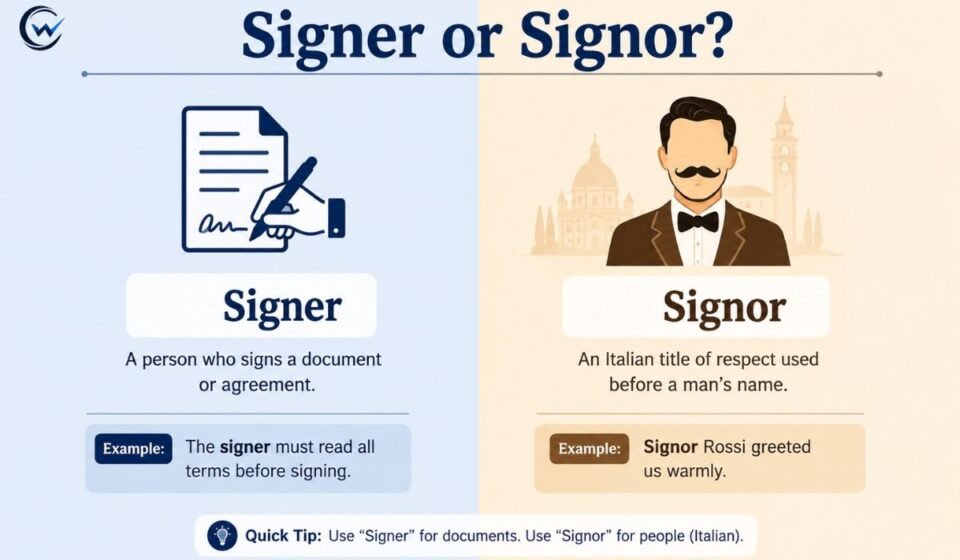
Signer is the person who signs something, like a contract, check, or petition. Signor is an Italian title of respect for a man, similar to “Mister” or “Sir” in English.
If someone put their name on a document, they’re a signer. If you’re addressing an Italian gentleman formally, he’s a signor. Different jobs, different words, easy to remember once you see them side by side.
Signer vs Signor: Quick Comparison Table
| Feature | Signer | Signor |
| Meaning | A person who signs something | Italian title for “Mister” or “Sir” |
| Word type | Noun (English) | Noun (Italian loanword) |
| Origin | From the verb “to sign” | From Italian “signore” |
| Example use | “The signer of the lease must be 18.” | “Good evening, Signor Rossi.” |
| Common context | Legal, business, everyday English | Names, formal address, Italian culture |
What Does “Signer” Mean?
A signer is anyone who puts their signature on something. That’s it. No hidden complexity here.
You’ll see this word everywhere in daily life. Someone signs a mortgage, a birthday card, a petition at a farmers market, a will. All of them are signers.
The word comes straight from the English verb “sign,” plus the suffix “er,” which turns an action into the person doing it. Just like “runner” runs and “teacher” teaches, a signer signs.
Example sentences:
- Every co-signer on the loan needs to provide ID.
- The petition needed 500 signers before it could go to a vote.
- She was the first signer of the class agreement.
What Does “Signor” Mean?
Signor is an Italian honorific. It’s the equivalent of calling a man “Mister” or “Sir” in English.
You’ll usually see it attached to a name, like Signor Bianchi or Signor Rossi. It shows respect, and it’s used the same way “Monsieur” works in French or “Herr” works in German.
In Italian, the full spelling is actually “signore.” English speakers and writers often trim it to “signor” when using it as a title directly before a name, similar to how “doctor” becomes “Dr.” before a surname.
Example sentences:
- The waiter greeted him with a warm “Buonasera, Signor Marino.”
- Signor Vitale runs the small bakery on the corner.
- In the opera, the count is addressed as Signor throughout the entire second act.
More Confusing Words Made Simple: Messege or Message
Where Does Each Word Come From?
This is where the confusion actually makes sense. These two words aren’t related at all, they just happen to look similar.
Signer traces back to Old French “signer” and Latin “signare,” meaning to mark or seal. English absorbed the root and built its own noun form using the standard “er” ending.
Signor comes directly from Italian. It descends from the Latin word “senior,” meaning elder or someone of higher rank. Over centuries, Italian shaped “senior” into “signore,” and that eventually gave English speakers the shortened form “signor.”
So one word is homegrown English tied to the act of signing. The other is an imported title tied to Italian social customs and rank. Different languages, different histories, similar spelling. That’s the whole trap.
How to Remember the Difference
Here’s a trick that sticks. Signer has the word “sign” sitting right inside it. If you can picture a pen touching paper, you’re thinking of the right word.
Signor doesn’t relate to signing at all. Think of it next to its Italian sibling, “signora,” which means “Mrs.” or “Madam.” If you know one, you know the other belongs to the same family of titles.
Another trick: signor almost always comes before a name, like a title. Signer almost always comes after context about a document or agreement. Notice the pattern and the confusion mostly disappears.
Signer or Signor in a Sentence: Real Examples
Seeing both words used naturally makes the difference click faster than any rule.
Using signer:
- The bank requires two signers on a joint account.
- As the sole signer of the contract, she assumed full responsibility.
- Every signer of the Declaration of Independence risked their life doing it.
Using signor:
- “Signor, your table is ready,” the host said with a polite nod.
- The letter opened formally: “Dear Signor Alberti.”
- Tourists often mispronounce Signor when greeting shop owners in Florence.
Notice how signer fits naturally into legal, business, and everyday American English. Signor mostly shows up in formal address, travel writing, or dialogue involving Italian characters or culture.
Common Mistakes People Make
The biggest mistake is using signor when you actually mean the person who signed a document. If you’re filling out paperwork, you almost never need signor. Save that word for Italian titles only.
The second mistake goes the other way. Writers sometimes use signer when trying to sound formal or European, thinking it’s some fancier version of “sir.” It isn’t. Signer has zero connection to titles or respect, it’s purely functional.
A smaller mix up happens with signature. Some people assume “signor” relates to “signature” because the spelling feels close. It doesn’t. Signature and signer share a root, but signor is a completely separate Italian import.
One more trap: autocorrect. Many spellcheckers don’t flag “signor” as wrong even in a legal document, because it’s a real word, just the wrong one for that context. Proofread manually when both words could plausibly appear.
Signer, Signor, and Signore: What’s the Difference?
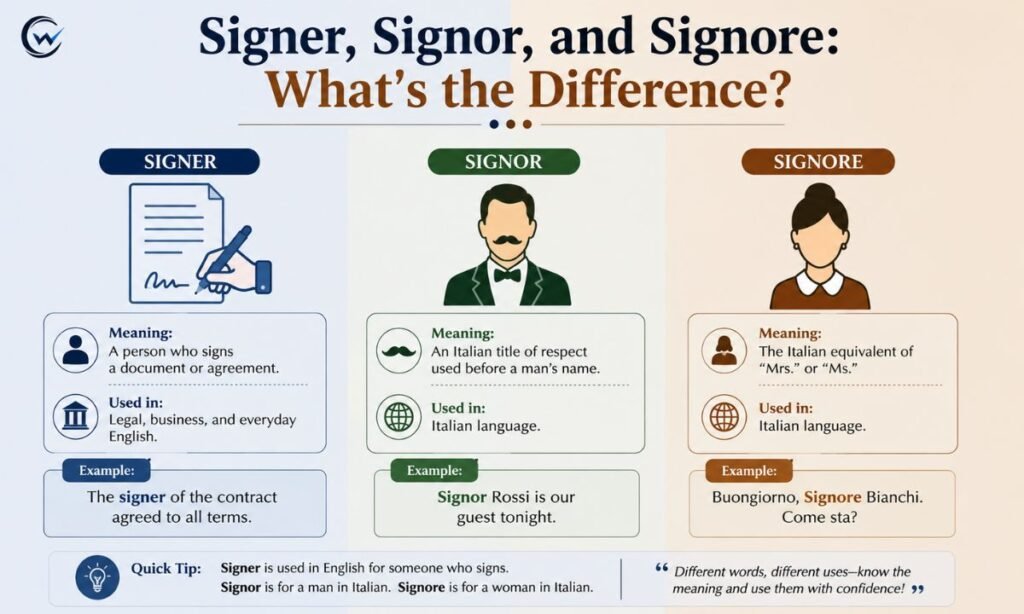
You might also run into signore, the full, unshortened Italian word. Signor is simply signore with the final “e” dropped when it comes directly before a name.
Think of it like “Doctor Smith” versus just “the doctor.” You’d say “Signor Bruno” when using his name, but you’d say “Buongiorno, signore” when greeting a man without using his name at all.
So the three words break down like this. Signer signs documents. Signor is the title used before a specific man’s name. Signore is the full, standalone form of that same title.
How to Pronounce Signer vs Signor
The pronunciation gap is actually bigger than the spelling gap, which helps once you hear it out loud.
Signer rhymes with “diner” or “miner.” You say it “SY-ner,” with a long I sound, exactly how it looks to an English speaker.
Signor is pronounced the Italian way, “seen-YOR,” with the emphasis landing on the second syllable. The S sounds soft, almost like it’s leaning into the following vowel.
If you say “SY-ner” when greeting someone in Florence, you’ll get a confused smile. If you say “seen-YOR” while asking about a lease agreement, you’ll get the same result. Matching the pronunciation to the right context is half the battle.
Plural Forms: Signers and Signori
Signer pluralizes the normal English way. Just add an “s.” A contract can have multiple signers, a petition can gather thousands of signers, no exceptions.
Signor works differently because it follows Italian grammar rules instead of English ones. The plural form is “signori,” not “signors.” You’d say “Buonasera, signori” when greeting a group of men, the same way “signora” becomes “signore” in the plural for women.
This trips up a lot of writers who assume every English style rule applies to a borrowed word. It doesn’t. Signor keeps its Italian roots even when English speakers use it in a sentence.
More Confusing Words Made Simple: Curtesy vs Courtesy
Signer, Signor, and Related Titles Around the World
Once you understand signor, a bunch of other honorifics start making sense too, since many European languages built similar titles from the same Latin root.
Spanish uses “señor.” French uses “monsieur.” Portuguese uses “senhor.” All four trace back to that same Latin word for elder or senior, they just evolved along different paths depending on the language.
Signer doesn’t have this kind of family. It’s a functional English word describing an action, not a title tied to respect or rank. That’s the clearest way to separate the two once and for all, one word has cousins across Europe, and the other stands completely alone.
FAQ’s
Is “signor” a real English word?
Yes, signor is recognized in English dictionaries as a borrowed Italian title, used the same way “monsieur” or “señor” are used from French and Spanish.
Can “signer” refer to someone who uses sign language?
No, that person is called a “signer” too, but the word describes someone signing with their hands, not signing paperwork, so context matters.
Do you capitalize “signor” when using it as a title?
Yes, capitalize signor when it directly precedes a name, just like you would capitalize “Mister” or “Doctor” before someone’s surname.
Is “signor” the same as “señor”?
No, signor is Italian and señor is Spanish, they mean the same thing but come from different languages with slightly different spelling and pronunciation.
Which word should I use in a legal document?
Always use signer in legal documents, since it refers to the person providing a signature, while signor has no legal or contractual meaning at all.
The Bottom Line
Signer and signor aren’t cousins, they’re strangers who happen to dress alike. One belongs to contracts and signatures. The other belongs to Italian names and polite greetings.
Next time your fingers hover over the keyboard, ask yourself one question. Are you talking about someone’s signature, or someone’s name? That single question sorts out the entire mix up in about two seconds.