
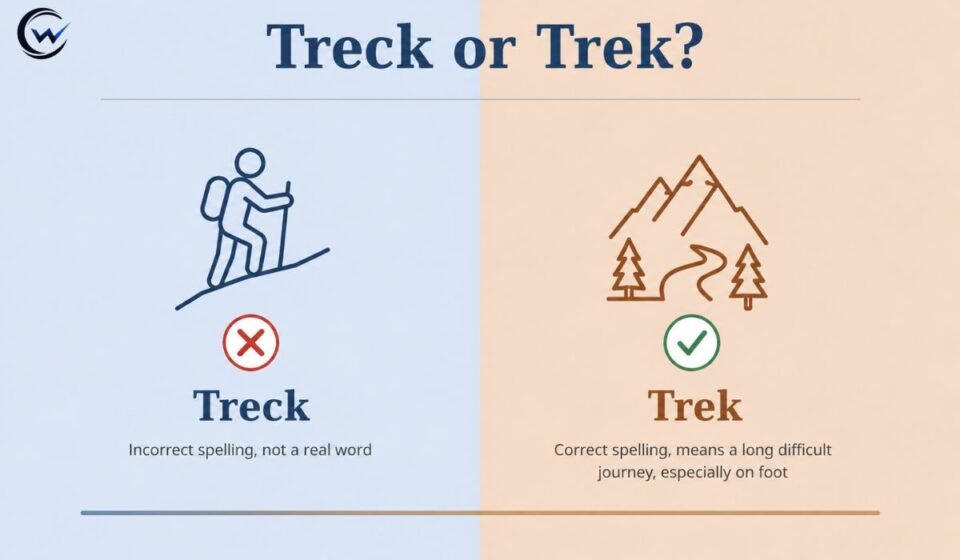

You’re writing about a long hike, an exhausting journey, or even a tough trip, and suddenly you stop at one word: treck or trek? It’s an easy spelling mix-up because “treck” looks like it should be correct. You may even see it used online, which makes the confusion worse. But there’s a clear winner. Trek is the correct spelling, while treck is a common misspelling.
In this guide, we’ll break down the difference, explain the trek meaning, and show you exactly how to use it without making the same mistake again.
Quick Answer: Is It Treck or Trek?
“Trek” is the correct spelling. “Treck” is not the standard English spelling of the word. Whether you mean a long, difficult journey or the act of traveling on foot, trek is the word you want.
Treck vs Trek: Quick Comparison
| Treck | Trek |
| Correct spelling | No |
| Found as the standard English word | Yes |
| Common usage | Misspelling |
| Example | “We went on a trek.” ✅ |
What Does “Trek” Mean?
Trek means a long or difficult journey, especially one made on foot. It can also be used as a verb to describe the act of making such a journey.
Think about hiking through mountains, backpacking across a country, or taking a long journey through rough terrain. All of these situations can be described as a trek.
The word usually suggests distance, effort, or difficulty. A quick walk to the mailbox isn’t normally a trek. However, a five-day hike through challenging terrain definitely qualifies.
Where Did the Word “Trek” Come From?
The word trek comes from Afrikaans and is related to the Dutch word trekken, meaning to pull, travel, or move. It originally referred to traveling by ox wagon.
The word entered English during the 19th century, partly through accounts of the Great Trek, the migration of Dutch-speaking settlers across southern Africa. Over time, English speakers began using trek more broadly for long or difficult journeys.
This history also helps explain the spelling. English adopted the word without adding a “c,” so treck was never the standard English form.
More Confusing Words Made Simple: Bougie or Boujee
Why Do People Write “Treck” Instead of “Trek”?
The main reason is that English spelling often follows patterns that aren’t always consistent. Words such as check, deck, and peck end in -eck, so “treck” can look natural at first glance.
However, trek is a short borrowed word with its own established spelling. Adding a “c” changes the spelling incorrectly.
Autocorrect doesn’t always catch the mistake, either. As a result, “treck” can occasionally appear in texts, captions, emails, and online articles.
How to Use “Trek” in a Sentence
Using trek correctly is easy once you see it in context. Here are some natural examples:
- “We’re planning a trek through the Himalayas next spring.”
- “That commute feels like a trek every morning.”
- “She trekked across three countries before settling down.”
- “Getting to the airport during rush hour is a real trek.”
The word can describe genuine travel or an exaggerated everyday experience. Both uses are common in modern English.
Trek as a Noun vs. a Verb
Trek can function as both a noun and a verb.
As a noun, it refers to the journey itself.
Example: “The trek took us five days.”
As a verb, it describes the act of making that journey.
Example: “We trekked for five days straight.”
The past tense is trekked, while the present participle is trekking. Both forms use a double k.
Trekking vs. Treking: Which Is Correct?
Because trek ends with a single vowel followed by a consonant, the final consonant is doubled before adding -ing or -ed.
That gives us:
- Trek + ing = trekking ✅
- Trek + ed = trekked ✅
- “Treking” ❌
- “Treked” ❌
The double k is easy to overlook, but it follows a standard English spelling pattern.
Common Mistakes to Avoid
Several mistakes appear frequently when people use this word.
Adding a “c”: Writing “treck” instead of “trek” is the most common error.
Dropping the second “k”: Forms such as “treking” and “treked” are incorrect. The correct spellings are “trekking” and “trekked.”
Confusing it with “track”: These are completely different words. Track can refer to a path, trail, or method of following something, while trek describes a long or difficult journey.
Using it for every short walk: You can jokingly call a five-minute walk a trek, but the word normally suggests something longer, harder, or more demanding.
Trek in Pop Culture and Everyday English
You’ve probably encountered trek many times without thinking about its spelling. The famous title Star Trek uses the word to suggest exploration and long journeys through space.
The word is also common in travel writing, hiking guides, outdoor content, and adventure blogs. It conveys more effort and distance than words such as walk or trip.
People also use it figuratively for difficult everyday experiences. For example, saying “Getting through Monday was a trek” suggests that the day felt long or exhausting.
More Confusing Words Made Simple: Weiner or Wiener
Quick Memory Trick to Remember the Spelling
Here’s an easy way to remember it: think of Star Trek.
The famous franchise is never spelled “Star Treck.” That familiar name can help reinforce the correct spelling whenever you’re unsure.
Just remember:
Trek = T-R-E-K
Not = T-R-E-C-K
Frequently Asked Questions
Is Treck a Word?
“Treck” is not the standard English spelling of the word. If you’re referring to a long or difficult journey, the correct spelling is “trek.”
What Is the Meaning of Trek?
Trek means a long, difficult, or demanding journey, especially one made on foot. It can also be used as a verb meaning to travel or walk a long distance.
What Is the Difference Between Trek and Track?
Trek refers to a long or difficult journey, while track can mean a path, trail, route, or the act of following something. They sound somewhat similar but have different meanings.
How Do You Spell the Past Tense of Trek?
The past tense of trek is trekked, with a double k. The spelling “treked” is incorrect.
Is Trek a Formal Word?
Yes. Trek is standard English and can appear in both formal and casual writing. It’s commonly used in travel articles, journalism, hiking guides, and everyday conversation.
Where Does the Word Trek Come From?
Trek comes from Afrikaans and is related to the Dutch trekken. It originally referred to travel, particularly travel by ox wagon, before developing its broader modern meaning.
Bottom Line
Trek is the correct spelling every time. It has no “c” and refers to a long, difficult, or demanding journey. If you catch yourself typing “treck,” think of Star Trek and remember the simple spelling: T-R-E-K.