
Your cursor is blinking. You just wrote “everyone should introduce” and now you’re staring at two options that both look fine and both look off.
That split second hesitation over themself or themselves happens to writers, students, and editors alike, and it’s not because you forgot your grammar rules.
It’s because English quietly added a new word to the mix without sending out a memo. Stick around for the next few lines and this will stop being a guessing game for good.
Quick Answer: Themself vs Themselves
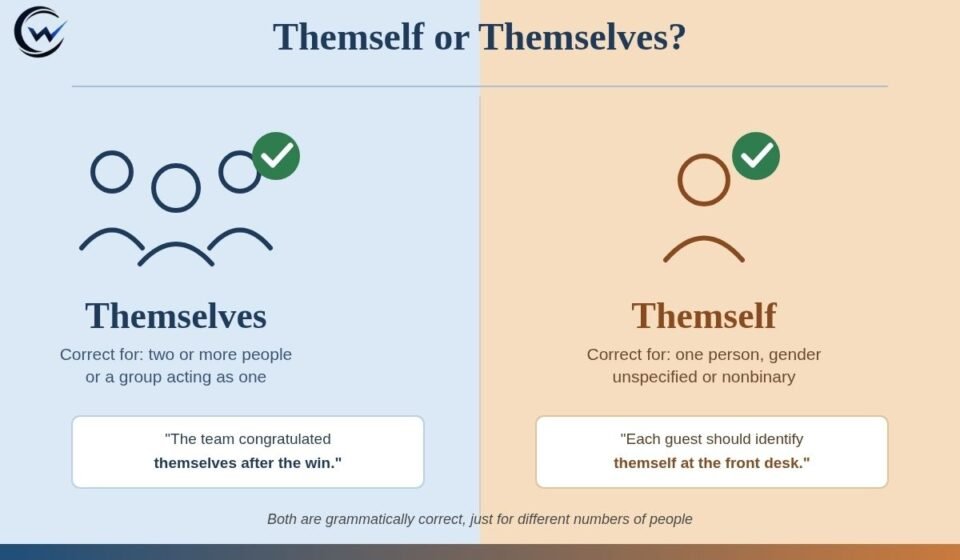
Themselves is the standard, grammatically correct plural reflexive pronoun and works in almost every sentence.
Themself is a singular reflexive pronoun used specifically when referring to one person whose gender is unknown, unspecified, or nonbinary. Major style guides now accept both, but themselves remains the safer default for formal writing.
The Real Difference Between Themself and Themselves
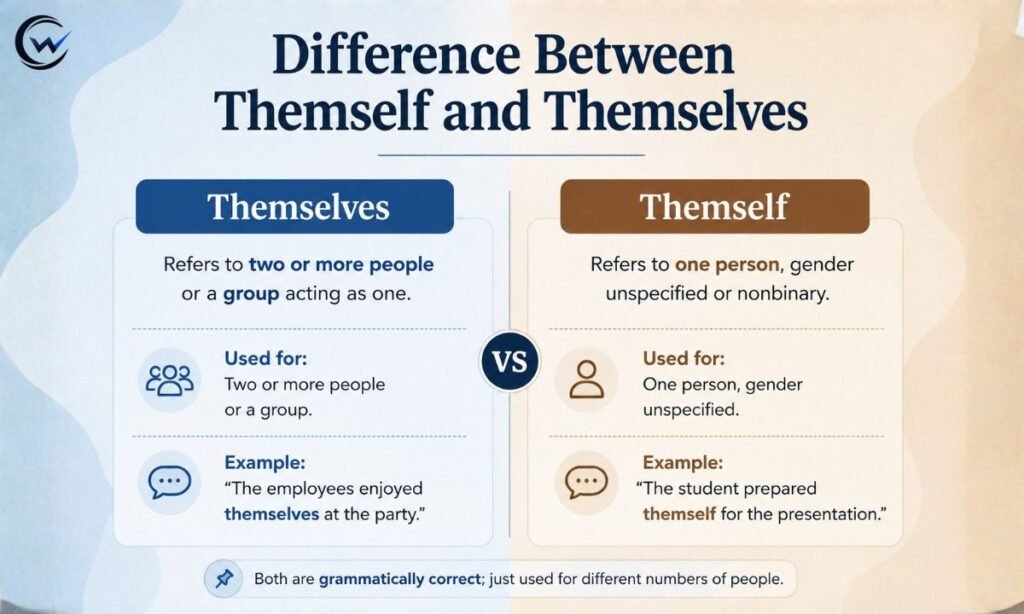
Think of it this way. Themselves refers to more than one person, or a group acting as a unit. Themself refers to exactly one person.
The confusion happens because “they” can mean one person or many people. English has used singular “they” for centuries in casual speech, but the reflexive form had to catch up.
That catch up is themself. It exists to match singular they the same way “himself” matches “he” and “herself” matches “she.”
When to Use Themselves
Use themselves when you’re talking about two or more people. This is the traditional, textbook correct usage that nobody argues about.
- Example: The employees congratulated themselves after finishing the project early.
- Example: My kids made themselves lunch while I was on a call.
Themselves also works when “they” refers to a single group or organization treated as one entity.
- Example: The committee positioned themselves as neutral on the issue.
When to Use Themself
Use themself when referring to a single person and their gender isn’t specified, isn’t relevant, or is nonbinary.
Example: Anyone who forgot their badge should identify themself at the front desk.
Example: My coworker uses they/them pronouns and always brings themself extra coffee on Mondays.
This usage has grown fast in the last decade, especially in journalism, HR documents, and everyday conversation. It fills a real gap that English didn’t have a graceful word for.
Themself or Themselves: Quick Comparison Table
| Feature | Themselves | Themself |
| Grammatical number | Plural | Singular |
| Refers to | Two or more people | One person (unknown/nonbinary gender) |
| Formal writing status | Fully accepted | Increasingly accepted |
| Dictionary status | Standard entry | Recognized in Merriam-Webster and others |
| Common use case | Groups, teams, general statements | Individual with singular they |
Where Themself Came From
Themself isn’t actually new. It showed up in Middle English writing centuries ago, then fell out of favor as themselves took over as the standard plural form.
It resurfaced because singular they needed a matching reflexive pronoun. Once singular they became common for referring to a person of unspecified gender, themself followed naturally.
Dictionaries noticed the shift. Merriam-Webster added themself as a recognized entry, describing it as used to refer to a single person whose gender identity is nonbinary.
Is Themself Grammatically Correct?
Yes, when it matches singular they. Grammar isn’t frozen in time. It shifts to fill gaps that speakers actually need filled.
Themself fills the gap between “himself,” “herself,” and the absence of a gender neutral singular option. That’s not sloppy language. That’s language doing its job.
Some style guides still flag it as informal. Others, including the American Psychological Association, actively recommend it when referring to a person who uses they/them pronouns.
Themself in Formal and Professional Writing
Formal writing tends to favor caution. If you’re writing a legal document, an academic paper, or a corporate policy, themselves is still the safer bet in general statements.
Example: Each participant must complete the form by themselves. (Traditional, safe, formal.)
But if you know the subject uses singular they, themself is not just acceptable. It’s accurate.
Example: The applicant described themself as detail oriented and organized.
Match the pronoun to the person, not the other way around.
Common Mistakes People Make
The biggest mistake is using themself for a group. That’s a clear error.
- Wrong: The players celebrated themself after the win.
- Right: The players celebrated themselves after the win.
The second mistake is avoiding themself entirely out of habit, even when it’s the accurate word for the sentence. If you know someone uses singular they, swapping in “himself or herself” is clunky and outdated.
- Awkward: Each employee should identify himself or herself at check in.
- Better: Each employee should identify themself at check in.
A third mistake is inconsistency. Pick one form per sentence and stick with it. Don’t slide between themself and themselves when referring to the same subject.
More Confusing Words Made Simple: Trailer or Trailor
Themself vs Themselves in Everyday Speech
In casual conversation, people already use singular they constantly without thinking twice. “Someone left their jacket here” sounds completely natural.
Themself is the reflexive extension of that same instinct. It’s showing up more in texts, emails, and social media because it matches how people already talk.
Language doesn’t wait for permission from a rulebook. It changes when enough people need a word, and then the rulebook catches up.
How Style Guides Handle It
The AP Stylebook accepts themself in specific cases involving nonbinary individuals. The Chicago Manual of Style acknowledges its growing use while still favoring themselves for general plural contexts.
Merriam-Webster lists themself as standard when referring to a person who identifies as nonbinary. That’s a meaningful shift from just a few years ago, when the word barely appeared in dictionaries at all.
If you’re writing for a specific publication, check their house style. Most modern guides now permit themself in the right context.
A Simple Test to Pick the Right Word
Ask yourself one question: am I talking about one person or more than one?
- One person, gender unknown or nonbinary: themself.
- Two or more people, or a general group statement: themselves.
That’s the entire rule. No exceptions worth memorizing beyond that.
FAQ‘s
Is “themself” a real word?
Yes. Themself is a recognized word in Merriam-Webster and other major dictionaries, used as the singular reflexive form matching singular they for one person.
Can I use “themself” in an essay?
Yes, if referring to one person of unspecified or nonbinary gender. For general plural statements, themselves remains the more traditional academic choice.
Why does “themselves” sound more correct?
Themselves has been the standard plural reflexive pronoun for centuries, so it feels more familiar. Themself is newer to formal usage, even though it has old historical roots.
Is “themself” only for nonbinary people?
Mostly, yes. It also appears in older or dialectal English for any single person, but its current main use matches singular they for nonbinary or unspecified gender individuals.
What’s the safest choice in professional emails?
Use themselves for general statements about people in general. Use themself only when you know the individual uses singular they pronouns.
Bottom Line
Themselves is your default for groups and general statements. Themself steps in for one person when their gender isn’t specified or when they use singular they.
Neither one is a mistake. They just do different jobs. Once you match the pronoun to the number of people you’re actually talking about, you’ll never freeze on this one again.