

You glance at the clock and wonder how long until 2:35. Maybe a meeting starts then. Maybe a bus leaves, a class ends, or an alarm rings.
You want a number, and you want it fast. This guide gives you a simple subtraction method, worked examples, and fixes for the slip ups that trip most people. Grab your current time and let’s count.
Quick Answer
To find how long until 2:35, subtract the current time from 2:35. If it’s 1:00 now, you wait 1 hour and 35 minutes. Check whether you mean AM or PM first. If 2:35 already passed today, count forward to the same time tomorrow by adding 24 hours.
Quick Overview
- Core formula: target time minus current time equals the wait.
- Two versions of 2:35: 2:35 AM (02:35) and 2:35 PM (14:35).
- Past already? Add 24 hours to the target and subtract again.
- Fastest check: add your answer back to the start time. You should land on 2:35.
- Different city? Convert the time zone before you count.
How to Calculate How Long Until 2:35
You subtract your current time from 2:35 after you confirm AM or PM. The math takes three small steps.
Step 1: Pick AM or PM
2:35 AM sits in the dead of night. 2:35 PM lands in the early afternoon.
Context usually settles it. A school pickup points to PM. A red eye flight points to AM. When a message just says “2:35” with no label, ask the sender.
Step 2: Break the Gap Into Chunks
Big subtraction feels clumsy on a clock face. Chunks feel easy. Split the wait into three parts:
- Count the minutes from now to the next full hour.
- Count the whole hours from there up to 2:00.
- Add the final 35 minutes.
Try it with a real case. It’s 10:50 PM and you’re waiting for 2:35 AM.
- From 10:50 PM to 11:00 PM is 10 minutes.
- From 11:00 PM to 2:00 AM is 3 hours.
- From 2:00 AM to 2:35 AM is 35 minutes.
Add the pieces. You get 3 hours and 45 minutes.
Step 3: Check Your Math
Reverse the process to confirm. Take your start time and add the answer. Start at 10:50 PM and add 3 hours 45 minutes. You land on 2:35 AM, so the answer holds.
This two second check catches most errors. Use it every time the stakes feel high.
The Minute Shortcut for Any Start Time
The minutes part of a clock trips people more than the hours do. A small cheat sheet fixes that. It shows how many minutes you need to reach the :35 mark from your current minutes.
| Current minutes | Minutes until :35 |
|---|---|
| :00 | 35 |
| :10 | 25 |
| :15 | 20 |
| :25 | 10 |
| :30 | 5 |
| :40 | 55 |
| :50 | 45 |
Notice the last two rows. Once your minutes pass :35, the next :35 sits in the following hour. At 1:40, the 1:35 mark is behind you. You’re 55 minutes away from 2:35.
Use this table for the minute piece. Then count the hours separately. Keep the two parts apart and the math stays clean.
Worked Examples for 2:35 AM and 2:35 PM
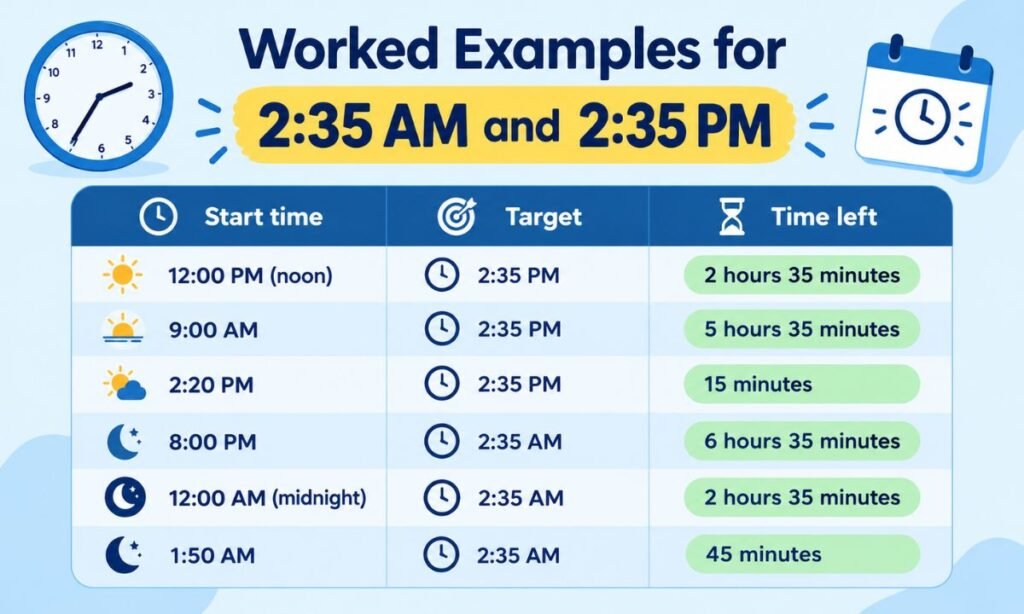
Examples lock the method in. The table below covers common start times for both versions of 2:35.
| Start time | Target | Time left |
|---|---|---|
| 12:00 PM (noon) | 2:35 PM | 2 hours 35 minutes |
| 9:00 AM | 2:35 PM | 5 hours 35 minutes |
| 2:20 PM | 2:35 PM | 15 minutes |
| 8:00 PM | 2:35 AM | 6 hours 35 minutes |
| 12:00 AM (midnight) | 2:35 AM | 2 hours 35 minutes |
| 1:50 AM | 2:35 AM | 45 minutes |
Look at the 8:00 PM row. The wait crosses midnight, so the clock flips from PM to AM along the way. People often lose track at that flip. Count to midnight first. Then add the time after it.
Here’s a second case in plain words. Say you finish work at 5:15 PM and plan to wake at 2:35 AM for an early drive. From 5:15 PM to midnight is 6 hours 45 minutes. Add 2 hours 35 minutes after midnight. Your total sits at 9 hours 20 minutes. That’s your maximum window for dinner and sleep.
Read This: How Long Until 1:50? Quick Countdown Math for AM and PM
What If 2:35 Already Passed?
The target time just moves to tomorrow. Add 24 hours to 2:35, then subtract as usual.
Take a real example. It’s 4:10 PM and you want the next 2:35 AM.
- From 4:10 PM to midnight is 7 hours 50 minutes.
- From midnight to 2:35 AM is 2 hours 35 minutes.
- The total is 10 hours 25 minutes.
Now flip it. It’s 3:00 PM and 2:35 PM slipped away 25 minutes ago. The next 2:35 PM sits a full day minus those 25 minutes away. That’s 23 hours 35 minutes.
A handy rule helps here. If your answer comes out negative, you’ve gone past the target. Add 24 hours to fix it.
Reading 2:35 on a 24 Hour Clock
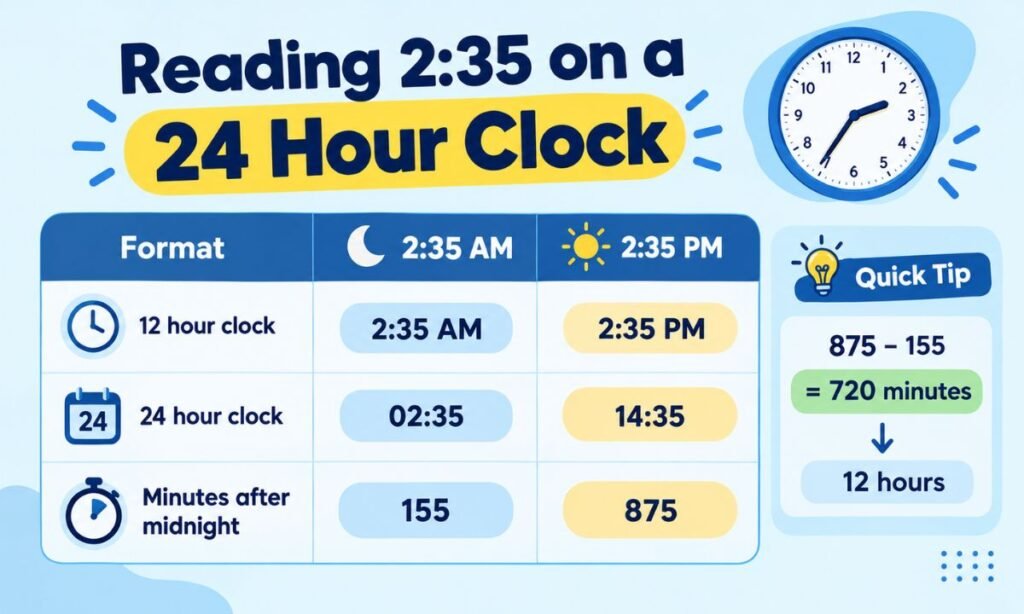
Many schedules, train boards, and hospital systems skip AM and PM. They use a 24 hour clock. That setup removes the AM or PM guesswork, which is a real perk.
| Format | 2:35 AM | 2:35 PM |
|---|---|---|
| 12 hour clock | 2:35 AM | 2:35 PM |
| 24 hour clock | 02:35 | 14:35 |
| Minutes after midnight | 155 | 875 |
The last row offers a neat trick. Convert both times to minutes after midnight. Subtract one from the other. Then turn the result back into hours.
Test it. You want 14:35 and it’s 11:05 now. Minutes after midnight for 11:05 is 665. Your target is 875. The gap is 210 minutes, which equals 3 hours 30 minutes. This path works well for long gaps or spreadsheets.
Time Zones and Daylight Saving Can Shift Your Answer
A 2:35 in another city runs on that city’s clock. Convert first. Count second.
Say a friend lives three hours ahead of you. They announce a call at 2:35 their time. Subtract three hours from 2:35 to get 11:35 on your clock. Now count from your current time to 11:35.
Daylight saving adds one more wrinkle. In places that use it, such as the United States, clocks jump forward by one hour in spring. On that night, the hour from 2:00 to 3:00 AM reportedly vanishes from the clock. A 2:35 AM that night simply never happens. In autumn the opposite occurs, and an extra hour appears.
So check the calendar if your countdown crosses a clock change night. The wait could run an hour longer or shorter than the plain math says.
Tools That Count for You
Mental math works, but a tool can do it while you do something else. Here are easy options:
- Alarm apps: set an alarm for 2:35. Many phones show how long remains until it rings.
- Timers with voice control: ask your assistant for a countdown to your target time.
- Search box timers: type “timer” into a search engine and enter the gap you calculated.
- Calendar events: add 2:35 as an event with a reminder five minutes early.
Pick one that fits your routine. An alarm is the safest choice for anything tied to sleep or a deadline. It keeps working even if you forget the math.
Common Mistakes and Quick Fixes
Most errors come from a handful of habits. Avoid these and your answers stay sharp.
Don’ts
- Don’t skip the AM or PM check. It swaps a short wait for a 12 hour one.
- Don’t subtract minutes straight across. Borrow an hour when the minutes go negative. For example, 1:50 to 2:35 is 45 minutes, not 15.
- Don’t forget the midnight flip on overnight waits.
- Don’t assume a friend’s 2:35 uses your time zone.
- Don’t trust your gut on clock change nights.
Do’s
- Do count to the next full hour first.
- Do check your answer by adding it back to the start time.
- Do convert to the 24 hour format when a gap feels confusing.
- Do set an alarm for anything that truly matters.
- Do write the result as hours and minutes so it reads clearly.
FAQs
How many hours until 2:35 AM from now?
Subtract your current time from 2:35 AM and add 24 hours if it’s already past 2:35 AM today. From 11:00 PM the wait is 3 hours 35 minutes.
How long is it from 2:00 to 2:35?
It’s exactly 35 minutes. The hour stays the same and only the minutes change.
Is 2:35 AM or PM?
Both exist. AM means the night hours after midnight and PM means the afternoon after noon, so check your context or ask the person who gave the time.
What is 2:35 in military time?
2:35 AM reads 02:35 or 0235. 2:35 PM reads 14:35 or 1435.
How do I set a countdown to 2:35?
Set an alarm for 2:35 on your phone. Many alarm apps display the exact hours and minutes left until it rings.
Conclusion
Finding how long until 2:35 comes down to one move. Subtract your current time from the target, and confirm AM or PM before you start. Break the wait into minutes to the next hour, whole hours, and the final 35 minutes.
Remember three rescue tricks. Add 24 hours when the target already passed. Convert to minutes after midnight for long gaps. Verify every answer by adding it back to the start time.
Next time the question pops up, run the three step method. It takes under a minute. If the moment matters, back it up with an alarm and relax.