
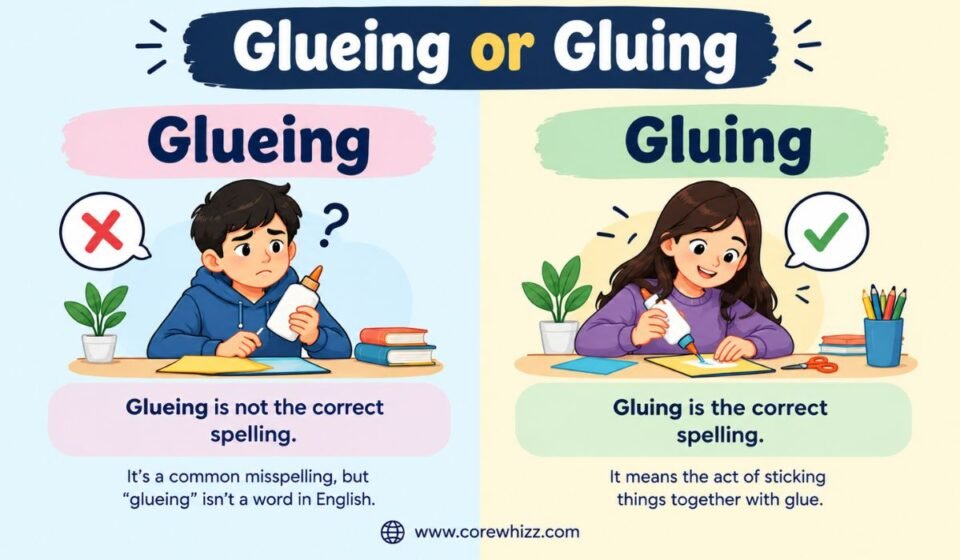

Glueing or gluing—which spelling should you use? If you’ve ever paused while writing this word, you’re definitely not alone. The difference comes down to one simple spelling rule that makes the answer much easier to remember.
In this guide, we’ll look at glueing vs gluing, explain why one spelling is preferred, and show you how to use the correct form naturally. By the end, you’ll have one less spelling mistake to worry about.
Quick Answer: Is It Glueing or Gluing
✅ Correct: Gluing
❌ Incorrect: Glueing
Gluing is the correct spelling in modern American and British English. When you add -ing to a verb ending in a silent e, you usually drop the e first. So, glue → gluing, not glueing.
What Gluing Actually Means
Gluing is the present participle form of the verb “glue,” meaning the act of joining or fixing something using adhesive. It describes an action happening right now or continuously.
You’ll see it in sentences like “She is gluing the broken vase” or “He spent the afternoon gluing photos into an album.” It works as a verb form and sometimes as a gerund acting like a noun.
Glueing is simply a misspelling. It shows up often enough that some readers assume it’s a British variant, but it isn’t standard in any major English dialect today.
Where Glueing or Gluing Comes From
The word “glue” traces back to Old French “glu,” which itself came from Late Latin “glus” or “gluten,” meaning a sticky substance. English absorbed it in the 14th century, and it stuck around largely unchanged in spelling.
When English speakers started forming the present participle, the standard rule for silent “e” verbs already existed. That rule shaped “gluing” the same way it shaped “arguing” from argue and “truing” from true.
Older printed texts from the 1800s occasionally show “glueing,” which is where some of the confusion started. Style guides eventually standardized on the shorter form, and dictionaries followed.
The Grammar Rule Behind Gluing
English has a dependable pattern for verbs ending in a silent “e” followed by a consonant. You drop the “e” before adding a suffix that starts with a vowel, like “ing.”
Compare it with these familiar examples:
- Make becomes making
- Bake becomes baking
- Write becomes writing
- Glue becomes gluing
Exceptions exist, but they’re rare and usually involve avoiding confusion with another word. “Dye” becomes “dyeing” instead of “dying” so it doesn’t get mixed up with the verb “die.” Glue doesn’t need that protection, so the normal rule applies cleanly.
If double letters at the end of short verbs confuse you too, check out our breakdown of Eventhough or Even Though.
How to Use Gluing in Professional Writing
Use “gluing” when describing the process of joining materials with glue.
It is suitable for reports, instructions, manuals, and workplace documents.
See Examples:
- “The technician is gluing the two components together.”
- “Gluing the panels requires a clean, dry surface.”
- “The team used a strong adhesive for gluing the parts.”
Tip: Use “gluing”, not “glueing,” in professional writing because “gluing” is the standard spelling.
How to Use Gluing in Casual Writing

Use “gluing” when talking about joining things with glue.
It works well in casual messages, instructions, and everyday conversations.
Example:
- “I’m gluing the broken pieces back together.”
- “She’s gluing pictures into her notebook.”
- “We spent the afternoon gluing decorations to the card.”
Tip: “Gluing” is the standard spelling in American English. Avoid “glueing” in casual writing because it is generally considered an incorrect spelling.
Gluing vs Glueing: Comparison Table
| Form | Correct? | Notes |
| Gluing | Yes | Standard spelling in US and UK English |
| Glueing | No | Common misspelling, rarely used in edited text |
| Glued | Yes | Past tense, no spelling debate here |
| Glues | Yes | Third person singular present tense |
Common Mistakes People Make With Gluing
Most errors trace back to the same instinct: writers want to keep the whole word “glue” visible before adding “ing.” It feels safer, even though it’s wrong.
Here are the mistakes that show up most often:
- Typing “glueing” out of habit, especially by people who also write “shoeing” or “canoeing,” which do keep their “e”
- Assuming glue follows the same pattern as shoe or canoe, when it doesn’t
- Autocorrect occasionally letting “glueing” slide through unflagged in casual apps
- Writers copying the mistake from an unedited blog post or forum comment
The shoe and canoe comparison is worth pausing on. Those words keep the “e” because dropping it would create confusing letter combinations (“shoing,” “canoing”). Glue doesn’t have that problem, so it drops the “e” like most other silent “e” verbs.
More Confusing Words Made Simple: Carrer vs Career
Real-Life Example: When the Mistake Costs You
A small Etsy seller once ran a product listing for handmade jewelry boxes. Her description read “Each piece is carefully glueing by hand for extra durability.”
Not only was the spelling wrong, the grammar around it broke too. A potential buyer left a comment pointing out the typo, and the seller admitted she’d never actually looked up the correct form.
She fixed it within the hour, but the listing had already been live for two weeks. Small mistake, visible cost, completely avoidable with one quick search.
How Common Is This Mistake
Search data consistently shows people typing “glueing” into search engines looking for reassurance, which tells you the confusion is real and widespread. It’s not a rare typo limited to a handful of careless writers.
Grammar checking tools flag “glueing” as an error at a high rate whenever it appears in submitted documents, student papers, and marketing copy. The pattern lines up with other silent “e” verbs that get misspelled for the same reason, like “arguing” sometimes appearing as “argueing” in early drafts.
The takeaway: if you’ve made this mistake before, you’re in very large company.
Memory Trick to Remember Gluing
Here’s a simple trick. Picture the silent “e” getting pushed out the door the moment “ing” walks in. Glue plus ing pushes the e away, leaving gluing.
Another option: think of “gluing” like “using.” Use drops its “e” for “using,” and glue does the same for gluing. If you already spell “using” correctly, you already know how to spell “gluing.”
Step-by-Step Guide to Spelling Gluing Correctly
- Start with the base verb: glue
- Identify the silent “e” at the end
- Drop that “e” before adding a vowel suffix
- Add “ing” to what remains: glu + ing
- Read the result out loud to confirm it sounds right: gluing
- Double check against a word you already know follows the same rule, like using or arguing
Following these steps takes seconds once it becomes habit, and it removes the guesswork completely.
Mini Quiz: Test Yourself on Gluing
Try answering these before checking the answers below.
- Which spelling is correct: glueing or gluing?
- What is the silent letter dropped when forming this word?
- True or false: dye becomes “dying” in its present participle form.
- Fill in the blank: She is ___ the broken frame back together.
- Which of these follows the same rule as glue: shoe, use, canoe?
- What is the past tense of glue?
- Which sentence is correct: “He was glueing the tiles” or “He was gluing the tiles”?
- Why doesn’t “shoe” drop its “e” the way “glue” does?
Answers:
- Gluing
- The silent “e”
- False, it becomes “dyeing” to avoid confusion with “die”
- Gluing
- Use
- Glued
- “He was gluing the tiles”
- Dropping the “e” would create the confusing spelling “shoing”
FAQ: Glueing or Gluing
Is glueing ever correct in British English?
No, gluing is standard in both American and British English. Glueing is treated as a misspelling in UK style guides too.
Why do people confuse gluing with words like canoeing?
Canoe and shoe keep their “e” to avoid awkward letter combinations, while glue doesn’t have that issue, so it follows the standard silent “e” rule instead.
What is the correct past tense of glue?
The past tense is glued, formed by simply adding “ed” without dropping any letters from the base word.
Does spell check always catch glueing as wrong?
Most modern spell checkers flag it, but older tools or casual apps sometimes miss it, so a manual check is still worth doing.
Is there a noun form related to gluing?
Yes, gluing itself can function as a gerund, acting like a noun in sentences such as “Gluing takes patience and a steady hand.”
Final Thoughts on Glueing or Gluing
The rule behind this one is simpler than it feels in the moment. Drop the silent “e,” add “ing,” and you land on gluing every time.
Once you connect it to familiar words like using and arguing, the spelling sticks for good. No more second guessing, no more embarrassing typos in a listing or a report.
Want to save this one for later? Bookmark it, and you’ll never type “glueing” by accident again.