
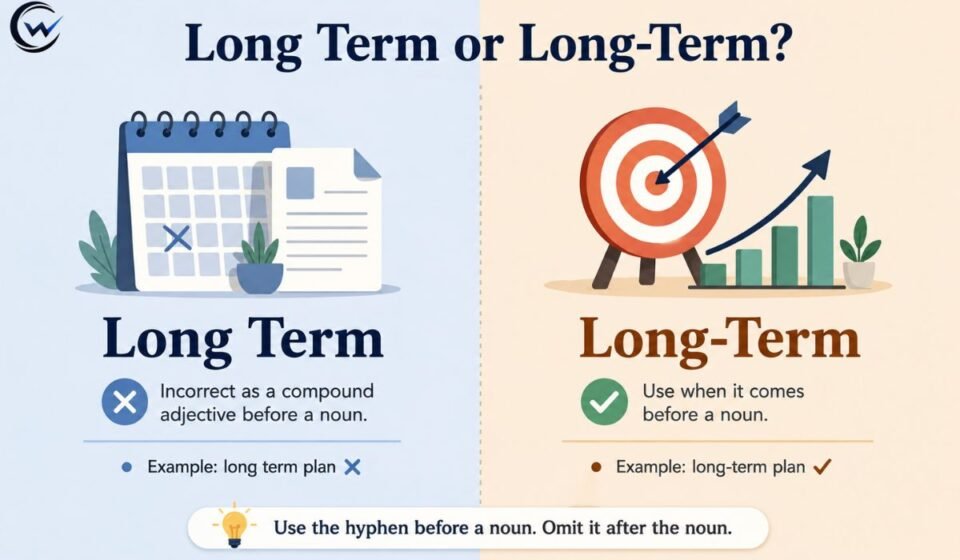

Long Term or Long-Term can be confusing because both forms appear in everyday writing. The correct choice depends on how the phrase is used in a sentence.
Usually, “long-term” is hyphenated when it works as an adjective before a noun, while “long term” is commonly used when it functions as a noun phrase. Let’s look at the difference with simple examples so you can use each form correctly.
Quick Answer – Long Term or Long-Term
Long term and long-term are both correct, but they are used in different situations.
Use long term when you are talking about a period of time or using it as a noun phrase.Example:
We are planning for the long term.
Use long-term when it comes before a noun and describes something.Example:
She created a long-term plan for her career.
A simple rule to remember:
- Before a noun = long-term
- Talking about a period of time = long term
What Does Long Term or Long-Term Mean?
Both long term and long-term describe something that continues for a long period. The meaning does not change. The difference is only in how the words function in a sentence.
For example:
- A long-term investment can grow over many years.
- Investing for the long term requires patience.
In the first sentence, long-term describes the investment.
In the second sentence, long term refers to a period of time.
When Should You Use Long Term?
Use long term as two separate words when you are talking about a length of time.
It often appears after phrases like:
- in the long term
- for the long term
- over the long term
Examples:
- Healthy habits help you in the long term.
- We need to think about the long term before making a choice.
- This decision may create benefits over the long term.
Here, the phrase acts like a noun because it represents a period of time.
When Should You Use Long-Term?
Use long-term with a hyphen when it works as an adjective before a noun. The phrase describes the type of person, thing, plan, or situation being discussed.
Examples:
| Correct Phrase | Meaning |
| long-term goal | A goal that takes a long time to achieve |
| long-term relationship | A relationship that lasts many years |
| long-term strategy | A strategy designed for the future |
| long-term effects | Results that continue for a long time |
More examples:
- The company needs a long-term strategy.
- Exercise can have long-term benefits.
- She is looking for a long-term solution.
The hyphen connects the two words because they work together as one description.
Long Term vs Long-Term: Comparison Table
| Form | Usage | Example |
| long term | Refers to a period of time | We are focused on the long term. |
| long-term | Describes a noun | They made a long-term plan. |
Remember:
If the phrase answers “what kind?”, use long-term.
Example:
- What kind of plan?
- A long-term plan.
If the phrase answers “how long?”, use long term.
Example:
- How long will the benefits last?
- In the long term.
More Confusing Words Made Simple: Parent’s or Parents’?
Why Is Long-Term Hyphenated?
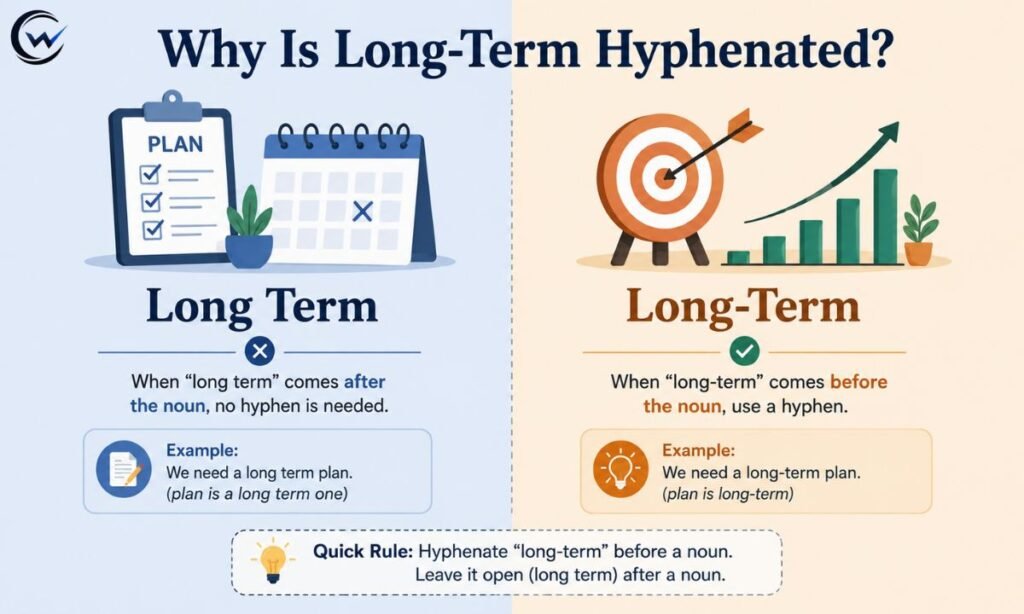
The hyphen in long-term helps readers understand that both words are working together to describe one noun. Without the hyphen, the meaning can become less clear.
Compare these examples:
- ❌ She wants a long term solution.
- ✅ She wants a long-term solution.
In the second sentence, the hyphen shows that “long” and “term” combine to describe the word “solution.”
English uses this rule with many similar phrases:
- well-known author
- high-quality product
- full-time job
- long-term plan
When two words act as one adjective before a noun, a hyphen often makes the meaning clearer.
The Origin of Long Term and Long-Term
The phrase long term comes from two older English words.
- Long has been used in English for centuries to describe distance, duration, or something that lasts a significant amount of time.
- Term comes from the Latin word terminus, meaning an end point or boundary. Over time, the word developed meanings related to periods, conditions, and fixed lengths of time.
Together, long term became a common expression for something that continues over an extended period.
Today, both long term and long-term are widely used in areas like business, education, finance, and personal planning.
Common Mistakes With Long Term and Long-Term
Many people use these forms incorrectly because they focus only on the meaning and ignore the grammar role.
Here are the most common mistakes.
Mistake 1: Using Long Term Before a Noun
Incorrect:
The company needs a long term strategy.
Correct:
The company needs a long-term strategy.
The company needs a long-term strategy.
Why?
Because long-term describes the type of strategy.
Mistake 2: Adding a Hyphen After “The”
Incorrect:
We should focus on the long-term.
We should focus on the long-term.
Correct:
We should focus on the long term.
We should focus on the long term.
Why?
Because it refers to a period of time, not a description.
Mistake 3: Writing Longterm as One Word
Incorrect:
They have a longterm plan.
They have a longterm plan.
Correct:
They have a long-term plan.
They have a long-term plan.
Longterm is not considered a standard spelling in English.
Always use either:
- long term
- long-term
depending on the sentence.
Using Long Term and Long-Term in Professional Writing
These words appear frequently in business, finance, education, and workplace communication. Understanding the difference helps your writing look more professional.
Business Examples
- The company developed a long-term growth strategy.
- Managers should consider the long term before making decisions.
Finance Examples
- Many people choose long-term investments.
- Investors often focus on returns over the long term.
Personal Goals Examples
- She created a long-term career plan.
- Learning new skills can help you in the long term.
The rule remains the same in every situation:
- Describing something = long-term
- Talking about time = long term
How to Remember the Difference Between Long Term and Long-Term
A simple trick can help you choose the correct form.
Ask yourself: Is “long term” describing another word?
If yes, use:
Examples:
- long-term goal
- long-term plan
- long-term effects
If it is talking about a period of time, use:
Examples:
- in the long term
- for the long term
- think about the long term
This quick check will help you avoid most mistakes.
Frequently Asked Questions
Is long term one word or two words?
Long term is written as two words when it refers to a period of time. When it describes a noun before it, the correct form is long-term with a hyphen.
Is longterm a correct spelling?
No. Longterm is not accepted as the standard spelling in English. The correct forms are long term and long-term.
Should I write long term goals or long-term goals?
The correct form is long-term goals.
Example:
- She has long-term goals for her future.
The phrase describes the type of goals, so a hyphen is needed.
Is “in the long-term” correct?
No. The standard expression is:
- in the long term
Example:
- This decision will save money in the long term.
No hyphen is needed because the phrase refers to a period of time.
What is the difference between short term and long term?
The difference is the amount of time being discussed. Short term refers to a shorter period, while long term refers to a longer period.
The same grammar rule applies:
- short-term solution
- short-term goal
- in the short term
- in the long term
Final Thoughts
The difference between long term and long-term is simple once you understand their role in a sentence.
Use long-term when the phrase comes before a noun and describes it.
Example:
- A long-term investment can grow over time.
Use long term when you are talking about a period of time.
Example:
- Saving money helps you in the long term.
Both forms are correct, but using the right one makes your writing clearer and more professional. After learning this simple rule, you will know exactly when to use long term and when to use long-term.