

You typed it fast in a text. Then you paused. Is it goodmorning or good morning? This tiny question trips up more people than you’d think, and autocorrect doesn’t always save you.
The good news is the answer is simple once you see the logic behind it. No confusing grammar rules, no exceptions to memorize. Just one clear fact you’ll never forget after reading this.
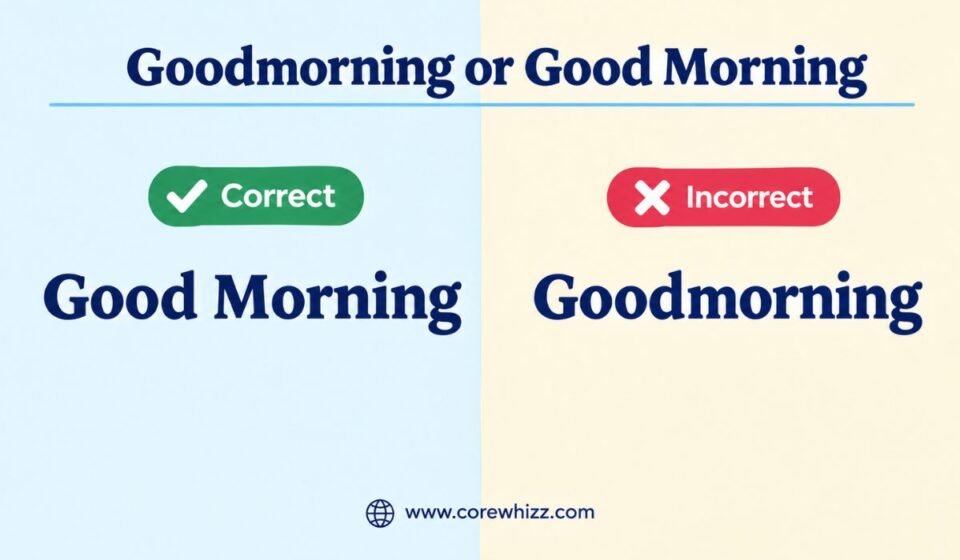
Quick Answer: Good Morning Is Always Two Words
Good morning is the correct spelling. It should never be written as one word.
“Good” is an adjective describing “morning,” a noun. English keeps adjective and noun pairs separate unless they’ve officially merged into a compound word, and this pair never has. Save “goodmorning” for typos and autocorrect slips.
What Good Morning Actually Means
Good morning works as both a greeting and a simple observation about the time of day. When you say it to a coworker, you’re wishing them well as the day starts.
It also shows up in sentences describing conditions, like “It was a good morning for a walk.” Here it’s just an adjective plus noun, doing normal descriptive work.
Why People Write It as One Word
Most of the confusion comes from speed and habit. When you’re typing quickly on a phone, spaces feel optional, especially in casual chats.
Some people also mix it up with words like “goodbye” or “goodnight,” which really did fuse into single words over time. Good morning simply never went through that same process.
Texting culture makes it worse. Shorthand spellings spread fast, and “goodmorning” started looking normal to a lot of readers even though it’s technically wrong.
The Origin of Good Morning
Greetings tied to time of day go back centuries in English. Phrases like “good day” and “good evening” followed the same adjective plus noun pattern from early on.
Language historians trace this structure to Old and Middle English, where wishing someone a “good” version of a time period was a common courtesy. Good morning simply survived as a fixed phrase without ever collapsing into a single word.
Compare that to “goodbye,” which came from a shortened blessing, “God be with you.” That phrase morphed and compressed over generations. Good morning never had that kind of pressure to merge.
Grammar Breakdown: Adjective Plus Noun
Here’s the mechanical reason this matters. “Good” modifies “morning” the same way it modifies any other noun, like “good food” or “good idea.”
English doesn’t smash adjectives and nouns together just because they’re used often. If it did, we’d be writing “goodfood” and “goodidea” too, which obviously looks wrong.
The only reason “goodmorning” feels tempting is repetition. You say it so often that your brain starts treating it like a single unit, even though grammatically it isn’t one.
How to Use Good Morning in Everyday Sentences
Good morning fits naturally into casual and semi-formal speech. You can use it standalone or build it into a full sentence.
Here are a few natural examples:
- Good morning, everyone. Hope your week is off to a good start.
- She smiled and said good morning before grabbing her coffee.
- Good morning traffic on this street is brutal, so leave early.
Notice the greeting always stays as two separate words, no matter how casual the sentence around it gets.
Using Good Morning Professionally
In work emails, good morning often opens the message before you get into business. Keep it simple and don’t overthink the punctuation.
Examples of professional usage:
- Good morning, team. Quick update on today’s schedule.
- Good morning, Mr. Alvarez. Thanks for your patience on this request.
- Good morning all, attaching the report you asked for yesterday.
A comma after “morning” is optional but common when a name or group follows right after. Either way works fine in professional writing.
Good Morning vs Goodmorning: Comparison Table
| Form | Correct? | Why |
| Good morning | Yes | Standard adjective plus noun structure |
| Goodmorning | No | Not a recognized compound word |
| Good Morning (mid-sentence) | Situational | Capitalize only in titles or when starting a sentence |
| GoodMorning | No | Incorrect capitalization and spacing |
Read More: Cacoon or Cocoon? Correct Spelling & Meaning Guide
Common Mistakes People Make
The biggest mistake is simply smashing the words together out of habit. It happens most in fast texting or when people are typing on autopilot.
Another common error is inconsistent capitalization, like writing “good Morning” with a random capital letter in the middle of a sentence. That’s a typo, not a style choice.
Some writers also treat “Good Morning” as a proper noun in headlines when it isn’t one, capitalizing it everywhere instead of following normal title case rules.
A Real-Life Example of the Mistake
Sarah managed a small customer service team and sent a company-wide email that opened with “Goodmorning everyone.” A few people noticed, but nobody said anything until her manager forwarded the email back with the typo circled in red.
It wasn’t a huge deal, but it did make her second guess every email she sent that week. Small spelling slips like this stick with people longer than you’d expect, especially in professional settings where writing quality gets quietly judged.
She started double checking greetings before hitting send, and the mistake never happened again.
How Common Is This Mistake? Search Data and Trends
Search interest in “goodmorning or good morning” stays consistently high year round, which tells you this isn’t a rare slip. It’s one of the most searched spelling clarifications in casual English.
Mobile texting habits are largely responsible. Autocomplete sometimes suggests merged spellings based on how frequently users type fast without spaces, reinforcing the wrong version.
Non-native English speakers also search this phrase often, since many other languages do combine similar greetings into single words, like “buongiorno” in Italian.
Memory Trick: How to Never Mix This Up Again
Here’s a simple trick. Ask yourself if you’d write “good afternoon” as one word. You wouldn’t, and nobody does.
Good morning follows the exact same pattern. If separating the words feels natural for afternoon and evening, morning deserves the same treatment.
Another trick: think of “good” as a separate compliment you’re handing to the morning, like saying “nice morning” or “great morning.” Those never merge, and neither should this one.
Step-by-Step Guide to Using Good Morning Correctly
Follow these steps whenever you’re unsure:
- Identify if you’re using it as a greeting or a description.
- Always keep “good” and “morning” as two separate words.
- Capitalize only the first word if it starts a sentence.
- Add a comma if a name or group follows directly after.
- Proofread quickly before sending texts or emails, since autocorrect can misfire.
Following this quick checklist takes seconds and eliminates the mistake almost entirely.
Mini Quiz: Test Your Good Morning Knowledge
Try these questions before checking the answers below.
- Which is correct: good morning or goodmorning?
- Is “good” an adjective or a verb in this phrase?
- True or false: good evening follows the same spacing rule.
- Should you capitalize both words mid-sentence?
- What historical process created words like goodbye?
- Fill in the blank: Good morning, ___ team.
- Is “Goodmorning” ever correct in formal writing?
- What’s a simple trick to remember the correct spacing?
Answers:
- Good morning
- Adjective
- True
- No, only if it starts a sentence or is a proper title
- Phrase shortening and fusion over time
- Any name or group, like “everyone” or “sales”
- No, never in formal writing
- Compare it to phrases like “good afternoon” or “nice morning”
FAQ
Is goodmorning one word or two?
Good morning is always two separate words in standard English writing, never one merged word.
Why isn’t good morning like goodbye or goodnight?
Goodbye came from a shortened blessing phrase that fused over centuries, while good morning kept its normal adjective and noun structure the whole time.
Can I use goodmorning in casual texting?
It’s common in texting, but it’s still technically incorrect, so switching to two words keeps your writing consistent and polished.
Should good morning be capitalized in an email?
Only capitalize the first letter unless it starts a title or heading, following normal sentence capitalization rules.
Is there ever a hyphenated version, good-morning?
No, good morning is never hyphenated in standard English, whether used as a greeting or a description.
Wrapping Up
Good morning stays two words, full stop. The pattern matches other adjective and noun greetings like good afternoon and good evening, and it always will.
Next time your fingers want to smash those two words together, picture “good afternoon” instead. It’s the fastest gut check you’ve got, and it works every single time.