

You typed it out, paused, and second guessed yourself. Was it cacoon or cocoon? Honestly, most people hit this exact wall at least once, especially since the word sounds nothing like it looks on paper.
Maybe you were writing about a caterpillar for a school project, or maybe you just wanted to tell someone you planned to cocoon all weekend with snacks and a good show. Either way, guessing feels risky when spelling actually matters.
This word trips up more writers than you would think, and the mix up usually comes down to how the word sounds when you say it fast. Let’s clear it up for good.
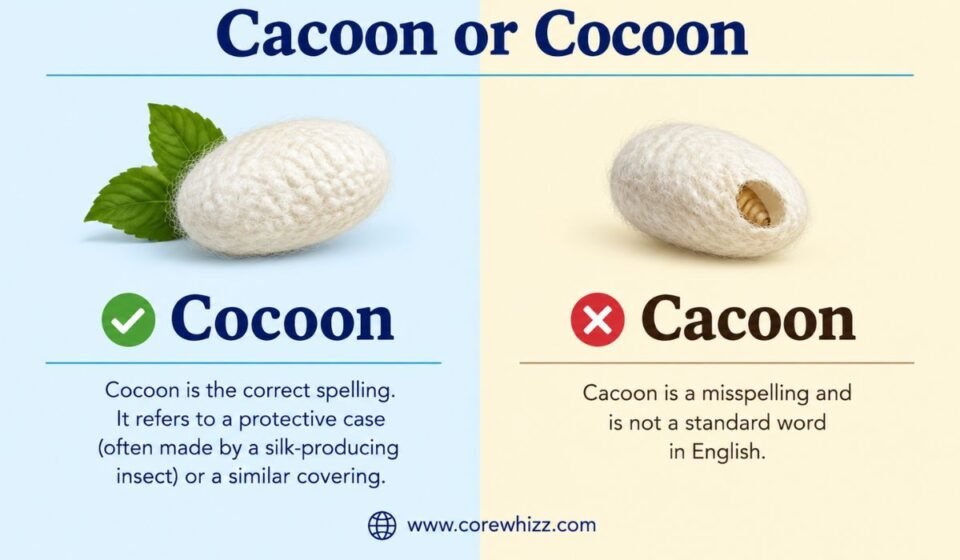
Quick Answer: Cacoon or Cocoon
✅ Cocoon is correct.
❌ Cacoon is a common misspelling with no dictionary backing.
The word comes from the French cocon, and English kept that double O. If you remember nothing else from this article, remember that.
How Do You Spell Cocoon?
The correct spelling is cocoon. It is spelled C-O-C-O-O-N. A cocoon is a protective covering that some insects, especially moths, create around themselves while developing into adults. The spelling cacoon is incorrect and is a common misspelling.
If you often confuse the two, remember that cocoon contains two “o” sounds in the middle and ends with -oon. So, when writing the word, use cocoon, not cacoon.
What Does Cocoon Actually Mean
A cocoon is the silky protective casing that certain insect larvae, especially moths, spin around themselves before transforming into their adult form.
It also works as a verb. To cocoon means to wrap yourself up, isolate, or shelter from the outside world, often for comfort.
You will see it used two main ways:
- Literal sense: the physical silk casing an insect builds
- Figurative sense: a protective bubble a person creates around their life or routine
Both uses are common, and both spell it the same way: cocoon.
In biology class, you probably saw the literal version first. A caterpillar spins silk around itself, seals itself in, and quietly transforms into a moth over several weeks. That casing is the cocoon.
In everyday conversation, though, the figurative sense shows up far more often. People “cocoon” when they cancel plans, stay home, and recharge without any outside noise. Think of a rainy Sunday with blankets, tea, and your phone on silent.
Why Do People Spell It Cacoon Instead
Most people write “cacoon” because of how the word sounds out loud. The first syllable gets swallowed, and “cuh” easily gets mistaken for “ca.”
There is also a real place called Cacoon Bay in Jamaica, and that name pops up in searches often enough to confuse the spelling further. That is a proper noun though, unrelated to the insect term.
Where Does the Word Cocoon Come From
Cocoon entered English in the 17th century from the French word cocon, meaning shell or eggshell. That French term traces back further to the Occitan word coca, meaning shell. The double O pattern has stuck around ever since, which is exactly why the correct spelling keeps that shape today.
Knowing the origin helps the spelling click. French loanwords in English often keep unusual vowel patterns, and cocoon is a textbook example.
Compare it to words like “balloon” or “cartoon.” Same double O sound, same French influenced pattern, and nobody spells those with an “a” instead. Once you see cocoon as part of that family, the correct spelling starts to feel obvious rather than arbitrary.
The figurative “wrap yourself up and hide from the world” meaning is much newer. It only became common in everyday English during the 20th century, borrowed directly from the image of an insect sealing itself away for protection.
Grammar Breakdown: Noun and Verb Forms
Cocoon works as both a noun and a verb, and the forms shift depending on the job it is doing in a sentence.
As a noun:
- Singular: cocoon
- Plural: cocoons
As a verb:
- Base form: cocoon
- Present tense (third person): cocoons
- Past tense: cocooned
- Present participle: cocooning
A quick example of each:
- The caterpillar built a cocoon.
- She cocooned herself in blankets all weekend.
- He has been cocooning since the move.
More Confusing Words Made Simple: Trash vs Garbage: Meaning, Differences & Usage
How to Use Cocoon in a Sentence
Seeing the word in context makes the spelling stick faster than any rule ever will.
Everyday examples:
- The moth emerged slowly from its cocoon.
- I just want to cocoon at home this weekend.
- Her apartment felt like a cozy cocoon during the storm.
- New parents often cocoon with their baby for the first few weeks.
Professional examples:
- The startup entered a quiet cocooning phase before its public launch.
- Analysts described the market’s brief cocoon period ahead of the earnings call.
- The design team cocooned itself away from outside feedback during the sprint.
Notice that in professional writing, “cocoon” almost always shows up in its figurative, sheltering sense rather than the literal insect meaning.
That is worth remembering if you write business content. “Cocooning” in a workplace context usually signals a deliberate, temporary withdrawal, not literal isolation. Analysts and journalists use it to describe consumer habits, product launches, and even economic cycles where activity slows and then re-emerges stronger.
Casual, everyday examples worth noting:
- We are just going to cocoon this weekend and watch movies.
- After the breakup, she cocooned for a while before dating again.
- Winter makes me want to cocoon under three blankets and never leave.
Cacoon vs Cocoon: Side-by-Side Comparison
| Spelling | Status | Notes |
| Cocoon | Correct | Standard dictionary spelling, from French cocon |
| Cacoon | Incorrect | Common misspelling based on pronunciation |
| Cacoon Bay | Correct (proper noun only) | A real bay in Jamaica, unrelated to insects |
| Coccoon | Incorrect | Extra letter, rare typo variant |
Common Mistakes People Make With This Word
A few patterns show up again and again in real writing samples.
- Writing “cacoon” because the first vowel sound gets misheard
- Doubling the wrong letter and typing “coccoon”
- Confusing the noun form with the verb form in a sentence
- Assuming “cacoon” is a valid British spelling variant (it is not)
None of these are dictionary approved. Only one spelling survives spell check, and that is cocoon.
A less obvious mistake is misusing the tense in longer sentences. Writers sometimes pair “cocoon” with a past tense verb elsewhere in the sentence and forget to update the word itself, ending up with something like “yesterday she cocoon at home” instead of “cocooned.” Small slip, but it stands out to careful readers.
Real-Life Example: A Small Mistake, A Big Moment
Amanda spent three weeks polishing her graduate school personal statement. In her closing line, she wrote about feeling ready to leave her “cacoon” and step into the world.
Her advisor caught it during a final read through, minutes before the submission deadline. A one letter fix, and the essay went out clean.
It sounds minor. But a misspelled word in a closing sentence, the part admissions readers remember most, can quietly undercut an otherwise strong piece of writing.
How Common Is This Mistake? What the Data Shows
Search behavior tells the real story here. Queries like “cacoon or cocoon” and “how do you spell cocoon” generate consistent monthly search volume, which signals this is not a rare slip.
Spelling confusion tends to spike around words where pronunciation does not match the written form. Cocoon fits that pattern closely, alongside similar sound-based mix ups like “definately” for “definitely.”
The takeaway: if you have second guessed this word before, plenty of other writers have too.
Autocorrect actually helps here more than it hurts. Most phones and browsers flag “cacoon” instantly and suggest “cocoon” as the fix. That is one reason the misspelling rarely survives into published, edited content, even though it shows up constantly in first drafts, texts, and quick search queries.
Memory Trick: How to Remember the Correct Spelling
Here is a simple way to lock it in. Think of the phrase “cozy cocoon.”
Both words share that same double O sound, and the alliteration makes it stick. A cocoon is meant to feel cozy and enclosed, so pairing the two reinforces both the meaning and the spelling at once.
Another trick: cocoon has two O’s, just like the word “cool,” which is exactly how a cocoon might feel from the inside.
Step-by-Step Guide to Using Cocoon Correctly
Follow these steps whenever you are unsure mid sentence.
- Pause before writing and say the word slowly in your head
- Picture the double O, as in “cool” or “moon”
- Decide whether you need the noun (cocoon, cocoons) or the verb form (cocoon, cocoons, cocooned, cocooning)
- Check the sentence for tense, since past and present forms change the ending
- Reread the full sentence out loud to confirm it flows naturally
- Run a final spell check pass before submitting or publishing
This takes seconds once it becomes a habit, and it eliminates the guesswork completely.
Mini Quiz: Test Your Cocoon Knowledge
Try these before checking the answers below.
- Which spelling is correct? a) Cacoon b) Cocoon
- What language did the word originally come from? a) Latin b) French
- The past tense of the verb form is: a) Cocooned b) Cocoond
- True or False: “Cacoon” is an accepted British spelling.
- Which sentence uses the word correctly? a) She loves to cacoon on rainy days. b) She loves to cocoon on rainy days.
- The present participle form is: a) Cocooning b) Cocoonning
- Cacoon Bay is located in: a) Jamaica b) Portugal
Answers: 1-b, 2-b, 3-a, 4-False, 5-b, 6-a, 7-a
Frequently Asked Questions
Is cacoon ever an acceptable spelling?
No, cacoon is not listed in any major dictionary. Cocoon is the only standard spelling recognized in English.
What is the plural of cocoon?
The plural is cocoons, formed the regular way by adding an S to the singular noun.
Can cocoon be used as a verb?
Yes, cocoon works as a verb meaning to wrap up or shelter, as in “cocooning at home.”
Does cacoon mean anything at all?
Cacoon has no standard dictionary meaning, except as part of the proper noun Cacoon Bay in Jamaica.
Why does cocoon have a double O?
It comes from the French word cocon, and English preserved that original double O spelling pattern.
Conclusion
Cocoon is the spelling to remember, every single time. It carries the double O straight from its French root, works cleanly as both a noun and a verb, and shows up just as often in cozy weekend plans as it does in biology class.
Next time your fingers want to type “cacoon,” picture that cozy cocoon on your couch instead. The spelling, and the meaning, will follow.