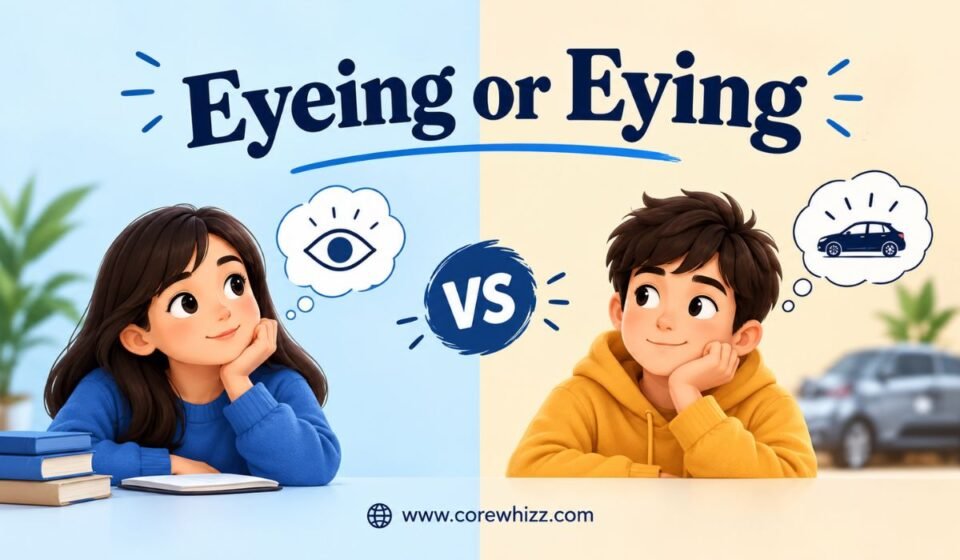

Eyeing or eying is one of those spelling questions that can make you pause in the middle of a perfectly good sentence. Both forms are used in English, but which one should you choose? If you are eyeing a new car, watching someone across the room, or considering a business opportunity, the meaning stays the same.
The difference comes down to spelling preference. In American English, eyeing is the preferred form, while eying is also accepted. Let’s break down the difference with simple examples.
Quick Answer: Eyeing or Eying?
Eyeing is the correct and standard spelling in modern English. It keeps the silent e from “eye” before adding -ing, which is why dictionaries and style guides list it as the primary form.
Eying is a recognized variant, but it’s far less common and can look like a typo to most readers.
| Form | Status | Where You’ll See It | Recommended Use |
| Eyeing | Standard spelling | US and UK writing, dictionaries, news | Yes, always safe |
| Eying | Minor variant | Older texts, some British sources | Avoid unless quoting |
Why “Eyeing” Is the Preferred Spelling
English usually drops a silent e before -ing (like “hope” becoming “hoping”). “Eye” breaks that pattern on purpose.
Dropping the e would leave “eying,” which visually clashes with the word “eye” itself. Keeping the extra e in eyeing preserves the root word and keeps the pronunciation obvious at a glance.
That small exception is exactly why so many writers pause and question it.
What Does “Eyeing” Mean?
Eyeing means looking at something closely, often with interest, suspicion, or intent. It can describe a longing glance, a wary stare, or quiet consideration of an option.
You’ll see it in casual speech and formal writing alike:
- “She’s eyeing that promotion.”
- “The dog kept eyeing my sandwich.”
- “Investors are eyeing the new market.”
The meaning stays constant no matter which spelling a writer picks.
Is “Eying” a Real Word?
Yes, technically. Eying appears in some dictionaries as a secondary or variant spelling, mostly tied to older or British texts.
It’s not incorrect in a strict grammatical sense. It’s just uncommon enough that most editors will flag it or quietly correct it to eyeing during a review.
If you’re writing for a US audience, professional publication, or anything SEO focused, stick with eyeing every time.
The Origin of the Word “Eye” as a Verb
“Eye” has functioned as a verb since at least the 1500s, originally meaning simply “to look at” or “to observe.”
Over time, it picked up shades of meaning like suspicion, desire, and careful evaluation. Think of a hawk eyeing its prey versus a shopper eyeing a discount rack. Same verb, very different emotional weight depending on context.
The -ing form followed standard English rules with that one quirky exception for the retained e.
Eyeing vs Eying: A Side-by-Side Comparison
Here’s the difference laid out plainly:
Eyeing:
- Standard, dictionary preferred spelling
- Used in news, business writing, and everyday conversation
- Never looks like an error to readers
Eying:
- Valid but rare variant
- More likely in older or British sources
- Risks being read as a mistake
When in doubt, eyeing wins nearly every time.
Here we have more helpful guides on Grammar:
How to Use “Eyeing” in a Sentence
Eyeing works as the present participle of “eye” and slots into sentences the same way any other -ing verb does.
Examples across different tones:
- Casual: “He’s been eyeing that new phone for weeks.”
- Business: “The company is eyeing expansion into Europe.”
- Descriptive: “The cat sat still, eyeing the bird outside the window.”
Notice how the word adapts to formal and informal writing without needing any adjustment.
Common Sentences That Use “Eyeing” Correctly
Real usage helps cement the spelling in memory. Here are a few more natural examples:
- “Recruiters are eyeing recent graduates for entry level roles.”
- “She kept eyeing the clock during the meeting.”
- “The team is eyeing a playoff spot this season.”
Each sentence uses eyeing to show attention, interest, or anticipation.
Why This Spelling Mix-Up Happens So Often
Most -ing words simply drop the silent e. Writers apply that pattern automatically, and “eye” quietly breaks the rule.
Add in autocorrect inconsistencies and older texts that use eying, and the confusion makes complete sense. It’s not a sign of poor grammar. It’s a genuinely irregular case in English spelling.
Other Words That Keep Their Silent E Before -ing
“Eye” isn’t entirely alone in bending the rules. A few other words keep an unusual letter pattern to avoid confusion:
- Dyeing (coloring fabric) keeps its e to avoid confusion with “dying.”
- Singeing (slightly burning) keeps its e to avoid confusion with “singing.”
Eyeing follows that same logic of clarity over strict rule following.
Common Mistakes to Avoid With “Eyeing”
The most frequent error isn’t spelling eying itself. It’s inconsistency, using eyeing in one paragraph and eying in another within the same document.
Other small mistakes include:
- Confusing eyeing with “eyeballing,” which carries a more casual, rougher tone
- Overusing the word when a simpler verb like “watching” or “considering” fits better
- Assuming spellcheck will always catch the rare variant (it often won’t)
Picking one spelling and sticking with it keeps your writing polished.
Eyeing in Formal Writing and Journalism
News outlets, business reports, and academic writing almost exclusively use eyeing. It reads as professional and doesn’t distract readers who might pause over the rarer form.
If you’re producing content meant to rank well or read as credible, eyeing is the safer, more search friendly choice across the board.
Quick Recap Before the FAQs
Eyeing is the standard, dictionary backed spelling. Eying exists but rarely appears in modern American writing. Both mean the same thing: looking at something with interest, suspicion, or intent.
Now let’s clear up a few related questions readers commonly ask.
Frequently Asked Questions
Is “eying” grammatically incorrect?
No, eying isn’t grammatically wrong. It’s a recognized variant spelling, just far less common than eyeing in modern usage.
Which spelling do dictionaries list first?
Most major dictionaries, including Merriam-Webster, list eyeing as the primary spelling and eying as a secondary variant.
Does British English prefer “eying” over “eyeing”?
Not exactly. British English uses eyeing most often too, though eying appears slightly more in older British texts than in American ones.
Can I use “eyeing” and “eying” interchangeably?
You can, since both are technically valid. For consistency and professionalism, sticking with eyeing throughout your writing is the better habit.
What’s a simple way to remember the correct spelling?
Picture the word “eye” sitting inside “eyeing.” If you can still see “eye,” you’ve spelled it right.
Final Thoughts
Both spellings are correct, but American English prefers eyeing. Here is the simple takeaway:
- Eyeing: Preferred in American English.
- Eying: Accepted alternative, common in British English.
Both mean looking at, watching, or considering something. We hope this guide helped you understand the difference. For more helpful English spelling and grammar articles, read more on CoreWhizz.