

IDM stands for “I don’t mind” in most text conversations. It tells the other person you’re happy with their idea and have no strong preference.
The same three letters can also point to a music genre or a piece of software. Context settles the question fast. This guide covers the meaning, the tone, smart replies, and the mistakes that trip people up.
Quick Answer: What Does IDM Mean in Text?
IDM means “I don’t mind.” It signals that you’re fine with an option and won’t push for another one.
Think of it as a verbal shrug, only friendlier. A friend asks where to eat. You type IDM. The choice lands in their hands, and nothing more is needed.
Two other meanings exist. They rarely show up in chats. Talk of artists, albums, or synth tracks points to the music genre. Talk of download speeds or browsers points to the software. Everything else is almost certainly “I don’t mind.”
| Meaning | Where you’ll see it | Frequency in texting |
| I don’t mind | Chats, DMs, group texts | Very common |
| Intelligent dance music | Music forums, playlists | Rare |
| Internet Download Manager | Tech talk, software help | Rare |
Why Do People Use IDM in Text Messages?
People use IDM because it’s quick, light, and low pressure. Three letters beat a full sentence on a tiny phone keyboard.
Speed is only half the story. The abbreviation also lets you sound agreeable without inventing an opinion you don’t hold. Shorthand like this reportedly grew from early SMS and chatroom habits, when every character counted. Nobody can say who typed it first. Gen Z users, in particular, keep it in daily rotation.
There’s a social angle too. Choosing for a group carries a bit of risk, since someone might dislike the pick. IDM lets you skip that responsibility politely. It keeps the mood easy and the chat moving.
Why write a whole phrase when three letters carry the message?
Is IDM Formal or Informal?
IDM is informal. Save it for friends, family, and casual group chats.
Picture yourself emailing a client. Would “IDM, either date works” feel polished? Probably not. In workplace messages, spell it out or rephrase with something like “Either option suits me.” Plenty of readers also won’t recognize the abbreviation, because it lacks the reach of LOL or BRB. A confused reader is a slow reader.
Teachers, managers, and older relatives belong in the play-it-safe group.
How to Use IDM in a Text Message
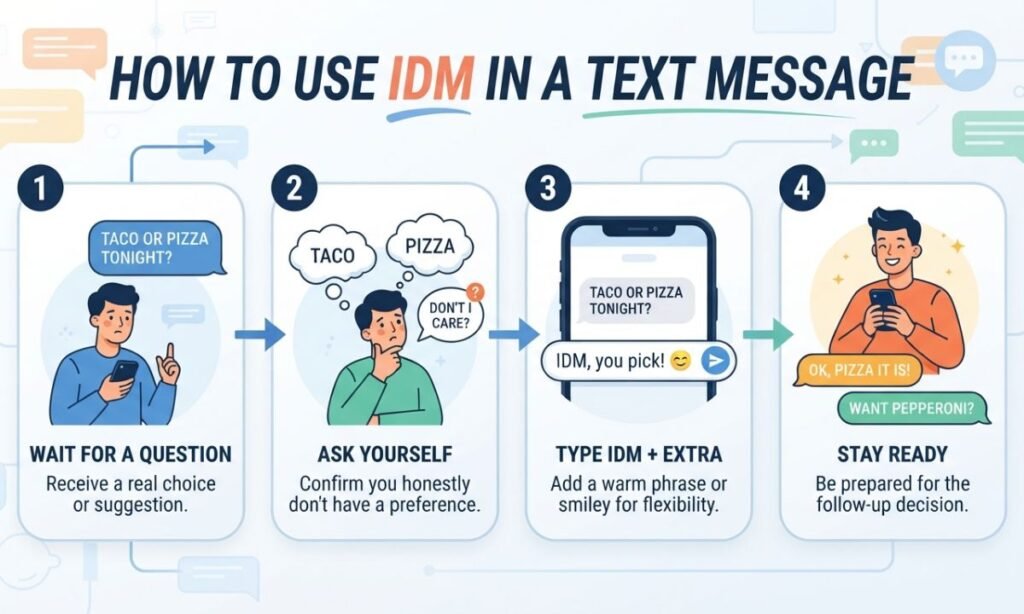
Use IDM when someone offers a choice and you truly have no preference. Put it first in your reply, then add a small friendly touch.
Here’s the simple routine:
- Wait for a real question or suggestion.
- Ask yourself whether you honestly don’t care which option wins.
- Type IDM, followed by a warm extra like “you pick” or a smiley.
- Stay ready for a follow-up question.
A bare “IDM” can read as flat. “IDM, surprise me” sounds relaxed and inviting. Small add-ons change the whole mood, so treat them as part of the message.
Common Situations Where IDM Is Used
IDM shows up wherever friends make casual, low stakes decisions together. Plans, food, and timing top the list.
Restaurant picks are the classic case. Movie nights come next, followed by meeting times and weekend outings. Group chats lean on IDM heavily because nobody wants to steer the whole crowd alone. You’ll also spot it when someone asks which selfie to post or whether they can borrow a charger. In that last case, it works as a relaxed yes.
Spoken conversation rarely uses it. The abbreviation lives in typed chats, where fast replies matter. Gaming lobbies and comment sections see plenty of it too.
Read More: Nonge Meaning: Definition, Origin, and Real Examples (2026)
IDM Examples in Real Conversations
Real chats explain the abbreviation faster than any definition. These five cover the most common patterns.
| Message you receive | Reply | What it means |
| “Rainy day. Museum or bowling?” | “IDM, both sound fun.” | Happy with either |
| “Can I bring my cousin along?” | “IDM, the more the merrier.” | Welcomes the idea |
| “Split the bill or take turns paying?” | “IDM, whichever is easier.” | Flexible on payment |
| “Want me to text the landlord, or will you?” | “IDM, I can do it.” | Willing to take the task |
| “Pick a playlist for the drive?” | “IDM, surprise me.” | Hands over control |
Notice the pattern. Each reply carries a small extra phrase. That phrase tells you whether the person is truly relaxed or just being polite.
How to Respond to “IDM” in a Text
Reply by making the decision yourself or by gently checking what the person really wants. Someone who sends IDM has handed you the wheel.
For small choices, just pick. “Tacos it is!” keeps things moving and shows you appreciate the flexibility. Bigger decisions deserve a softer check. Ask whether they’re sure, which gives them an easy way to share a real preference without awkwardness. Match their energy, too. A breezy IDM deserves a breezy reply.
A few replies that work:
- “Perfect, I’ll book it.”
- “Going with option two, then.”
- “You sure? Speak up if something sounds better.”
- “Thanks for being flexible!”
When Should You Avoid Using IDM?
Avoid IDM when the decision matters or when the other person needs your honest opinion. In those moments, it can feel detached.
Imagine a friend asking whether to accept a job in another city. Replying IDM would sting. They want your take, not a shrug. Arguments, apologies, and emotional chats follow the same rule. When someone shares bad news, IDM will look like you stopped listening. Formal emails are off limits too, along with messages to anyone who may not know the slang.
Big life topics need words, not initials.
Common Mistakes When Using IDM
The biggest mistake is saying IDM when you actually have a preference. The result disappoints you. The blame lands on your own message.
Here are the slip-ups people make most:
- Hiding a real opinion. You say IDM, then sulk about the outcome.
- Sending it cold. A lone “IDM.” can feel curt without a friendly extra.
- Mixing it up with IDC. One letter shifts the tone from easygoing to dismissive.
- Using it at work. Slang can weaken a professional message.
- Inviting a misread. Occasionally, readers see “I DM” (I direct message) instead of “I don’t mind.”
The quick fix is simple. Add a few words of context and you’re safe.
IDM vs. Similar Texting Abbreviations
IDM is warmer than IDC and more decisive than IDK. The three look alike but land very differently.
| Abbreviation | Stands for | Typical tone | Example |
| IDM | I don’t mind | Easygoing | “IDM, you choose.” |
| IDC | I don’t care | Blunt, sometimes cold | “IDC, whatever.” |
| IDK | I don’t know | Unsure | “IDK, maybe Friday?” |
| NP | No problem | Friendly | “NP, take your time.” |
Just one letter separates “mind” from “care.” The emotional gap is wide. IDM says you’re flexible. IDC says the topic doesn’t matter to you at all, and that can sting. Meanwhile, IDK admits uncertainty and quietly asks for help.
IDM on Snapchat, TikTok, Instagram, and WhatsApp
IDM carries the same meaning, “I don’t mind,” on all four apps. Only the setting changes.
Snapchat
Snap chats move fast. Short replies win. IDM fits neatly when friends are locking in a meetup spot or deciding which filter to use.
TikTok
Comments and DMs on TikTok run on brevity. A creator asking which video to post next may get IDM from viewers who like both. It also appears when friends debate which sound to use.
Story replies and direct messages are the main homes for IDM here. Context matters, since some readers confuse it with “I DM.” A reply like “IDM, either photo works” removes any doubt.
Group chats for family plans and weekend outings use IDM often. Long threads make a quick, agreeable answer a welcome break.
The IDM Tone Decoder: What the Message Really Signals
Here’s the thing: the words are simple, but the tone is where people get lost. Many guides stop at the definition. The packaging around IDM tells you far more.
Use this quick decoder to read the mood:
| What you see | Likely reading |
| “IDM 😊” or “IDM, you pick!” | Truly relaxed |
| “IDM.” with a full stop | Flat, tired, or slightly annoyed |
| “idm lol” | Playful, low stakes |
| “IDM if you’re happy” | Polite deferring that may hide a preference |
| Long silence, then “IDM” | Distracted or pulling back |
These are patterns, not rules. Still, they help.
One more trick works even better. Compare the message with the person’s usual style. A friend who normally picks every restaurant and suddenly says IDM might be tired, stressed, or upset. The abbreviation stays the same. The baseline shifts. That’s your cue to ask a gentle question instead of just choosing.
FAQ’s
Does IDM mean “I don’t mind” or “I don’t care”?
IDM means “I don’t mind.” IDC is the abbreviation for “I don’t care,” and it sounds harsher.
Is IDM still used?
Yes, it still appears in casual chats, though it’s reportedly less common than IDK or IDC. Younger users keep it alive on messaging apps and social platforms.
Can IDM mean something other than “I don’t mind”?
Yes. It can also stand for intelligent dance music, an electronic music genre, or Internet Download Manager, a software tool. In text messages, “I don’t mind” is the likely reading.
Is IDM rude?
Not usually. It reads as easygoing, but a bare “IDM” during a serious talk can feel dismissive.
What is a good reply to IDM?
Make the choice and confirm it, such as “Great, let’s do Saturday.” That keeps the plan moving and thanks them for being flexible.
Conclusion
IDM is a quick, friendly way to say “I don’t mind.” It works best for casual choices and falls flat in serious moments. Watch the tone around it, and you’ll read and use it with confidence.