

CM in text most often means “call me.” It can also stand for “check message,” “come on,” “comment,” “community manager,” or centimeters. Context decides which one you’re looking at.
Two letters, six possible meanings. Annoying, right? This guide sorts them out fast, so you can reply without guessing.
Quick Answer: CM Meaning in Text
CM means “call me” in most casual chats, especially when a friend or family member sends it alone.
Other meanings exist, though. Some are common. Some are rare. Here’s the full lineup.
| Meaning | Where you’ll see it | Example |
| Call me | Friends, family, dating chats | “cm when you’re free” |
| Check message | Busy threads, work chats | “cm, details are above” |
| Come on | Playful, teasing chats | “cm, just say yes” |
| Comment | Social posts, communities | “cm your favorite song” |
| Community manager | Brands, Discord, gaming | “ask the cm” |
| Centimeters | Measurements | “It’s 30 cm wide” |
CM Meaning in Chat Conversations
In private chats, CM usually points to an action the sender wants from you. Someone wants your voice, your eyes, or your energy. Three readings cover most cases, and tone plus timing tell you which one fits.
CM as “Call Me”
This is the most widely reported meaning. The sender wants a phone call instead of more typing.
People reach for it when a topic feels too long, too touchy, or too urgent for text. Picture a friend who sends “cm when you’re free.” Nothing dramatic there. They just want to talk.
CM as “Check Message”
Here, CM points you toward something already sent. It’s reportedly rare and turns up mostly in crowded threads.
Say you’re in a group chat with fifty unread notes. A teammate types “cm, plan is above.” Scroll up, and you’ll find it.
CM as “Come On”
Sometimes CM works as a playful push. Think of it as a friendly elbow to the ribs.
A friend hesitates over a party invite. You type “cm, it’ll be fun.” The mood is teasing rather than bossy. This reading is informal and hard to verify, so lean on context.
CM Meaning on Social Media Platforms
Each platform pulls CM toward a different meaning, and no app officially defines it. Usage comes from habit, not rules.
CM on WhatsApp
WhatsApp users lean toward “call me.” Voice calls sit one tap away there. A message like “cm asap” reads as urgent.
CM on Instagram
Instagram leans toward “comment.” Creators write “cm your guess” under posts to spark engagement. In direct messages, however, “call me” still applies.
CM on Snapchat
Snapchat chats vanish fast. That makes “call me” or “check message” a natural fit. A friend might snap a photo, then follow with a lone “cm.”
CM on TikTok
TikTok creators often use it to mean “comment.” You’ll spot it in captions that ask viewers a question. Occasionally it also refers to a brand’s community manager.
Why People Use CM in Texting
People use CM because it saves time and thumb effort. “Call me” takes seven keystrokes, spaces included. “cm” takes two. That sounds tiny. Across a hundred messages a day, though, it adds up.
Speed isn’t the only draw. Shorthand feels casual, warm, and low pressure. A blunt “Call me.” can sound stern, while a quick “cm” lands lighter. And yes, some people just enjoy being a little cryptic.
Understanding CM Based on Context
Context tells you the meaning more reliably than any list can.
Three signals do most of the work: who sent it, what came before it, and where you’re chatting. A number right before it, like “45 cm,” almost always means centimeters. A question about weekend plans points to “call me.” A link to a post points to “comment.”
Timing matters too. A message that arrives at 2 a.m. rarely means “comment.” Trust your gut, then confirm if the stakes feel high.
Real-Life Usage Examples
Three short scenes show how the same two letters shift meaning.
Example 1: Urgent Situation
Your flatmate texts: “Landlord just showed up, cm now.” CM means “call me,” and speed matters. Dial right away.
Example 2: Reminder
A coworker writes: “Sent the invoice, cm.” That reads as “check message.” The file is waiting in your inbox or chat.
Example 3: Reaction
A friend answers your excuse with “cm, you’re coming.” That’s “come on,” delivered with a grin.
When to Use CM
Use CM with people who already know your texting style. Close friends, siblings, and long-standing group chats qualify. Pair it with a clue so the meaning lands, such as “cm when you’re free.” Keep the topic low stakes.
A few good moments:
- Asking a friend for a quick call
- Pointing a group toward an earlier message
- Teasing someone into joining plans
Read More: What Does IDM Mean in Text? Meaning and Examples
When NOT to Use CM
Skip CM whenever a misread could cause real trouble.
Formal emails, client chats, and messages to managers top the list. Older relatives may not decode it at all. Anything medical, legal, or financial deserves full words too.
A vague “cm” from a boss could mean five things. Nobody wants to guess during a deadline. Spell it out.
Similar Slang Terms to CM
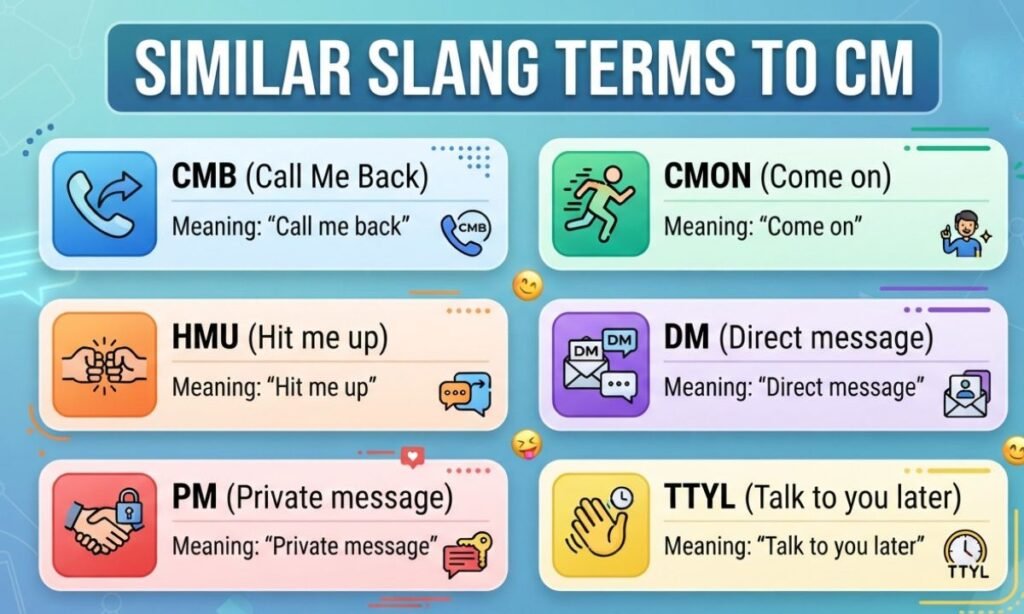
Several shorthand terms overlap with CM in purpose, if not in spelling.
| Term | Usual meaning |
| CMB | Call me back |
| CMON | Come on |
| HMU | Hit me up |
| DM | Direct message |
| PM | Private message |
| TTYL | Talk to you later |
CMB is the closest cousin. It narrows the meaning to a return call, which makes it clearer than plain CM.
Why CM Is Popular
CM spreads because it’s fast, flexible, and easy to type on a phone. Mobile keyboards reward short words. Ambiguity helps too, since one abbreviation can cover many small requests. Then there’s culture. Text speak mirrors how people talk aloud, with clipped phrases and shared context.
Group chats also reinforce the habit. Once a few friends use it, everyone else picks it up within days.
CM Meaning Based on Intent
Intent shapes meaning as much as spelling does. Who sends the message changes how you should read it.
From a Friend:
A friend’s CM usually means “let’s talk” or “come on.” It’s relaxed and warm. Reply with a call or a joke.
From a Colleague:
A colleague’s CM most likely means “call me” or “check message.” Keep your reply clear. If you’re unsure, ask “Call or message?”
In Emotional Context:
After an argument or bad news, CM almost always means “call me.” The sender wants to hear your voice. Answer gently, and phone soon.
How CM Is Used in Daily Text Conversations
CM slips into daily texting at small, ordinary moments. Mornings bring quick nudges, like “cm before you leave.” Midday, it points people toward earlier notes in busy work threads. By evening, it turns playful, with “cm, we’re going out.”
Notice the pattern. CM rarely carries heavy news by itself. It works as a doorway, and the real conversation happens on the call or in the message it points to.
CM Meaning in Different Situations
The likeliest reading changes with the setting, so match your reply to the moment.
| Situation | Likely meaning | Smart reply |
| Friend, after plans change | Call me | “Calling now” |
| Group chat, long thread | Check message | “Found it, thanks” |
| Under a social post | Comment | Leave a comment |
| Brand or Discord chat | Community manager | Contact the CM |
| Number in front | Centimeters | Answer the measurement |
| Playful, pushing tone | Come on | Reply with humor |
CM in Professional vs Casual Communication
Casual chats tolerate CM. Professional ones rarely do.
With friends, shared context fills the gaps. Nobody blinks at “cm later.” At work, that same shorthand can look lazy or confusing. Clients may not know your habits, and recipients may read it on a small screen between meetings.
There’s one exception worth knowing. In gaming and online communities, “CM” often means community manager. Inside those spaces, it’s standard vocabulary.
So match the room. When in doubt, write “Please call me” and skip the guesswork.
Common Mistakes When Using CM
Most CM mix-ups come from assuming everyone shares your meaning.
- Sending it with no context or clue
- Using it with clients or senior colleagues
- Mixing it up with CMB or “centimeters” in numeric chats
- Replying to an urgent CM with another text instead of a call
Tips to Understand CM Correctly
A few habits will help you decode CM in seconds.
- Check for a number directly before it.
- Read the last two messages for clues.
- Note the platform you’re on.
- Consider the sender’s usual style.
- Ask a quick question if the stakes are high.
The CM Decoder: What Other Guides Skip
Most guides list meanings but never rank them. Several top pages even disagree on which reading comes first. A ranking approach fixes that.
Use position and punctuation as your tiebreaker. The table below reflects typical usage patterns rather than a formal study, so treat the confidence levels as estimates.
| Clue | Best reading | Confidence |
| Number right before it | Centimeters | High |
| Alone as the whole message | Call me | High |
| Comma, then a reference to earlier text | Check message | Medium |
| Comma, then persuasion (“cm, you’re coming”) | Come on | Medium |
| Linked to a post or video | Comment | Medium |
| “The CM” or “our CM” | Community manager | High |
Capitalization adds a small hint. Uppercase “CM” leans toward a title or role, as in community manager. Lowercase “cm” leans toward casual requests or measurements. It’s a nudge, not a rule.
FAQs
What does CM mean in text?
CM most often means “call me.” It can also mean check message, come on, comment, community manager, or centimeters, depending on context.
Does CM mean “call me” on WhatsApp?
Usually, yes. On WhatsApp, “cm” most often signals a request for a voice call, though the surrounding chat can change that.
Is CM the same as CMB?
No. CMB typically means “call me back,” while CM is broader and more ambiguous.
Is CM appropriate at work?
Only with colleagues who know you well. For clients and managers, write the full phrase to avoid confusion.
What should I reply when someone texts CM?
Call the person, or ask “Call or message?” if you’re unsure. A quick clarifying question beats a wrong guess.
Conclusion
CM is a tiny abbreviation with a wide range, and “call me” is the safest first guess. Read the sender, the platform, and the surrounding words before you reply. When the stakes rise, skip the shorthand and spell it out.