

TMP in texting and on Snapchat or Instagram usually means “text me please.” Less often, it stands for “too much pressure” or “tag me please,” and the right read depends entirely on where you saw it.
That’s the short version. The long version is messier, because three unrelated meanings share the same three letters, and most guides online just list them without telling you which one actually fits your situation.
| Quick Facts | Details |
| Most common meaning | “Text me please” |
| Secondary meanings | “Too much pressure,” “tag me please” |
| Platforms where it’s most used | Snapchat, Instagram, group chats |
| Formality level | Very casual, not for work or professional messages |
| Tone | Playful, low-pressure, sometimes flirty |
| Opposite/contrast term | “TM” (usually “too much” or “text me”) |
| First popularized | Not publicly documented; grew organically through mobile messaging |
| Risk of misreading | High, since context changes the meaning completely |
Why You’re Probably Here
Somebody sent you “tmp” and left it at that. No punctuation, no follow-up, just three lowercase letters sitting in your notifications like a tiny puzzle.
Maybe it was a friend after a rough day. Maybe it popped up under a Snapchat story you posted. Either way, you paused, reread it, and typed “what does tmp mean” into a search bar. You’re not alone. This term trips people up constantly because it’s short, informal, and never explains itself.
What It Actually Means in Real Life
Here’s the thing: TMP isn’t one fixed phrase. It’s a shorthand that shifts based on who sent it and where.
The most widespread meaning right now is “text me please.” Someone wants you to reach out, and instead of typing three words, they compress it into one. You’ll see this a lot after a call gets missed, or when someone wants to move a conversation off a public comment thread and into direct messages.
A second, less common reading is “too much pressure.” This one shows up when someone’s venting about stress, deadlines, or a situation that’s weighing on them. Think of a coworker texting “this project is tmp rn” instead of spelling out the whole complaint.
Third, and rarer still, is “tag me please,” usually seen under photos or posts where someone wants to be included or credited. This meaning stays fairly contained to social platforms and rarely shows up in one-on-one texts.
Outside slang entirely, tmp also refers to temporary computer files (like a .tmp file your operating system creates and deletes). That’s a totally separate world, and nobody texting you a slang “tmp” means that.
How People Use It in Everyday Situations
Picture a few real scenarios:
- A friend leaves a voice memo unanswered, then follows up with “tmp when free.”
- Someone comments “tmp” under a group photo, hoping to get tagged.
- A sibling texts “today was tmp” after a stressful shift at work.
Notice how the same three letters carry three completely different jobs. That’s not sloppy communication. It’s just how compressed slang behaves once it spreads past its original context. One group adopts it for convenience, another group sees it and adapts it for something else entirely, and eventually the term means whatever fits the sentence around it.
Read More: It’s Called vs It Called: Meaning, Difference and Usage 2026
Tone & Context (This Is Where It Gets Tricky)
So how do you actually tell which meaning applies? Context does almost all the work here, and punctuation gives away more than you’d expect.
A question mark usually points toward “text me please,” since it reads like a request. “tmp?” after a missed call practically answers itself. Drop the question mark and pair it with a complaint or a tired tone, and “too much pressure” becomes far more likely. “tmp today, ngl” reads as venting, not a request.
Location matters just as much as punctuation. Under a photo or post, “tmp” leans toward “tag me please” almost every time, since that’s the one context where tagging makes sense. In a private text thread, tagging isn’t even a possibility, so your brain should rule it out automatically.
When You Should NOT Use This Term
Skip it in professional emails, client messages, or anything going to someone older or less online than you. It reads as confusing at best and careless at worst in a formal setting.
Also avoid it when clarity actually matters, like coordinating logistics, sharing time-sensitive info, or texting someone who might not know the term. A missed connection over three letters isn’t worth the ambiguity. If there’s any chance the recipient won’t decode it instantly, just spell it out.
Natural Alternatives (Grouped by Tone)
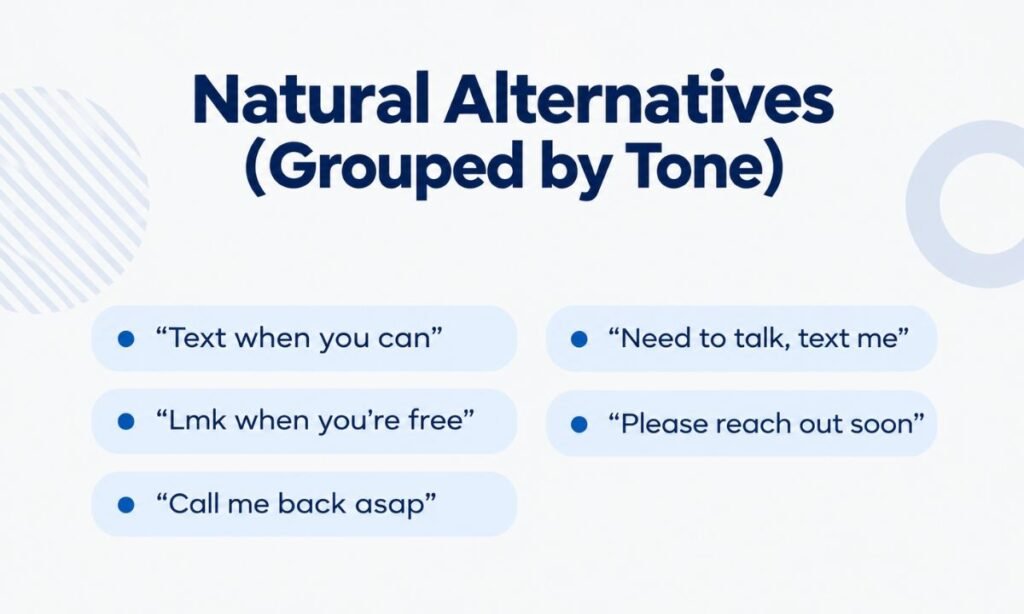
Sometimes the safer move is skipping the abbreviation altogether. Here’s what to use instead, sorted by the tone you’re going for.
Casual and friendly:
- “Hit me up”
- “Text when you can”
- “Lmk when you’re free”
Urgent or direct:
- “Call me back asap”
- “Need to talk, text me”
- “Please reach out soon”
Venting or stressed:
- “This is a lot”
- “Feeling overwhelmed today”
- “Running on empty”
Requesting a tag:
- “Tag me in this”
- “Add me to the post”
- “Loop me in”
Real-Life Examples
A group chat conversation might look like this: “we’re all meeting at 7, tmp if you’re running late.” That’s a request, plain and simple, no drama attached.
Compare that to a caption reading “best trip ever, tmp everyone who was there.” Totally different job, same three letters. And then there’s the venting version: “finals week is so tmp, I can’t even think straight.” No request here at all, just someone expressing that they’re stretched thin.
Platform or Culture Notes
Snapchat and Instagram carry most of the “text me please” and “tag me please” usage, since both platforms revolve around quick replies and photo tagging. TikTok comment sections lean toward the tagging meaning more than the others, mostly because tagging drives engagement on that app specifically.
Group texts and iMessage threads skew toward “too much pressure” or general venting, probably because there’s no tagging feature to compete with that meaning. Gaming chat and Discord rarely use “tmp” at all, favoring other shorthand instead, so don’t expect much consistency if you’re jumping between platforms.
TMP Meaning by Platform (A Comparison Nobody Else Breaks Down)
Most guides on this topic list the meanings once and move on, without connecting them back to where you’ll actually run into each one. Here’s that missing piece.
| Platform | Most Likely Meaning | Why |
| Snapchat | Text me please | Built around quick, private replies |
| Instagram comments | Tag me please | Tagging drives visibility and engagement |
| Group texts / iMessage | Too much pressure | No tagging feature, venting is more common |
| TikTok comments | Tag me please | Comment culture rewards being included |
| Discord / gaming chats | Rare, inconsistent | Other slang dominates these spaces |
Knowing the platform before you even read the sentence around “tmp” cuts your guesswork nearly in half. That’s the shortcut nobody else spells out clearly, and it’s often faster than analyzing tone or punctuation at all.
Common Misunderstandings
People often confuse TMP with TM, assuming they’re just different spellings of the same idea. They’re not. TM usually stands for “too much” or “text me,” while TMP tends toward “text me please” or the pressure-related meaning. Similar letters, different roots, different vibes.
Another mix-up: assuming tmp always means the computer file extension. Outside of tech contexts, nobody’s texting you about temporary system files. And a smaller one worth flagging: not every “tmp” is a request. Some are statements, so replying “sure, on it” to a venting message can land awkwardly.
Fast Facts
- TMP most often means “text me please” in casual texting and social apps
- Secondary meanings include “too much pressure” and “tag me please”
- Punctuation is a strong clue: question marks lean toward requests
- Platform matters: Instagram and TikTok lean toward tagging, private texts lean toward venting
- It’s not appropriate for professional or formal communication
- TMP is unrelated to the .tmp computer file extension in everyday texting
- TM and TMP are frequently confused but carry different core meanings
- Context around the message usually resolves any ambiguity within seconds
- Safer alternatives exist for every tone, from “hit me up” to “this is a lot”
- The term’s popularity isn’t tied to one platform; it spread organically across several
Frequently Asked Questions
Does TMP always mean “text me please”?
No, it doesn’t always mean that. It’s the most common reading, but context can shift it toward “too much pressure” or “tag me please” depending on the platform and tone.
Is TMP the same as TM in texting?
No, they’re different. TM usually means “too much” or “text me,” while TMP leans toward “text me please” or a stress-related meaning, so swapping them can cause confusion.
Can I use TMP in a work email?
It’s best to avoid it. TMP is casual slang meant for texting and social apps, and it can come across as unclear or unprofessional in formal communication.
Why does TMP mean different things on different apps?
Slang evolves separately across platforms based on each app’s features. Tagging drives usage on Instagram and TikTok, while private texting favors the venting or request meanings instead.
What should I text back if I’m unsure what TMP means?
Just ask directly, like “did you mean text me or tag you?” A quick clarifying question beats guessing wrong and replying to the wrong message entirely.
Wrapping This Up
TMP isn’t complicated once you know to check the platform and the tone around it. Most of the time, someone just wants you to text them back, though venting and tagging requests show up often enough to catch you off guard. When in doubt, a quick clarifying question always beats a confused reply.