
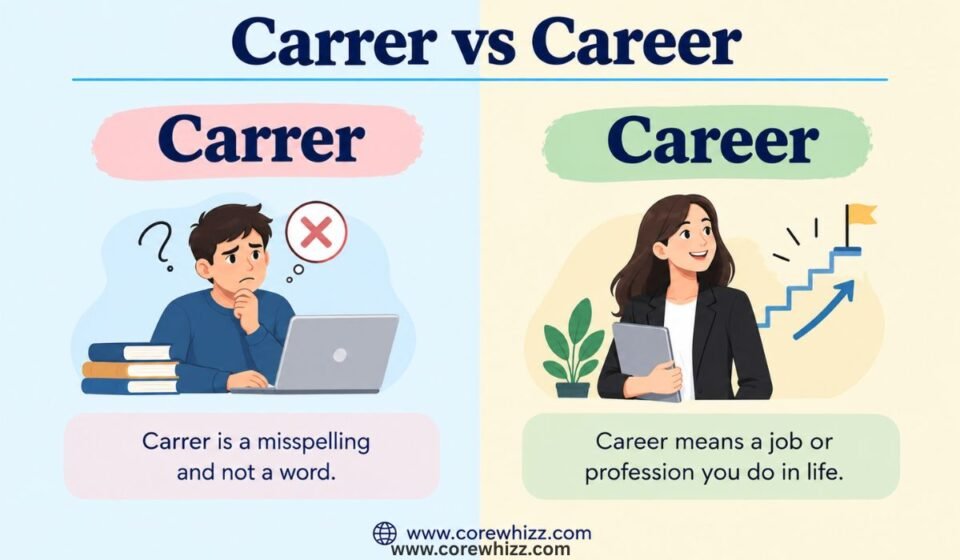

You typed it fast, looked at it twice, and something felt off. Is it “carrer” or “career“? You’re not imagining things.
This is one of the most Googled spelling mix ups in professional writing, and the mistake sneaks into resumes, emails, and LinkedIn bios more often than people admit.
The good news is the answer is simple, and once you see why the confusion happens, you’ll never second guess it again.
Quick Answer: Is It Carrer or Career?
Career is the correct spelling. “Carrer” is not a real English word, it’s a common misspelling caused by dropping one of the E’s. Career refers to a person’s long term occupation or professional path, and it’s the only version you’ll find in a dictionary.
What Does Career Actually Mean?
A career is the overall path a person follows through their working life. It can include different jobs, positions, skills, and professional experiences rather than being limited to one particular job title.
For example, someone can build a career in nursing, software development, teaching, or even move between completely different fields. The word usually suggests long-term work, progress, and direction rather than simply earning a paycheck from one job.
In older or literary English, career can also be used as a verb to describe moving rapidly or out of control. For example, “The car careered down the hill.” You won’t hear this use often in everyday conversation, but it gives an interesting link to the word’s older sense of movement along a course.
In everyday English, career can describe several things. It may refer to someone’s professional identity, their progress over time, or the field they choose to work in. Unlike a job, which may be temporary or short-term, a career usually refers to the bigger professional journey someone builds over the years.
Where Does the Word Career Come From?
The word career has an interesting history. It comes from the French word carrière, which once referred to a road, course, or racecourse. Its roots go back to the Latin carraria, related to carrus, meaning a wheeled vehicle. So, the word originally had a connection with physical paths and tracks rather than jobs.
Over time, the meaning of career changed. English speakers began using it to describe the course or direction of a person’s working life. The idea of following a path made a natural comparison to professional life, where people move from one job, role, or stage to another.
Today, career usually refers to a person’s profession, work life, or progress in a particular field. Its journey from a physical track to a professional path is a simple example of how word meanings can change naturally over time.
More Confusing Words Made Simple: Goodmorning or Good Morning
Grammar Breakdown: Why “Carrer” Isn’t a Word
Here’s the simple grammar rule behind it. Career is spelled with two E’s, one after the C and one before the R at the end. Carrer only has one E, which breaks the pattern entirely.
Career functions as a noun most of the time, as in “her career in marketing,” and occasionally as a verb, as in “the truck careered off the road.” Carrer has no grammatical function because it isn’t recognized in standard English.
Spell check will catch it instantly, and so will most readers. That’s exactly why this typo can quietly damage a resume or cover letter if it slips through.
Using Career at Work: Professional Examples
In professional writing, career shows up constantly, and getting the spelling right matters more than people think.
- “I’m looking to grow my career in project management.”
- “She switched careers from teaching to UX design.”
- “His career highlights include leading three product launches.”
- “This role could be a great next step in your career.”
Recruiters and hiring managers scan resumes fast. A misspelled version of a word this common signals carelessness, even if the rest of the document is strong.
Using Career in Everyday, Casual Conversation
Outside the office, career still shows up naturally in daily talk.
- “What career do you want when you grow up?”
- “I took a career break to travel for a year.”
- “My mom had a long career as a nurse.”
- “He’s not sure what career path fits him yet.”
Notice how the word flexes easily between formal and informal tone. That versatility is part of why it appears so often, and why the spelling mistake spreads just as widely.
Carrer vs Career: Side by Side Comparison
| Term | Correct Spelling | Meaning | Example |
| Career | Yes | A person’s long term profession or job path | “She built her career in finance.” |
| Carrer | No | Misspelling, not a recognized English word | Incorrect in any context |
| Carreer | No | Another common misspelling with a doubled E | Incorrect in any context |
| Carer | Yes (different word) | Someone who cares for another person | “He works as a carer for his father.” |
That last row matters. Carer is a real word, just an entirely different one, and it’s often confused with career simply because the letters look similar at a glance.
Common Mistakes People Make With This Word
Most errors around this word fall into a few predictable patterns.
- Dropping the second E, writing “carrer” instead of career
- Doubling the middle E by mistake, writing “carreer”
- Confusing career with carer, a word about caregiving, not employment
- Confusing career with career used as a verb, which almost nobody uses anymore
- Autocorrect silently “fixing” career into carer on mobile keyboards
That last one catches people off guard constantly, especially when typing quickly on a phone.
A Quick Story: How One Typo Almost Cost a Job Offer
A recent graduate named Priya was finishing her resume at midnight before an application deadline. Under her summary section, she typed “seeking a long term carrer in digital marketing,” saved the file, and sent it off without a second look.
The hiring manager later admitted the typo almost got the resume tossed into the reject pile. It wasn’t the only reason, but it was the first impression, and first impressions on paper are unforgiving. Priya got the interview anyway because her portfolio was strong enough to outweigh the slip. Not everyone gets that second chance, which is exactly why a two second spelling check matters.
Stories like this play out constantly in hiring, though most never get told out loud. A hiring manager scanning fifty resumes in an afternoon isn’t looking for reasons to reject people, but a glaring typo in a word this common gives the brain an easy shortcut to move on. The fix costs nothing. It just takes a moment of attention that’s easy to skip when you’re exhausted and racing a deadline.
How Common Is This Mistake? A Look at the Data
Search data tells an interesting story here. Queries for “carrer or career” and “how to spell career” rank among the more frequent spelling lookups in English learning and job search categories, alongside classics like “definately” and “recieve.”
Google Trends shows steady, consistent search volume for career spelling questions year round, with noticeable spikes every January and September, right when job hunting and career changes peak. This isn’t a rare, obscure typo. It’s one of the most common mix ups in professional English, largely because the correct spelling doesn’t follow an obvious phonetic pattern.
Language learning platforms report similar patterns. Non native English speakers frequently list career among words that don’t spell the way they sound, alongside words like “necessary” and “restaurant.” The double E in the middle of a word without a doubled consonant nearby just isn’t intuitive, even for people who’ve spoken English for years.
Job search platforms have noticed too. Some resume screening tools now flag common misspellings like carrer automatically, precisely because so many applicants type it that way under deadline pressure. That’s a small sign of how often this exact typo shows up in real, high stakes documents.
Memory Trick: How to Never Misspell Career Again
Here’s a simple trick that sticks. Think of the phrase “career has two E’s, like two eyes watching your goals.”
Or try this: career rhymes with steer, and both words guide direction, one guides a car, the other guides your professional life. Picture steering toward your career, two E’s, one steady path.
If you’re a visual learner, break the word into “car” plus “eer,” like the sound of cheering for your own progress. Car, eer, career.
Step-by-Step Guide to Spelling and Using Career Correctly
- Start with “car,” the same three letters as the vehicle
- Add “eer” to the end, rhyming with “cheer” or “steer”
- Double check there’s an E right before the final R
- Confirm there’s no second R hiding in the middle, since “carreer” is also wrong
- Read the full word out loud, car, eer, career
- Use it as a noun in most sentences, referring to a profession or path
- Reserve the verb form, meaning to move fast and uncontrolled, for rare, dramatic writing
- Run a final spell check before submitting resumes, emails, or applications
Mini Quiz: Test Your Knowledge
1. Which spelling is correct?
- A) Carrer
- B) Career
- C) Carreer
Answer: B
2. What does career mean as a noun?
- A) A caregiver
- B) A long term profession
- C) A type of vehicle
Answer: B
3. True or False: “Carer” and “career” mean the same thing.
Answer: False
4. Where did the word career originally come from?
- A) German
- B) French, from a word meaning racecourse
- C) Latin for job
Answer: B
5. Which sentence uses career correctly?
- A) “She built her carrer in law.”
- B) “She built her career in law.”
- C) “She built her carreer in law.”
Answer: B
6. What part of speech is career most commonly used as?
- A) Verb
- B) Noun
- C) Adjective
Answer: B
7. Which memory trick helps you remember the spelling?
- A) Career rhymes with steer, two E’s guide the way
- B) Career has no vowels
- C) Career is spelled like carer with an extra letter
Answer: A
8. What season shows a spike in career related searches?
- A) Summer only
- B) January and September
- C) December only
Answer: B
FAQ’s
Is “carrer” ever an acceptable spelling in any English dialect?
No. Carrer is not recognized in American, British, Canadian, or Australian English. It’s a straightforward misspelling with no regional exception.
What is the difference between career and carer?
Career refers to someone’s professional path over time, while carer describes a person who provides care for someone else, often in a medical or family setting.
Why do people commonly misspell career as carrer?
Because the word has two E’s in a pattern that doesn’t match how it sounds when spoken quickly, making the second E easy to drop by accident.
Can career be used as a verb?
Yes, though rarely today. As a verb, career means to move quickly and without full control, like “the cart careered downhill.”
Does autocorrect fix carrer automatically?
Sometimes, but not reliably. Many keyboards will autocorrect it to “carer” instead of career, which creates a different, equally confusing error. Unlike regional spelling splits such as “colour” versus “color,” career has no British or American variant, so once you’ve got it memorized, it’s locked in everywhere.
Wrapping It Up
Career is the only correct spelling, and now you’ve got a quick trick, a clear grammar rule, and a mental image to make sure it sticks for good. Small spelling slips like this rarely reflect someone’s actual skill, but they can create an unfair first impression on a resume or in a professional email.
Next time you’re typing quickly and pause on that word, just remember, car plus eer, two E’s, one steady path forward.
Related read: Cacoon or Cocoon? Correct Spelling & Meaning Guide