
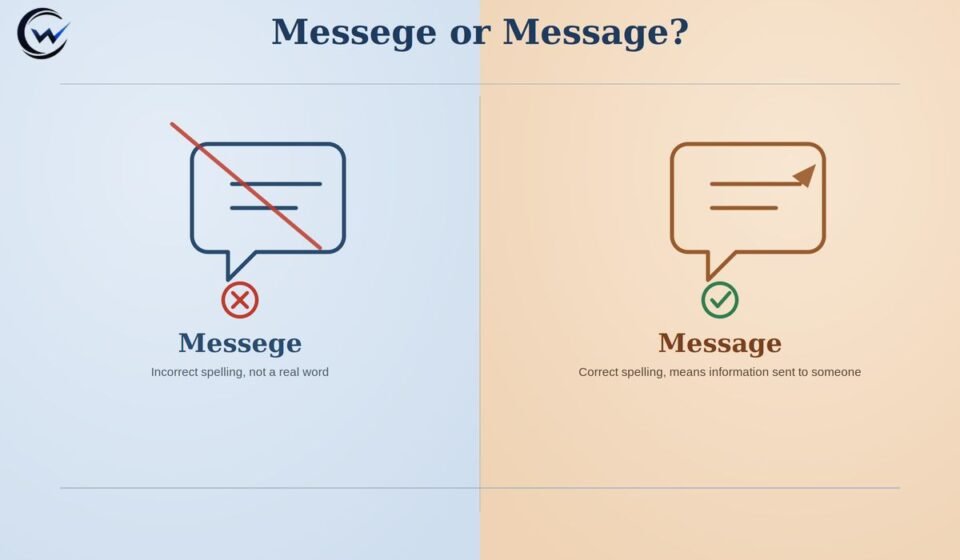

Messege or message trips up more people than you’d expect, and it usually happens in the middle of typing something that actually matters, a work email, a text, a caption you’re about to post. You pause, stare at the word, and suddenly neither spelling looks right.
That hesitation comes from how the word sounds out loud. The ending gets blurred when spoken, so your ear tells you one thing while the correct spelling asks for another. Once you see why that mix up happens, the confusion clears fast, and this guide walks through exactly where the mistake comes from and how to stop making it for good.
Quick Answer: Is It “Messege” or “Message”?
“Message” is the correct spelling. “Messege” is a common misspelling and it is not a real word in any English dictionary.
The word ends in “age,” not “ege.” Think of it like “package,” “sausage,” or “garage.” Same ending pattern, same rule. Once that clicks, the mistake basically disappears.
Messege vs Message at a Glance
| Messege | Message | |
| Correct spelling | ❌ No | ✅ Yes |
| Found in dictionaries | No | Yes |
| Pronunciation | N/A (not a word) | MESS-ij |
| Part of speech | N/A | Noun, verb |
| Example use | N/A | “Send me a message when you land.” |
What Does “Message” Mean?
A message is any piece of information sent from one person to another. It can be spoken, written, typed, or even signaled without words at all.
Text messages, voicemails, emails, and even a raised eyebrow across the room can all count as a message in the right context. As a verb, “to message” someone simply means to send them that information.
It’s one of those words that shows up everywhere. Business, texting, relationships, marketing, all of it runs on messages.
Where Does the Word “Message” Come From?
“Message” traces back to the Old French word “message,” which itself came from the Late Latin “missaticum,” rooted in “mittere,” meaning “to send.” English borrowed the word almost directly around the 13th century.
That Latin root “mittere” also gave us words like “mission,” “transmit,” and “dismiss.” All of them share that same core idea of sending something out.
So when you send a message, you’re literally doing what the word has meant for over 700 years.
Why Do People Misspell It as “Messege”?
Honestly? English pronunciation is a mess sometimes, and this word is a good example.
The unstressed “age” ending at the end of “message” gets swallowed when we speak. It comes out sounding almost like “mess-ij” or even “mess-edge,” and that vague “eh” sound is what tricks people into writing “ege” instead of “age.”
Autocorrect saves most people from ever noticing this, which is part of why the error keeps popping up in casual writing, forms, and social media posts where spellcheck isn’t watching.
How to Use “Message” Correctly in a Sentence
Using “message” correctly comes down to remembering it never has an “e” after the “g.” Here are a few natural examples:
- “I got your message this morning.”
- “Can you message me the address later?”
- “Her speech had a powerful message about second chances.”
- “The app shows when your message has been read.”
Notice the word works fine whether you’re talking about a text, a voicemail, or a bigger idea someone is trying to communicate.
“Message” as a Noun vs a Verb
As a noun, “message” refers to the actual content being communicated. “I left you a message” describes the thing itself.
As a verb, “message” describes the action of sending it. “I’ll message you tonight” means you’re about to send that content.
Same spelling, same rules, just a different job in the sentence. English does this with a lot of words, so once you notice the pattern, it stops being confusing.
Common Phrases That Use “Message”
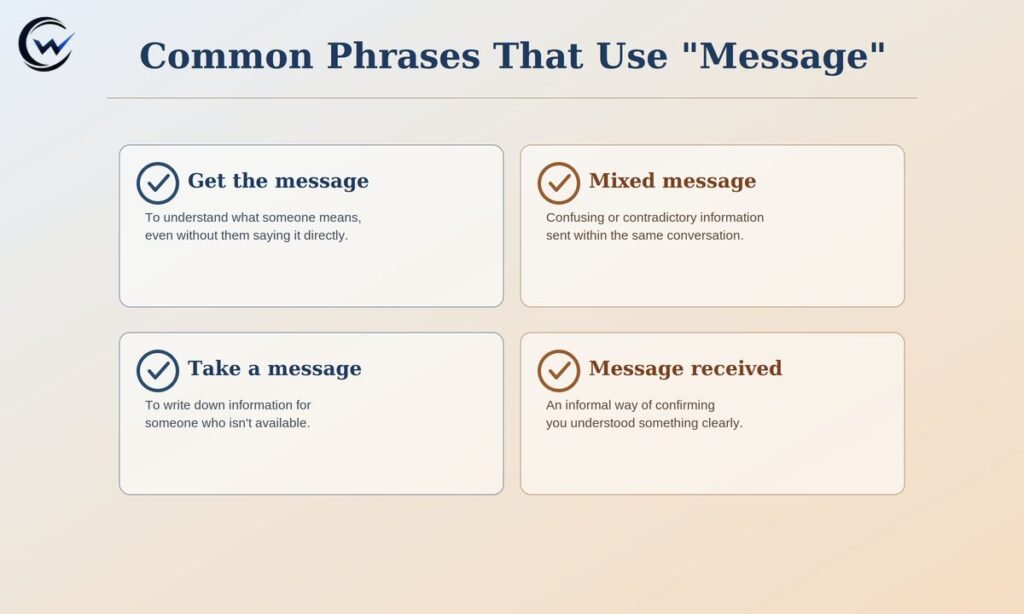
A few phrases show up constantly in everyday English:
- Get the message: to understand what someone means, often without them stating it outright
- Mixed message: confusing or contradictory information
- Take a message: to write down information for someone who isn’t available
- Message received: an informal way of confirming you understood something
If you’ve ever texted “message received 👍” after your boss sent instructions, you’ve already used this word correctly without even thinking about it.
More Confusing Words Made Simple: Curtesy vs Courtesy
Other Words People Often Misspell the Same Way
“Messege” isn’t a lone offender. English has plenty of “age” endings that trip people up the same way.
Words like “average,” “damage,” “manage,” and “package” all follow this exact pattern, and all of them get occasionally misspelled with “ege” for the same pronunciation reason.
Once you lock in the “age” rule for “message,” it tends to clean up your spelling on these other words too.
Tips to Never Misspell “Message” Again
A few quick tricks make this stick for good:
- Say the word slowly and stretch out the ending: mess-AGE, not mess-EGE
- Link it mentally to “package” or “garage,” words most people already spell correctly
- Remember the Latin root “mittere,” which has nothing to do with “ege” at all
- Read the word back before hitting send, especially in emails or professional messages
None of these take more than a few seconds, but they solve the problem permanently.
Messege or Message: Quick Recap Before the FAQs
“Message” is the only correct spelling. “Messege” is not recognized in English and won’t show up in any dictionary, spellchecker, or style guide.
The word comes from Latin roots meaning “to send,” follows the same “age” ending as words like “package” and “damage,” and works as both a noun and a verb depending on how you’re using it in a sentence. Now let’s clear up a few more specific questions people usually have.
FAQ’s
Is “messege” ever an acceptable spelling variant?
No. Dictionaries, style guides, and spellcheckers all reject “messege” completely. It’s simply a common typo, not a recognized alternate spelling anywhere.
What is the plural of “message”?
The plural is “messages.” Just add an “s” at the end, since it follows a standard regular noun pattern.
How do you pronounce “message” correctly?
Say “MESS-ij,” stressing the first syllable while the second stays soft and quick. That soft ending explains the common misspelling.
Is “message” a formal or informal word?
“Message” fits both tones perfectly. You’ll find it in business emails, legal notices, casual texts, and everyday marketing copy alike.
Why does spellcheck sometimes miss “messege” in fast typing?
Autocorrect usually catches it, but rushed mobile typing or a disabled spellchecker can let this typo slip through unnoticed.
Bottom Line
“Message” is correct. “Messege” isn’t a real word, no matter how often it shows up in comment sections, rushed texts, or quick social posts where nobody’s double checking spelling.
The fix is simple once it clicks. Remember the “age” ending, connect it mentally to words like “package” and “garage,” and the confusion basically disappears for good.
Small fixes like this one matter more than they seem to. Clean spelling makes texts, emails, and captions look more put together, and it saves you that annoying pause the next time this word pops up on your screen.