

You hear both words tossed around like they mean the same thing. Someone sleeping on a park bench gets called a hobo one minute and a vagrant the next.
But mixing these up in writing can make you sound careless, or worse, historically clueless. The hobo vs vagrant debate actually comes down to one clear distinction, and here’s the answer, explained simply.
Quick Answer: Hobo vs Vagrant
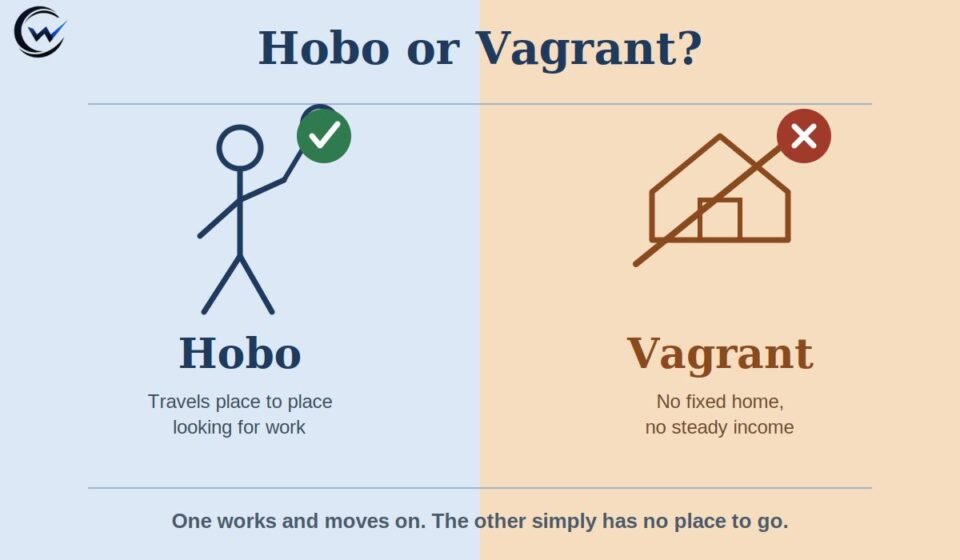
A hobo is someone who travels from place to place looking for work, often by hopping freight trains. A vagrant is someone with no fixed home or visible means of support, and the word carries a legal weight that hobo never had. The short version: hobos work, vagrants (by the old definition) don’t. That distinction is the whole ballgame.
What Does “Hobo” Mean?
A hobo is a migratory worker. That’s the core idea people forget. Picture a guy riding boxcars during the Great Depression, hopping off in a new town to pick fruit or work a rail yard for a few weeks, then moving on. That’s a hobo.
The word has a romantic streak to it in American culture. Hobos show up in folk songs, old films, and Woody Guthrie lyrics. There’s an entire hobo code of ethics that circulated among rail travelers, things like “don’t take what isn’t yours” and “help the next traveler when you can.”
Hobo implies motion with a purpose. They’re not staying still, and they’re not idle by choice.
What Does “Vagrant” Mean?
Vagrant is a colder, more clinical word. It refers to a person without a permanent home, steady income, or visible means of support.
Historically, vagrant wasn’t just descriptive. It was a legal category. Many US cities had “vagrancy laws” on the books well into the 20th century, and people could actually be arrested just for appearing homeless or unemployed in public.
That legal baggage is why vagrant sounds harsher today. It’s tied less to travel and more to a perceived lack of purpose or productivity, at least in how the word was historically used by law enforcement and courts.
More Confusing Words Made Simple: Themself or Themselves
Hobo vs Vagrant: Quick Comparison Table
| Feature | Hobo | Vagrant |
| Employment | Travels for work | Often unemployed |
| Movement | Constantly relocating | May stay in one place |
| Legal status | No formal legal category | Historically a criminal offense |
| Cultural tone | Romanticized, folk-hero image | Negative, often stigmatized |
| Typical era of use | 1870s to mid-1900s | 1300s to present |
Where Did These Words Come From?
The origin of “hobo” is genuinely murky. Some word historians trace it to “hoe boy,” a farm laborer who carried his own hoe looking for seasonal field work after the Civil War. Others link it to a railroad greeting, “Ho, boy!” No one has nailed it down with certainty, and honestly, that mystery is part of the word’s charm.
“Vagrant” has a much clearer paper trail. It comes from the Old French “wagrant,” meaning wandering, which traces back to the Latin “vagari,” to wander. English courts were using vagrant in legal statutes as far back as the 1300s to describe people who moved around without settled employment. This word has been doing legal work for over 700 years.
Hobo, Tramp, Vagrant, Bum: Where the Lines Blur
People often throw a third and fourth word into this mix: tramp and bum. Here’s the quick breakdown so you’re not left guessing.
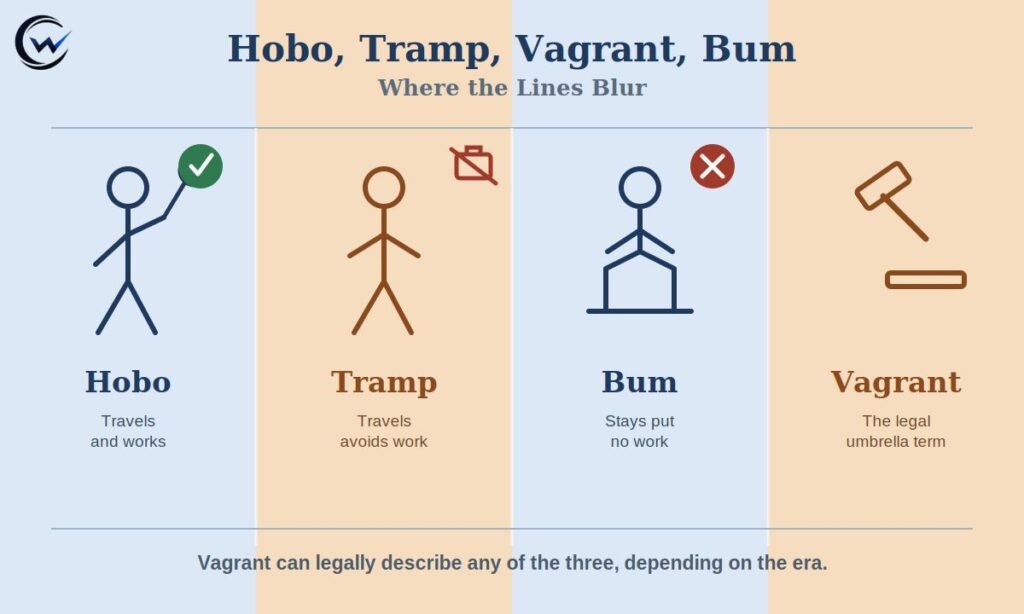
A tramp travels like a hobo but usually avoids working if he can help it. A bum doesn’t travel and doesn’t work. This little hierarchy actually shows up in old hobo slang itself:
- Hobo: travels, works
- Tramp: travels, dodges work
- Bum: stays put, doesn’t work
Vagrant sits outside this trio as the formal, legal umbrella term. It could technically apply to any of the three, depending on the era and the local statute.
How to Use “Hobo” in a Sentence
Use hobo when you’re describing someone in motion, usually tied to a historical or nostalgic context.
“During the Depression, my grandfather rode the rails as a hobo, picking up farm work wherever the train stopped.”
You’ll also see hobo used loosely today as a joking, informal term for someone scruffy or broke. “I look like a total hobo in these sweatpants” is common casual slang, though it’s worth knowing that usage can come across as insensitive depending on your audience.
How to Use “Vagrant” in a Sentence
Vagrant fits formal, legal, or journalistic writing better than casual conversation.
“The city council debated a new ordinance targeting vagrant encampments near the courthouse.”
You won’t hear people casually call themselves a vagrant as a joke the way they might with hobo. The word just doesn’t carry that same playful energy.
Common Mistakes People Make
The biggest mistake is treating these words as pure synonyms. They’re related, not identical.
Writers also mix up era. Calling a modern unhoused person a “hobo” sounds oddly dated, almost like calling someone a “flapper” out of nowhere. The word hobo is tied tightly to a specific slice of American history, roughly the 1870s through the 1940s.
Another slip is using vagrant to describe someone who clearly has a job and a stable routine, just an unconventional lifestyle, like a van-lifer or digital nomad. That’s a misuse. Vagrant specifically implies no visible income and no fixed residence.
Is One Word More Offensive Than the Other?
Neither term is considered a neutral, respectful way to refer to someone experiencing homelessness today. Both can land as dismissive or judgmental depending on tone and context.
That said, vagrant tends to carry a sharper edge because of its criminal law history. Many vagrancy statutes were used to target the poor, immigrants, and formerly enslaved people, which gives the word a heavier historical shadow.
If you’re writing about homelessness in a modern, respectful context, terms like “person experiencing homelessness” or “unhoused individual” are the current standard in journalism and public policy writing.
More Confusing Words Made Simple: Targetted or Targeted
The Legal Side of “Vagrant”
Vagrancy laws were once common across the US, criminalizing things like sleeping outdoors, loitering, or simply being unemployed in public. The Supreme Court case Papachristou v. City of Jacksonville in 1972 struck down a Florida vagrancy law for being unconstitutionally vague, and that ruling triggered a wave of similar laws getting tossed out nationwide.
Hobo never had this legal entanglement. You could be a hobo and never once run afoul of a vagrancy statute, as long as you had a job lined up down the line.
FAQ‘s
Is a hobo the same as a homeless person?
Not exactly. A hobo specifically travels for work, while “homeless” is a broader modern term that doesn’t require travel or employment status.
Can vagrant be used as a verb?
No, vagrant is strictly a noun or adjective. You’d say someone “vagrants around town,” which isn’t correct usage at all.
What’s the difference between a hobo and a tramp?
A hobo travels and works. A tramp travels but avoids steady work whenever possible.
Is “hobo” still used today?
Rarely in formal writing. It mostly survives in casual slang, historical references, and pop culture like folk music or old films.
Why do vagrancy laws no longer exist in most places?
Courts ruled many of these laws unconstitutionally vague, since they criminalized status rather than any actual criminal act, most notably in the 1972 Papachristou decision.
Final Thoughts
Hobo and vagrant both describe people without permanent homes, but they come from completely different worlds. One is a wandering worker wrapped in folklore. The other is a legal label with a rough history attached.
Next time you’re writing about either, ask yourself one question: does this person work and travel, or are you describing their legal or social status? That single question will point you to the right word every time.